Blood Results Help

Back Blood Results Help

SirSmokeALot

Newbie
Joined
Jul 17, 2025
Messages
1
Reaction score
0
Points
1.00
Looking for advice on my TRT bloodwork – feeling more tired and losing motivation after initially feeling great

Hi everyone,

I’m looking for some advice regarding my bloodwork and TRT protocol.

I’m a 34-year-old male, 176 cm (5’9”), 72 kg (158 lbs), around 11–12% body fat.

I’ve been training consistently since I was 18 years old. Currently I:
  • Lift weights 4 times per week
  • Go swimming/freediving once a week
  • Use the sauna 1–2 times per week
I’ve been on TRT for about 12 months.

I started with 140 mg/week Testosterone Propionate, but I never really felt great on it. Then I switched to 180 mg/week Testosterone Enanthate, and for the last 6 months I’ve been injecting 65 mg of Testosterone Enanthate every 48 hours (around 227 mg/week).

For the first few months on this protocol I felt amazing. My energy, mood and motivation were excellent.

However, over the last 2 months things have changed:
  • I’m starting to lose more hair.
  • I feel less motivated.
  • I often feel tired and mentally drained.
  • Sometimes I have very little motivation to get things done.
At first I thought my estradiol might be too high or too low, but after seeing my bloodwork it actually looks pretty reasonable to me.

My libido is still good—not excessively high, but definitely not low. Morning erections are still strong, and my gym performance hasn’t really declined.

One thing that surprised me was how high my testosterone levels are, especially considering the blood was drawn 48 hours after my last injection (right before my next shot).

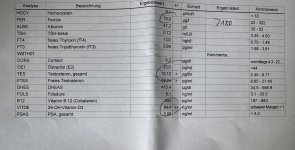
My relevant labs:
  • Total Testosterone: 15.12 ng/mL
  • Free Testosterone: 39.24 pg/mL
  • Estradiol (E2): 33 pg/mL
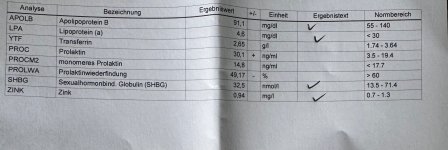
  • SHBG: 32.5 nmol/L
  • Hematocrit: 45.7%
  • Hemoglobin: 15.8 g/dL
  • Ferritin: 79 µg/L
  • Vitamin D: 94 ng/mL
  • TSH: 0.72
  • fT3: 2.69
  • fT4: 1.02
  • PSA: 0.98
  • Homocysteine: 8.1
  • Prolactin: 30.1 ng/mL, but monomeric prolactin is normal (14.8 ng/mL).
I also work rotating shifts (morning, evening and night shifts), and I’ve been doing shift work for about 15 years. I know that could definitely play a role, but it’s strange because I felt great until about two months ago.

What would you do in my situation?
  • Would you lower the testosterone dose?
  • Is there anything in my bloodwork that stands out?
  • Could this simply be accumulated fatigue from years of shift work?
  • Is there anything else you would test or change?
I’d really appreciate any advice or experiences from people who’ve been in a similar situation.

Thanks!
 

Attachments

  • IMG_8255.jpeg
    IMG_8255.jpeg
    2.1 MB · Views: 15
  • IMG_8256.jpeg
    IMG_8256.jpeg
    1.2 MB · Views: 12
  • IMG_8257.jpeg
    IMG_8257.jpeg
    718.4 KB · Views: 11
  • IMG_8258.jpeg
    IMG_8258.jpeg
    284.2 KB · Views: 13
Looking for advice on my TRT bloodwork – feeling more tired and losing motivation after initially feeling great

Hi everyone,

I’m looking for some advice regarding my bloodwork and TRT protocol.

I’m a 34-year-old male, 176 cm (5’9”), 72 kg (158 lbs), around 11–12% body fat.

I’ve been training consistently since I was 18 years old. Currently I:
  • Lift weights 4 times per week
  • Go swimming/freediving once a week
  • Use the sauna 1–2 times per week
I’ve been on TRT for about 12 months.

I started with 140 mg/week Testosterone Propionate, but I never really felt great on it. Then I switched to 180 mg/week Testosterone Enanthate, and for the last 6 months I’ve been injecting 65 mg of Testosterone Enanthate every 48 hours (around 227 mg/week).

For the first few months on this protocol I felt amazing. My energy, mood and motivation were excellent.

However, over the last 2 months things have changed:
  • I’m starting to lose more hair.
  • I feel less motivated.
  • I often feel tired and mentally drained.
  • Sometimes I have very little motivation to get things done.
At first I thought my estradiol might be too high or too low, but after seeing my bloodwork it actually looks pretty reasonable to me.

My libido is still good—not excessively high, but definitely not low. Morning erections are still strong, and my gym performance hasn’t really declined.

One thing that surprised me was how high my testosterone levels are, especially considering the blood was drawn 48 hours after my last injection (right before my next shot).

My relevant labs:
  • Total Testosterone: 15.12 ng/mL
  • Free Testosterone: 39.24 pg/mL
  • Estradiol (E2): 33 pg/mL
  • SHBG: 32.5 nmol/L
  • Hematocrit: 45.7%
  • Hemoglobin: 15.8 g/dL
  • Ferritin: 79 µg/L
  • Vitamin D: 94 ng/mL
  • TSH: 0.72
  • fT3: 2.69
  • fT4: 1.02
  • PSA: 0.98
  • Homocysteine: 8.1
  • Prolactin: 30.1 ng/mL, but monomeric prolactin is normal (14.8 ng/mL).
I also work rotating shifts (morning, evening and night shifts), and I’ve been doing shift work for about 15 years. I know that could definitely play a role, but it’s strange because I felt great until about two months ago.

What would you do in my situation?
  • Would you lower the testosterone dose?
  • Is there anything in my bloodwork that stands out?
  • Could this simply be accumulated fatigue from years of shift work?
  • Is there anything else you would test or change?
I’d really appreciate any advice or experiences from people who’ve been in a similar situation.

Thanks!

Hi SmokeAlot!!!

Bro! looking at the whole picture, I wouldn’t chase estradiol here. E2 at 33 pg/mL looks perfectly reasonable, hematocrit and hemoglobin are excellent, PSA is fine, glucose/HbA1c look good, liver markers are clean, kidney function looks good and ApoB at 91 isn’t alarming. Even the prolactin result looks much less interesting once we see that monomeric prolactin is normal at 14.8.

What jumps out at me is something much simpler: your TRT has gradually become a small cycle. At 65 mg E48H you’re around 227 mg/week, and your trough testosterone is still 15.12 ng/mL with free T at 39.24 pg/mL. That’s a lot of exposure for replacement, especially when libido, erections and gym performance are already good. More testosterone isn’t automatically more energy or more motivation.

Personally, this is where I’d have a conversation with the prescribing doctor about reducing the dose rather than adding anything else. Not because the bloodwork looks disastrous, because it doesn’t, but because I don’t see a compelling reason to keep testosterone that high when the original objective is TRT.

The hair loss is another clue that reducing exposure may be worth considering. I wouldn’t start throwing more medications at that before asking whether you’re simply using more testosterone than you actually need.

Your thyroid panel doesn’t scream obvious hypothyroidism either. Vitamin D at 94 ng/mL is already plenty high, so I certainly wouldn’t be trying to push that any further.

And then there’s the elephant in the room: 15 years of rotating morning, evening and night shifts. Testosterone can improve a deficiency, but it cannot make chronic circadian disruption disappear. The fact that you felt fantastic initially doesn’t exclude this. Sometimes the honeymoon effect of correcting hormones makes you feel almost superhuman for a while, then your baseline workload, sleep debt and life stress become visible again.

Before blaming hormones, I’d look brutally hard at sleep: actual hours, quality, snoring/apnea, how you feel after waking and whether the fatigue follows particular shift rotations. If the tiredness persists, I’d discuss a proper sleep assessment with your doctor rather than trying to solve fatigue by manipulating testosterone.

One small thing I would also correct is zinc at 0.54 mg/L, which is below that laboratory’s range. I wouldn’t megadose zinc blindly, but diet/supplement intake is worth reviewing and then rechecking it.

So if this were my situation: simplify, don’t complicate. Discuss bringing testosterone down to a genuine replacement level, keep E2 alone unless symptoms and repeat labs give you a reason not to, don’t treat the total prolactin number when the biologically relevant fraction is normal, address the low zinc, and investigate sleep/recovery properly.

Your bloodwork actually contains more reassuring information than bad news. The mistake would be seeing fatigue and immediately reaching for another pharmaceutical solution.

TRT should give you normal physiology with the minimum effective exposure, not the highest testosterone number you can maintain while the laboratory still looks decent.

Shark
 
Back
Top