The basics of the growth hormone system
Most athletes have heard of growth hormone (GH or somatotropin). Some associate it with muscle growth, others with fat burning and recovery. Let's clarify in advance that this article will not cover the medical use of growth hormone, which is mainly limited to the treatment of growth retardation in children. We will only touch on its use for athletes or those who want to keep themselves in shape—that is, to influence muscle growth, overall body strengthening, and reduction of subcutaneous and visceral fat.
In the sports world, GH is often perceived as a kind of "main anabolic hormone." But in practice, things are a little more complicated and much more interesting. Growth hormone is not just a single hormone that directly causes muscles to grow. It is part of an entire hormonal system. And a significant part of its effects are realized through another hormone, IGF-1.
That is why modern drugs and
Peptides often do not act directly on GH, but on the mechanisms that regulate the entire GH-IGF-1 system. If you understand how this system works, it becomes much easier to understand:
- The difference between growth hormone and IGF-1
- What is the difference between growth hormone and Peptides that increase its level?
- Why different types of Peptides are used
- Why is the effect sometimes strong and sometimes almost imperceptible?
This is exactly what this article will discuss.
What is growth hormone
Growth hormone is one of the body's key hormones, regulating recovery, tissue growth, and metabolism. It is produced by the pituitary gland, a small gland at the base of the brain, and is released into the blood in pulses. The strongest releases occur at night during deep sleep phases. This is why a normal sleep pattern plays such an important role for the hormonal system. Growth hormone is interesting for athletes because it affects several processes at once.
It participates in:
- Recovery after training
- Growth and renewal of muscle tissue
- Reducing fat mass
- The condition of ligaments, tendons, and joints
Most of the effects of growth hormone are not realized directly but through the hormone IGF-1, but some of the listed effects are created by growth hormone itself.
Lipolysis
Growth hormone affects what fuel the body uses. Under its influence, the body begins to use fat more actively as a source of energy. That is why GH is often associated with fat burning and improving body composition when accompanied by a diet.
Rise in glucose levels
When GH levels rise in the blood, glucose levels may also rise. This is because the body mobilizes its energy resources. That is why some athletes take one of the growth hormone injections before training — subjectively, this can increase the feeling of pump and energy during exercise.
The connection between growth hormone and IGF-1
A significant part of the effects of growth hormone occurs through another hormone — IGF-1 (Insulin-like Growth Factor-1). When the pituitary gland secretes GH, it enters the bloodstream and affects the liver. In response, the liver begins to produce IGF-1. IGF-1 then circulates throughout the body and acts on various tissues, including muscles. To simplify, this system looks something like this:
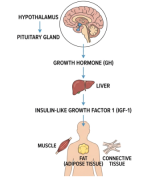
IGF-1 is largely responsible for growth and recovery processes. It stimulates protein synthesis, accelerates tissue repair, and improves the utilization of nutrients by cells. One of the key mechanisms of its action is the activation of the mTOR signaling pathway, one of the main regulators of cell growth. IGF-1 also improves glucose utilization by muscles. Its action is partly similar to insulin: it stimulates GLUT4 glucose transporters, thanks to which cells receive more energy.
In simple terms, growth hormone itself already provides some beneficial effects, such as lipolysis. But for athletes, it is very important that the entire GH → IGF-1 system works properly. When it works correctly, the body receives several benefits at once:
- Lipolysis and the use of fat as fuel
- Improved recovery
- More pronounced anabolic processes
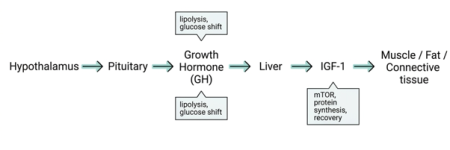
Therefore, in practice, when using growth hormone or peptides, several things are usually monitored: liver condition (so that it can produce IGF-1 to the required degree), stress levels, and sufficient carbohydrate intake. Too low a carbohydrate intake can sometimes impair IGF-1 production.
Why athletes seek to increase their growth hormone levels
In the sports world, growth hormone is often seen as one of the key factors affecting body composition and recovery. This is because GH triggers several processes that are beneficial for training and the body's adaptation to stress. When growth hormone levels rise, several physiological processes are triggered in the body. First, lipolysis increases—the body begins to use fat more actively as a source of energy. Second, the liver increases the synthesis of IGF-1, which then acts on various tissues in the body. Third, the mTOR signaling pathway is activated—one of the key mechanisms of cell growth and protein synthesis. The activity of muscle satellite cells, which are involved in the recovery and growth of muscle fibers, also increases. And one more important point — collagen synthesis increases, which has a positive effect on the condition of ligaments and tendons. If you look at the whole system as a whole, it becomes clear why the GH-IGF-1 axis plays such an important role in the body's adaptation to physical exertion.
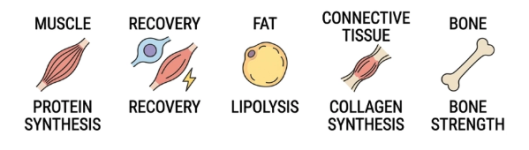
This means that the body is more actively building new structural proteins in muscle fibers.
Improved recovery
Secondly, the IGF-1 system activates so-called satellite cells, which are precursor cells of muscle fibers. They are involved in the recovery and growth of muscle tissue after training injuries.
Lipolysis
In addition, growth hormone stimulates lipolysis, the process of breaking down fat reserves. Subcutaneous and visceral fat begin to be used more actively by the body as a source of energy. This is why GH is often associated with the processes of "drying" and improving body composition.
Increased collagen synthesis
There is another point that is often overlooked. Growth hormone affects not only muscles but also connective tissue. It enhances collagen synthesis, which gradually strengthens ligaments, tendons, and joint structures. As in connective tissue, it affects collagen synthesis in bones, because collagen forms the basis on which minerals are then "deposited." Simply put, strong bones are not only "more calcium," but also a high-quality matrix that withstands stress and reduces the risk of microdamage. For strength athletes, the impact on tendons, ligaments, joints, and bones is especially important because connective tissue usually adapts to stress much more slowly than muscles.
Bone strengthening
Growth hormone and especially IGF-1 enhance the activity of osteoblasts — the cells that "build" bone. This means that the body actively forms new bone tissue and renews it faster as part of normal remodeling. IGF-1 also improves the incorporation of minerals into the bone matrix, which over time increases bone strength and mineral density (with normal nutrition and exercise).
How can you increase your growth hormone levels?
Simply put, there are two main approaches. The first is the external administration of growth hormone. In this case, the body receives a ready-made hormone. The second is the stimulation of the body's own production of growth hormone. Various peptides that affect the regulatory mechanisms of the pituitary gland are used for this purpose. Each method has its pros and cons.
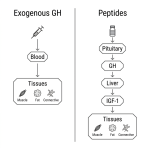
The first approach is the external administration of growth hormone. This means that the body receives ready-made GH, and the hormone level rises "externally," regardless of how the body's own regulation is working at the moment. This option usually gives a more direct and predictable increase in GH in the blood, but at the same time it is more dependent on the accuracy of dosing, the quality of the drug, and risk control, because the body does not "decide for itself" how much it needs at the moment. Below we list the features of this method:
- Exogenous GH is often perceived as a more "direct lever." You set the external influence.
- When GH is administered, the "ceiling" is set not by the pituitary gland's reserve, but by the administered dosage — but this also increases the requirements for glucose control and blood tests.
- Exogenous GH is usually perceived as more predictable in terms of its effect (you get what you inject).
Stimulations with peptides
The second approach is peptide stimulation. In ****this case, the person does not inject GH directly, but acts on the mechanisms that cause the pituitary gland to secrete the hormone "from within," more often in a more physiological way — in pulses, as happens normally. That is, they inject peptide hormones into the body that act on the pituitary gland. The potential advantage of this approach is that it relies more on the body's natural control system, but the effect can vary more significantly from person to person and depends on the initial state: sleep, stress, age, nutrition, and overall hormonal background. Below we list the features of this method:
- Stimulation of the body's own production is an attempt to "push the buttons" of regulation, so the profile may be closer to natural impulses, but it depends more on how the system works in a particular person.
- If a person initially has a reduced ability of the pituitary gland to respond (due to age, chronic stress, lack of sleep, metabolic problems), then stimulation may produce a weaker response.
- With stimulation, the effect can be "floating": today sleep/recovery is good — the response is better, tomorrow it is worse — the response is weaker.
What are the peptides that increase GH?
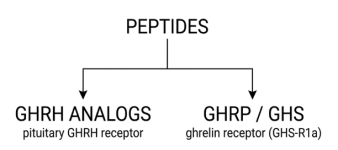
Peptides that increase growth hormone secretion are usually divided into several main groups based on which regulatory "buttons" they press. That is, these groups of peptides use different mechanisms to increase the body's own growth hormone levels.
GHRH analogues
The first group is GHRH (growth hormone-releasing hormone) analogues, which stimulate the pituitary gland to release growth hormone through a "physiological" signaling pathway (often referred to as GHRH peptides; examples of this logic are sermorelin/tesamorelin and similar substances).
GHRP/GHS
The second group consists of secretagogues that act through the ghrelin receptor, which also enhance GH release, but through a different receptor mechanism (this category usually includes GHRP-like peptides, such as ipamorelin, hexarelin, etc.).
GHRH peptides: how they work
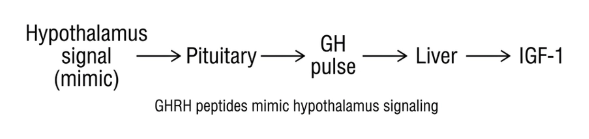
GHRH stands for Growth Hormone Releasing Hormone, a hormone that stimulates the release of growth hormone. Normally, this signal is produced by the hypothalamus, the part of the brain that regulates the hormonal system. When the body needs growth hormone, the hypothalamus sends a signal to the pituitary gland. The pituitary gland receives this signal and releases GH. GHRH peptides work on this very principle. They mimic the natural signal from the hypothalamus and stimulate GHRH receptors in the pituitary gland.
This triggers a natural chain reaction: the peptide activates the receptors → the pituitary gland secretes GH → GH stimulates the synthesis of IGF-1 → IGF-1 produces anabolic effects. In this way, growth hormone levels are increased through the body's own hormonal system.
The main drugs in the GHRH group
Despite the general principle of action, different drugs in this group differ in how long they stimulate the pituitary gland and what level of growth hormone they produce.
Sermorelin
Sermorelin is considered one of the drugs closest to natural physiology. After administration, it causes a short stimulation of the pituitary gland and a short-term release of growth hormone. In essence, its action resembles a slight enhancement of the natural function of the pituitary gland. This makes the drug quite mild and safe, but the effect is usually moderate and requires more frequent injections. Simply put, sermorelin is often considered the most "physiological" option for GH stimulation.
CJC-1295 without
DACThis peptide works on the same principle, but its molecule is more stable. As a result, the drug remains in the body longer and can stimulate the pituitary gland for a longer period of time. The effect is usually stronger than that of sermorelin, but the stimulation is still relatively short-lived.
CJC-1295 with
DACDAC (Drug Affinity Complex) is a modification of the molecule that allows the peptide to bind to blood proteins, primarily albumin. Due to this, the drug circulates in the body for much longer. As a result, we get not a short pulse of growth hormone, but a prolonged elevated GH background. This can enhance the effect on body composition, but there is one important nuance here: growth hormone affects carbohydrate metabolism. With a prolonged increase in GH, tissue sensitivity to insulin may decrease. Therefore, when using long-acting drugs, it is usually recommended to carefully monitor your diet and control your intake of fast carbohydrates.
Tesamorelin
Tesamorelin is considered one of the most powerful drugs among GHRH peptides. It is capable of causing a more pronounced increase in growth hormone and IGF-1 levels. This can lead to more noticeable changes in body composition and increased fat burning. However, a stronger effect also means a more pronounced effect on metabolism. Therefore, when using Tesamorelin, it is especially important to control your diet and carbohydrate intake.
GHRP peptides: a different mechanism of growth hormone stimulation
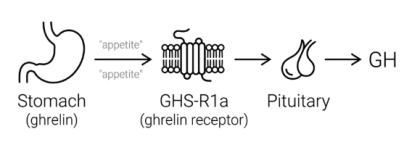
While GHRH peptides stimulate the pituitary gland directly, GHRP (Growth Hormone Releasing Peptides) work a little differently. They act on ghrelin receptors (GHS-R1a**)**. Ghrelin is a hormone (and signaling molecule) that is mainly produced in the stomach and tells the brain that the body needs energy. Simply put, it increases feelings of hunger, helps regulate appetite, and participates in metabolism. But in addition to appetite, it has another important function: it participates in the regulation of growth hormone release. When ghrelin receptors are activated, the pituitary gland receives a signal and begins to secrete GH. Therefore, GHRP peptides often cause more pronounced peaks in growth hormone secretion.
What determines the effectiveness of GHRP
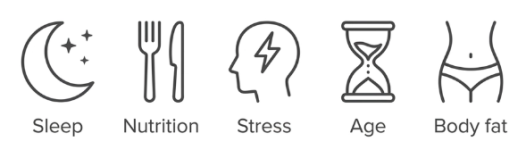
There is one important point to note about peptides in this group: their effectiveness depends heavily on lifestyle.
Sleep
If sleep patterns are disrupted, the effect of peptides may be significantly reduced. The main GH releases are associated with deep sleep phases (especially in the first half of the night). When a person is constantly sleep deprived, goes to bed late, or has fragmented sleep, the body has more difficulty "entering" deep sleep phases, and natural peaks become weaker. In practice, this looks like this: the peptide can send a signal, but if the basic "platform" of sleep is broken, the overall hormonal background and recovery decline, and the effect is noticeably weaker.
Nutrition
After using GHRP, it is usually recommended to eat a meal. However, if it contains too many fast carbohydrates, the effect of the peptide may be slightly reduced. After taking GHRP, you often feel like eating — this is logical because they act through the ghrelin receptor, and ghrelin is associated with appetite. If you consume a lot of fast carbohydrates right away, your insulin will rise, and high insulin is one of the factors that can "mute" the hormonal signals associated with GH. Therefore, the question is not that "you can't eat," but that the composition and timing of meals can affect the severity of the response.
Stress
Chronic stress is an overstimulation of the nervous system, which in turn increases cortisol levels. High cortisol can reduce the sensitivity of the hormonal system. Against this background, the body is more often in "survival" mode, where the priority is to maintain energy and stability, rather than growth and recovery. Because of this, the sensitivity of the hypothalamus-pituitary axis may decrease and sleep may deteriorate, which has a negative impact on results in two ways.
Age
With age, pituitary activity and the amplitude of natural hormonal impulses gradually decrease, including GH secretion—this is normal physiology. Therefore, in older athletes, the response to peptides sometimes becomes less pronounced. In older athletes, peptides sometimes have a milder, "smeared" effect: the system responds, but the reserve is smaller. At the same time, it is precisely at this age that the role of basic factors such as sleep, stress, weight, and insulin resistance usually becomes more pronounced.
Percentage of fat and insulin resistance
With a high percentage of fat (especially visceral fat), the hormonal environment often becomes less "anabolic": inflammation is higher, tissue sensitivity to insulin is worse, and sleep is more often disturbed (up to apnea). All of this can reduce the amplitude of natural GH peaks and make the response to GHRP less pronounced. Constantly elevated insulin also plays a role: the body is more often in "high energy, store/hold" mode rather than "mobilize fat and recover" mode. Therefore, in people with carbohydrate metabolism problems, the effect of GH stimulation is often weaker and less stable.
The main drugs in the GHRP group
Despite the common mechanism, individual representatives differ significantly in their "character": GH peak strength, effect on appetite, sensations, and individual tolerance. Below are the most common options that are most often discussed in the sports community.
GHRP-6
GHRP-6 is one of the most well-known peptides in this group. It is particularly known for its effect on appetite. In many users, it causes a pronounced feeling of hunger and an empty stomach. Fluid retention may also sometimes be observed, although this is a rather individual reaction.
GHRP-2
GHRP-2 often causes a higher peak in growth hormone than GHRP-6. At the same time, its effect on appetite is usually weaker. Some users also report improved sleep quality. However, when using high doses, some people may experience irritability, which is sometimes associated with a possible increase in cortisol levels.
IpamorelinIpamorelin is generally considered the mildest drug in this group. It stimulates the release of growth hormone, but has virtually no effect on cortisol and prolactin levels. It increases appetite minimally and is usually easier to tolerate than other peptides in this group. Therefore, it is often considered one of the most comfortable options for stimulating the GH system.
HexarelinHexarelin is usually considered one of the "strongest" GHRPs in terms of stimulation. Some users report more noticeable subjective effects than with milder options such as ipataselulin. At the same time, the "downside" of hexarelin is often discussed—it can have a stronger effect on related hormonal markers such as prolactin and cortisol and cause more pronounced side effects in sensitive individuals, so it is usually considered an option "for advanced users."