Anyone starting a GLP-1 medication quickly asks three questions: Which dose will I get, how fast does it go up, and when will I see results? The answers are less dramatic than social media suggests. Doses are raised in fixed steps, weight loss builds over months, and tolerability depends on where you are in the escalation.
This article covers semaglutide (Wegovy), tirzepatide (Mounjaro) and retatrutide, an investigational drug that is not approved. Other GLP-1 medications, such as liraglutide, are not covered. It explains how treatment starts, why the dose goes up gradually, why rushing does not pay off, and what the trials show after 1, 2, 3 and more months.
Note: This article summarizes pivotal trials and prescribing information. It is not an individual dosing plan, and retatrutide has no approved dosing schedule. Dose, escalation and pauses are decided by the prescribing physician.
Overview
| Semaglutide (Wegovy) | Tirzepatide (Mounjaro) | Retatrutide (investigational) | |
|---|
| Mechanism | GLP-1 agonist | GIP/GLP-1 dual agonist | GIP/GLP-1/glucagon triple agonist |
| Starting dose | 0.25 mg weekly | 2.5 mg weekly | 2 mg or 4 mg in the phase 2 trial |
| Step interval | Every 4 weeks | Every 4 weeks (+2.5 mg) | Every 4 weeks, up to 12 weeks |
| Maintenance dose | 2.4 mg (7.2 mg if needed) | 5, 10 or 15 mg | Not established |
| Key result | −14.9% at 68 weeks (STEP 1) | −15.0% to −20.9% at 72 weeks (SURMOUNT-1) | −24.2% at 48 weeks (12 mg, phase 2) |
1. Starting Treatment: Why You Start Low
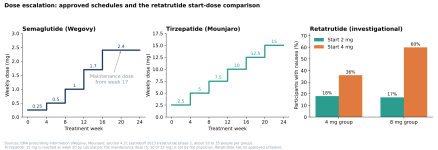
Both approved drugs begin at a dose that is far below the maintenance dose. The Wegovy label says escalation over 16 weeks is meant to reduce the likelihood of gastrointestinal symptoms.¹ The Mounjaro label notes that nausea, vomiting and diarrhea occur more often during escalation and decrease over time.² Starting low is a tolerability mechanism, not a sign that the starting dose "does not work."
Semaglutide (label schedule):¹
| Week | Weekly dose |
|---|
| 1 to 4 | 0.25 mg |
| 5 to 8 | 0.5 mg |
| 9 to 12 | 1 mg |
| 13 to 16 | 1.7 mg |
| From week 17 | 2.4 mg (maintenance) |
The label also allows an increase to 7.2 mg after at least 4 weeks on 2.4 mg in adults with a BMI of 30 kg/m² or higher. If 7.2 mg brings no additional benefit, the dose goes back to 2.4 mg. In the STEP UP trial, weight loss was 18.7% with 7.2 mg versus 15.6% with 2.4 mg; I only have these figures from the label.¹
Tirzepatide: The label schedule is 2.5 mg for 4 weeks, then 5 mg, then further increases in 2.5 mg steps after at least 4 weeks on each dose. Maintenance doses are 5, 10 and 15 mg, with 15 mg as the maximum.² In SURMOUNT-1, escalation took up to 20 weeks to reach 15 mg.⁷
Retatrutide: In its phase 2 trial, people on 4 mg or more started at either 2 mg or 4 mg and then escalated every 4 weeks for up to 12 weeks.⁹ There is no approved schedule, and phase 3 may use different steps.
2. Gradual Increases: When Do Effects Begin?
Weight loss starts early, even on the lowest doses. In SURMOUNT-1, the curves for all tirzepatide doses separate from placebo within the first weeks, at 2.5 mg, and fall steadily through the escalation phase.⁷ In the retatrutide phase 2 trial, all dose groups were already below placebo by week 4.⁹ For semaglutide, weight loss was evident from week 4 in STEP 1.³
Two points help set expectations:
- The weight curve follows the dose ladder. Loss accelerates as the dose rises and flattens once the maintenance dose is held (see section 4).
- Appetite changes are often noticed first, but the trial papers report weight, not appetite, so I cannot give a timeline for it.
3. Why Rushing Does Not Pay Off
Three pieces of evidence argue against speeding up:
- Retatrutide phase 2. Participants on 8 mg who started at 4 mg had nausea in 60%, versus 17% for those who started at 2 mg. At the 4 mg dose, nausea was 36% versus 18%.⁹ The faster start gave only slightly more weight loss: at 24 weeks, −17.9% versus −16.7% (8 mg) and −13.9% versus −11.8% (4 mg). At 48 weeks the gaps were 2.2 and 1.5 percentage points.⁹ The groups were small (about 33 to 35 people each), and I did not see a formal test of these differences. The authors state that a lower starting dose partially mitigated gastrointestinal events.⁹
- Pivotal trials used fixed schedules. None of the semaglutide or tirzepatide pivotal trials directly compared escalation speeds, so there is no evidence that faster is better.
- Dose is not the only route to the goal. In SURMOUNT-5, the maximum tolerated dose was used in both arms. Escalation went by 2.5 mg (tirzepatide) or the standard semaglutide steps every 4 weeks, with the option to stay on lower doses when side effects were unacceptable.⁸ About 89% reached 15 mg on tirzepatide, and 93% reached 2.4 mg on semaglutide, so most people got there on the standard schedule.⁸
Side effects are part of the reason. Gastrointestinal events are most frequent during escalation, and in the semaglutide trials they were mostly mild to moderate (98.1%) and led to permanent discontinuation in 4.3%.⁵ Weight loss was not driven by them: fewer than 1 percentage point of the extra loss was explained by gastrointestinal events, so feeling nauseous does not mean the drug works better.⁵ A separate article covers side effects in detail.
4. What to Expect After 1, 2, 3 and More Months
The table combines exact published values with approximate values that I read from trial figures (marked ≈, accuracy about ±1 percentage point). Tirzepatide and retatrutide curves are on-treatment (efficacy estimand) values; real-world averages that include people who stop are somewhat lower.
| Time | Semaglutide 2.4 mg | Tirzepatide (5–15 mg) | Retatrutide (phase 2) |
|---|
| Month 1 (week 4) | Loss evident from week 4³ | ≈ −3 to −4%⁷ | ≈ −3 to −5%⁹ |
| Month 2 (week 8) | Not available to me | ≈ −6%⁷ | ≈ −6 to −9%⁹ |
| Month 3 (week 12) | Not available to me | ≈ −8 to −10%⁷ | ≈ −9 to −12%⁹ |
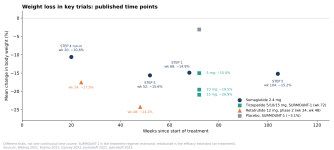
| About 5 months | −10.6% at week 20 (STEP 4)⁶ | −12.8 kg at week 20, about 12% (pooled doses)⁷ | −7.2% (1 mg) to −17.5% (12 mg) at week 24⁹ |
| About 1 year | −14.9% at week 68 (STEP 1)³ | −15.0% to −20.9% at week 72⁷ | −8.7% (1 mg) to −24.2% (12 mg) at week 48⁹ |
| 2 years | −15.2% at week 104 (STEP 5)⁴ | Not available to me | Not available |
The percentage for tirzepatide at week 20 is my calculation (12.8 kg divided by the mean baseline weight of 104.8 kg). Placebo groups lost about 2 to 3% (SURMOUNT-1: −2.7 kg at week 20).⁷
What this means in plain terms:
- Month 1: Small but measurable loss, usually a few percent, on the lowest doses.
- Months 2 to 3: Loss continues as the dose rises. Roughly 8 to 12% was seen with tirzepatide and retatrutide by week 12 in on-treatment trial data, but this varies widely between people.
- Months 4 to 6: The escalation phase ends. Most of the first year's loss is already visible.
- After 6 to 12 months: The curve flattens for semaglutide and tirzepatide. For semaglutide, the lowest mean weight was reached at about week 60 and held to week 104.⁴ In retatrutide's phase 2 trial, weight was still falling at week 48, with no plateau yet.⁹
Evidence tier: Randomized trials, all manufacturer-funded. The month-by-month figures for tirzepatide and retatrutide come from published figures and are approximate. I did not have the STEP 1 figure for semaglutide values at weeks 8 and 12.
5. Weight Loss Over Time: The Key Trials
Semaglutide
In STEP 1 (1,961 adults without diabetes, 68 weeks, lifestyle counseling), mean weight loss was 14.9% versus 2.4% with placebo. The lowest mean weight was reached at week 60.³ At 68 weeks, 86.4% lost at least 5%, 69.1% at least 10%, 50.5% at least 15% and 32.0% at least 20% (placebo: 31.5%, 12.0%, 4.9%, 1.7%).³ In STEP 5 (304 adults, 104 weeks), loss was 15.6% at week 52 and 15.2% at week 104, and the curve held until the end.⁴
Tirzepatide
In SURMOUNT-1 (2,539 adults, 72 weeks), mean weight loss was 15.0% (5 mg), 19.5% (10 mg) and 20.9% (15 mg), versus 3.1% on placebo. The shares reaching at least 20% loss were 30.0%, 50.1% and 56.7% (placebo 3.1%).⁷ The efficacy estimand gives higher numbers (−16.0%, −21.4%, −22.5%; placebo −2.4%), because it counts the effect while people took the drug as intended.⁷ The more conservative figures are closer to everyday expectations, because they include people who stopped.
Retatrutide
In the phase 2 trial (338 adults, 48 weeks, efficacy estimand), mean loss was −8.7% (1 mg), −17.1% (combined 4 mg), −22.8% (combined 8 mg) and −24.2% (12 mg), versus −2.1% with placebo. At 12 mg, 93% of participants lost at least 10% and 83% at least 15%.⁹ The trial did not require a specific calorie deficit. Participants with a BMI of 35 or higher lost more than those below 35.⁹ Phase 3 results have been announced by the manufacturer but not, to my knowledge, published in a peer-reviewed paper, so they are not used here.
Head to head
SURMOUNT-5 (751 adults, 72 weeks, open-label) compared the maximum tolerated dose of tirzepatide with that of semaglutide. Weight change was −20.2% versus −13.7%, a difference of 6.5 percentage points (95% CI −8.1 to −4.9), or −22.8 kg versus −15.0 kg.⁸ Discontinuation because of adverse events was 6.1% (tirzepatide) versus 8.0% (semaglutide), and gastrointestinal causes accounted for 2.7% versus 5.6%.⁸
Evidence tier: Randomized trials, all manufacturer-funded. SURMOUNT-5 was open-label, so participants and investigators knew the treatment.
6. When Escalation Does Not Go Smoothly
The Wegovy label allows delaying escalation or going back to the previous dose with significant gastrointestinal symptoms.¹ The Mounjaro label does the same, and in SURMOUNT-5, participants who could not tolerate the top dose could stay on a lower maintenance dose.⁸ That is part of the approved use, not a license for a self-designed schedule with stretched injection intervals or invented intermediate doses.
| Situation | Wegovy | Mounjaro |
|---|
| Missed dose | Take within 5 days; otherwise skip | Take within 4 days; otherwise skip |
| Changing injection day | At least 3 days between doses | At least 3 days between doses |
| Dehydration | Caution, especially in kidney impairment | Patients should be informed of the risk |
| Insulin or sulfonylurea | Dose may be reduced | Dose reduction may be considered |
Source: prescribing information.¹˒²
7. What the Numbers Do Not Tell You
- All participants had lifestyle support. In STEP 1, this included a 500 kcal daily deficit and 150 minutes of activity per week.³ Results reflect medication plus support.
- Populations differ from the general public. STEP 5 participants were 77.6% women and 93.1% white, without diabetes.⁴ In SURMOUNT-5, 64.7% were women.⁸
- Averages hide the spread. In STEP 1, one in three participants lost at least 20%, but 13.6% lost less than 5%.³
- Separate trials are not head-to-head comparisons. Only SURMOUNT-5 compares semaglutide and tirzepatide directly. Retatrutide has no direct comparison.
- Retatrutide is investigational. Evidence is one phase 2 trial with small dose groups.⁹
- Industry funding. All cited pivotal trials were funded by the manufacturers.
Summary
- Approved drugs start low and rise every 4 weeks; semaglutide reaches 2.4 mg at week 17, tirzepatide steps up to 15 mg over up to 20 weeks, and retatrutide has no approved schedule.
- Weight loss begins within the first weeks, builds over months, and flattens after about a year for semaglutide and tirzepatide.
- Starting higher gave little extra weight loss but much more nausea in the retatrutide phase 2 trial.
- Individual results vary widely. Dose changes belong in medical hands.
References
- Wegovy (semaglutide), Summary of Product Characteristics. European Medicines Agency, sections 4.2, 4.4, 4.8, 5.1. No DOI. Supports the schedule, 7.2 mg option, STEP UP figures and missed-dose rules. Holder: Novo Nordisk.
- Mounjaro (tirzepatide), Summary of Product Characteristics. European Medicines Agency, sections 4.2, 4.4, 4.8, 5.1. No DOI. Holder: Eli Lilly.
- Wilding JPH, et al. Once-weekly semaglutide in adults with overweight or obesity (STEP 1). N Engl J Med. 2021;384:989-1002. DOI: 10.1056/NEJMoa2032183. Funded by Novo Nordisk.
- Garvey WT, Batterham RL, Bhatta M, et al. Two-year effects of semaglutide in adults with overweight or obesity: the STEP 5 trial. Nat Med. 2022;28:2083-2091. DOI: 10.1038/s41591-022-02026-4. Funded by Novo Nordisk.
- Wharton S, Calanna S, Davies M, et al. Gastrointestinal tolerability of once-weekly semaglutide 2.4 mg in adults with overweight or obesity. Diabetes Obes Metab. 2022;24(1):94-105. DOI: 10.1111/dom.14551. Novo Nordisk-sponsored trials.
- Rubino D, et al. Effect of continued weekly subcutaneous semaglutide vs placebo on weight loss maintenance (STEP 4). JAMA. 2021;325:1414-1425. DOI not verified. Funded by Novo Nordisk.
- Jastreboff AM, Aronne LJ, Ahmad NN, et al. Tirzepatide once weekly for the treatment of obesity (SURMOUNT-1). N Engl J Med. 2022;387:205-216. DOI: 10.1056/NEJMoa2206038. Funded by Eli Lilly; full text read.
- Aronne LJ, Horn DB, le Roux CW, et al. Tirzepatide as compared with semaglutide for the treatment of obesity (SURMOUNT-5). N Engl J Med. 2025;393:26-36. DOI: 10.1056/NEJMoa2416394. Funded by Eli Lilly; full text read.
- Jastreboff AM, Kaplan LM, Frías JP, et al. Triple-hormone-receptor agonist retatrutide for obesity: a phase 2 trial. N Engl J Med. 2023;389:514-526. DOI: 10.1056/NEJMoa2301972. Funded by Eli Lilly; full text read.