Most peptide protocols don't fail because the compound doesn't work. They fail because the conditions required for it to work were never met.
This article covers the most common and consequential errors made by self-researchers — from the moment a vial arrives to the moment the last dose is injected. The mistakes are not random. They cluster around a few predictable misunderstandings: about what
Peptides physically are, about how the systems they target actually function, and about what "working" looks like for compounds that operate silently over weeks or months.
The article spans all major peptide classes: GH-axis secretagogues (Ipamorelin, CJC-1295 no DAC / with DAC, GHRP-2, GHRP-6, Hexarelin), repair/healing
Peptides (BPC-157, TB-500), metabolic
Peptides (Semaglutide, Tirzepatide, Retatrutide), mitochondrial peptides (MOTS-c, SS-31), nootropic peptides (Semax, Selank, PE-22-28), and others (GHK-Cu, IGF-1 LR3, PT-141, Melanotan II, Oxytocin). The mistakes are not all equally relevant to all classes — relevant class callouts are noted throughout.
Quick-reference: mistakes and who they hit hardest
| Mistake | Primary targets | Common symptom |
|---|
| Improper storage | All peptides | Silent potency loss, degraded vial appearance |
| Wrong reconstitution solvent | Oxytocin, fragile peptides | Degradation before first dose |
| Dosing math errors | All injectable peptides | Overdosing or underdosing without knowing it |
| Ignoring fed/fasted state | GH secretagogues (all GHRPs, GHRH analogs) | Blunted or near-zero GH pulse |
| Inadequate nutritional substrate | BPC-157, TB-500, GH axis | No raw material for the signaling to act on |
| Mechanism blindness | Semax, Selank, BPC-157, GHK-Cu | Stopping effective compounds because they feel like nothing |
| Expecting instant effects | GH axis, nootropic peptides | Premature abandonment |
| Continuous use without cycling | GHRPs (GHRP-2, GHRP-6, Hexarelin) | Progressive GHS-R1a desensitization |
| Neglecting sleep | GH secretagogues, BPC-157, TB-500 | Undermining both GH pulse timing and repair windows |
| NSAID co-administration | BPC-157 | Mechanism antagonism — direct pharmacological conflict |
| Skipping source verification | All compounds | Paying for an inactive or contaminated product |
Mistake 1 — Improper storage: the silent potency killer
Peptides are chains of amino acids. In their lyophilized (freeze-dried) form, they are relatively stable — but not invulnerable. Once reconstituted into solution, their degradation risk rises sharply. Four mechanisms destroy peptide integrity:
hydrolysis (water cleaving peptide bonds),
oxidation (oxygen attacking methionine, cysteine, tryptophan residues),
aggregation (peptide chains clumping into inactive particles), and
microbial degradation (bacterial enzymes consuming the compound).
The correct storage approach depends on the peptide's state:
Lyophilized (unreconstituted):
- Store at −20°C for long-term stability (2+ years for most peptides)
- Refrigerator (2–8°C) is acceptable for several months
- Use a desiccant if humidity is a concern — moisture absorption initiates hydrolysis even in powder form
- Protect from light: peptides containing tryptophan or tyrosine (e.g. Melanotan II, DSIP) are photosensitive; store in amber vials or wrapped in foil
- Do not use a frost-free freezer: the automatic defrost cycles create temperature fluctuations that accelerate degradation over time
- Allow vials to reach room temperature before opening — opening a cold vial causes condensation, introducing moisture directly onto the powder
Reconstituted (in solution):
- Store at 2–8°C; use immediately upon reaching room temperature, then return to the fridge
- Do not freeze a reconstituted peptide. Ice crystal formation mechanically shears peptide bonds and is irreversible — the vial will look normal and still be inactive. This is one of the most common and costly errors
- BAC water (0.9% benzyl alcohol) extends stability to ~4–6 weeks refrigerated; sterile water without preservative should be used within 24–48 hours
- Protect from light: reconstituted solutions are more photosensitive than lyophilized powder
- Discard if you observe cloudiness, particulates, unexpected color change, or any unusual odor
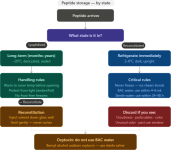
[DIAGRAM: Storage conditions flowchart Shows: Lyophilized → reconstituted state split, with correct storage conditions, degradation risks, and discard criteria for each state
Reconstitution technique matters too. Always inject the solvent down the glass wall of the vial — not directly onto the lyophilized cake. Direct jetting causes localized supersaturation and irreversible aggregation. Do not vortex. Gently swirl or roll until clear. The solution should be optically clear; cloudiness means precipitation has already occurred.
Compound-specific note — Oxytocin: Oxytocin is incompatible with bacteriostatic water. The benzyl alcohol in BAC water oxidizes oxytocin, accelerating its degradation. Use sterile water or normal saline, and either use single-dose aliquots or be aware of the shortened shelf life.
Mistake 2 — Dosing math errors: the problem nobody admits
Subcutaneous peptide dosing requires converting between milligrams and micrograms, calculating concentration from reconstitution volume, and then translating that into insulin syringe units. Each step is a multiplication or division error waiting to happen.
Standard concentration formula:
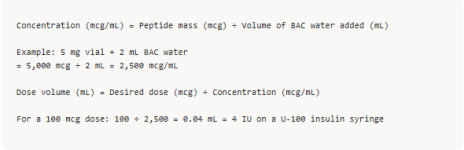
The most common errors:
- Confusing mg and mcg. 1 mg = 1,000 mcg. A "200 mcg dose" is not 0.2 mg — it's exactly 0.2 mg, but expressing it inconsistently leads to tenfold dosing errors
- Forgetting that BAC water volume changes the concentration. Adding 1 mL vs 2 mL to the same vial doubles or halves every subsequent dose
- Using U-40 vs U-100 syringes interchangeably. U-40 syringes give 40 units per mL; U-100 syringes give 100 units per mL. The same volume marking represents different doses. Write the concentration on the vial label when reconstituting
Affected compounds: All injectables. Especially relevant for high-potency or narrow-window compounds: IGF-1 LR3, Hexarelin, GHRP-2.
Mistake 3 — Ignoring the fed/fasted state for GH secretagogues
This is the most mechanistically concrete mistake on the list, and one of the most commonly ignored.
GH secretagogues — the entire GHRH/GHRP class (Ipamorelin, CJC-1295 no DAC/with DAC, GHRP-2, GHRP-6, Hexarelin, Tesamorelin) — work by stimulating the anterior pituitary to release a pulse of endogenous growth hormone. That release is conditional. It can be substantially or completely blocked by elevated blood glucose and elevated insulin. The mechanism: glucose suppresses hypothalamic somatostatin tone, and elevated insulin creates a hormonal environment antagonistic to GH release. Both free fatty acids and hyperglycemia are independently inhibitory.
The practical consequence: injecting a GH secretagogue 30–60 minutes after a carbohydrate-heavy meal means the pituitary receives the signal and largely cannot respond. The compound is not "not working" — the axis is pharmacologically gated shut.
Correct timing:
- GH peptides should be injected at minimum 2 hours after eating, ideally in a fully fasted state
- Pre-bed dosing (aligning with the endogenous deep-sleep GH pulse) and early morning fasted dosing are the two most physiologically appropriate windows
- Post-training dosing (after the glycogen depletion phase, typically 45–60 min post-workout) is also viable
- Fat has minimal insulin impact — a purely fat-based meal causes less blunting than a carbohydrate load, but still imperfect timing
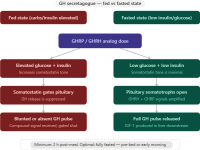
[DIAGRAM: GH secretagogue timing diagram Shows: Insulin/glucose suppression of pituitary GH release vs. fasted state. Parallel columns: fed state (blocked pathway) vs. fasted state (active pathway), with somatostatin tone as gating mechanism Style: Dual-pathway flowchart]
Note on CJC-1295 with DAC: The DAC (Drug Affinity Complex) modification extends half-life to ~6–8 days, creating a sustained elevation of GHRH signaling rather than a pulsatile one. This makes it less sensitive to individual meal timing, but continuous GH elevation carries its own risks and is mechanistically distinct from pulsatile secretion. Most protocols now favor CJC-1295 without DAC precisely to preserve physiological pulsatility.
Mistake 4 — Inadequate nutritional foundation
Peptides are signaling molecules. They instruct cells to do things — repair tissue, synthesize collagen, proliferate fibroblasts, increase GH output. But the actual execution of those instructions requires raw material.
For repair peptides (BPC-157, TB-500):
- Collagen synthesis is the primary repair output. Collagen requires glycine, proline, hydroxyproline, and vitamin C as direct substrates. A protein-deficient diet constrains repair outputs regardless of how potent the signaling stimulus is
- Adequate dietary protein (≥1.6 g/kg bodyweight for active individuals) is not optional — it is the substrate on which the repair cascade operates
- Caloric restriction at the same time as a repair protocol creates a competing signal: the body is receiving repair instructions while simultaneously being resource-constrained. Acute severe deficit will blunt repair
For GH-axis peptides (Ipamorelin, CJC-1295, GHRP-2/6, Hexarelin):
- GH and its downstream effector IGF-1 are protein-anabolic. Without adequate dietary protein to drive muscle protein synthesis downstream of elevated IGF-1, much of the anabolic signal has nowhere to go
- Chronic severe caloric deficit suppresses IGF-1 production independent of GH output — the liver requires adequate nutrition to convert GH signal into IGF-1. Dieting hard while running GH peptides creates a dissociation: GH levels are elevated but circulating IGF-1 is not
- Micronutrient status also matters: zinc, magnesium, and B vitamins are co-factors in protein synthesis pathways downstream of IGF-1
For metabolic peptides (Semaglutide, Tirzepatide, Retatrutide):
- The opposite problem is common: users expect weight loss to happen independently of dietary behavior. These compounds work by reducing appetite and slowing gastric emptying — but they do not override a caloric surplus. They also reduce total food intake substantially, making protein targets harder to hit. Deliberate dietary protein tracking matters here to avoid muscle loss during rapid weight loss.
Mistake 5 — Mechanism blindness: treating all peptides identically
The single most common reason people abandon a working protocol is failing to understand what their compound does and does not feel like.
Three mechanistically distinct profiles:
Group A — Compounds with clear subjective signal: Semax, Selank, PE-22-28, GHRP-6 (hunger signal), PT-141 (arousal), Melanotan II. These produce effects the user can feel — mental clarity, anxiolysis, appetite shift, libido. If they're not working, you'll know.
Group B — Compounds that work silently: BPC-157, TB-500, GHK-Cu, MOTS-c, SS-31. These activate repair pathways, collagen synthesis, mitochondrial biogenesis, and angiogenesis — none of which produce conscious sensation. A user running BPC-157 for tendon repair who stops after two weeks because they "don't feel anything" may be abandoning a compound that is actively accelerating fibroblast proliferation and collagen cross-linking. The outcome (reduced pain, improved function) often appears 3–6 weeks into a protocol, not days.
Group C — GH-axis peptides with delayed anabolic signal: Ipamorelin, CJC-1295, GHRP-2, IGF-1 LR3. Early effects (sleep quality, water retention, minor skin changes) appear in 2–4 weeks. Body composition changes (lean mass, fat reduction) require 8–12+ weeks of consistent use with appropriate nutrition and training. GH-related tissue changes (improved skin, joint lubrication) may not be apparent for 3–6 months.
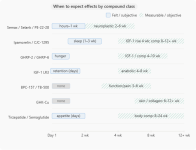
[DIAGRAM: Timeline expectations by compound class Shows: Horizontal timeline chart — onset of subjective effects vs. measurable outcomes for each class. Bars for: GH peptides (subjective early vs. objective late), repair peptides (silent throughout), nootropic peptides (fast subjective), metabolic peptides (progressive weight loss)
Style: Horizontal bar chart with two bars per row]
A critical secondary error: Conflating GH secretagogues with direct exogenous GH. GHRPs and GHRH analogs stimulate the pituitary to produce and release
endogenous GH — they do not deliver exogenous hormone. Their effects are bounded by the somatotroph's capacity and by the normal regulatory loop (somatostatin, IGF-1 feedback). The magnitude of effect is measurably real (IGF-1 levels will rise on a well-run GH peptide protocol) but moderate compared to direct GH administration. Expecting exogenous-GH-level results from secretagogue doses leads to inevitable disappointment.
Mistake 6 — Expecting instant effects
Addressed by compound class:
| Compound class | Early signal (if any) | Objective effects | Timeline for meaningful outcome |
|---|
| GH secretagogues (Ipamorelin, CJC-1295, GHRP-2/6) | Sleep quality improvement (1–2 weeks) | IGF-1 rise detectable by blood work (~4 weeks) | Body comp changes: 8–12+ weeks |
| Repair peptides (BPC-157, TB-500) | None subjectively | Tendon/ligament healing markers (not easily tested) | Pain reduction, functional improvement: 3–6 weeks |
| Nootropic peptides (Semax, Selank, PE-22-28) | Rapid (hours to days) | BDNF upregulation (not easily tested) | Acute anxiolysis/clarity dose-to-dose; neuroplastic effects over weeks |
| Metabolic peptides (Semaglutide, Tirzepatide) | Appetite reduction (days) | Weight loss (weeks–months) | Meaningful body comp change: 12–24+ weeks |
| GHK-Cu | None | Collagen synthesis, skin remodeling | Skin: 6–12 weeks; systemic: months |
| IGF-1 LR3 | Water retention (days) | Protein synthesis upregulation (measureable) | 4–8 weeks depending on training load |
The IGF-1 blood test is the most accessible objective verification for GH-axis protocols. If IGF-1 is not rising after 6–8 weeks of consistent, properly timed GH peptide use, the protocol has a problem — timing, storage, or compound quality.
Mistake 7 — Continuous use without cycling for GHRPs
This applies specifically to compounds in the GHRP class:
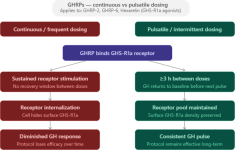
GHRP-2, GHRP-6, and Hexarelin — all of which work via GHS-R1a (ghrelin receptor) stimulation.
The published evidence (Ghigo et al.,
Eur J Endocrinol, 1997) is clear: GHRP effects undergo partial desensitization, and this desensitization is more pronounced during continuous infusion than during intermittent administration. At the receptor level, chronic GHS-R1a stimulation leads to receptor internalization, uncoupling, and downregulation — the cell reduces surface receptor availability in response to sustained stimulation.
The practical implication: GHRPs should be dosed in discrete pulses separated by at least 3 hours (to allow GH levels to return to baseline between pulses and preserve the natural pulsatile pattern). Some protocols use 5-days-on/2-days-off cycling. For long-term use (months), periodic breaks of 1–4 weeks are commonly observed.
This does not apply equally to all peptides:
- GHRH analogs (CJC-1295 without DAC, Tesamorelin): less desensitization risk than GHRPs; pulsatile dosing mitigates it
- BPC-157, GHK-Cu: no evidence of receptor desensitization; cycling these for "safety" is unnecessary and interrupts repair protocols
- Semax, Selank, PE-22-28: mild tolerance to subjective effects is anecdotally reported; structuring as pulsed protocols is reasonable but not as mechanistically urgent as for GHRPs
Mistake 8 — Neglecting sleep
Two-thirds of endogenous GH secretion occurs nocturnally, with 70% of total daily GH released during the first episode of slow-wave sleep. This is the physiological window GH secretagogues are most potent within — the pituitary is primed, somatostatin tone is at its lowest, and GHRH pulsatility is highest.
Disrupted or insufficient sleep reduces endogenous GH pulsatility independent of peptide dosing. A user taking Ipamorelin + CJC-1295 nightly while sleeping 5 hours with frequent awakenings is operating with a compromised GH window. The compound's effect is not negated entirely, but it is significantly reduced.
For repair peptides, tissue regeneration and fibroblast activity also peak during sleep. Running BPC-157 or TB-500 with chronic sleep deprivation constrains the very recovery window these compounds are meant to augment.
Minimum target: 7–9 hours of uninterrupted sleep. Pre-bed GH peptide dosing (20–30 min before sleep onset) aligns the secretagogue-driven pulse with the deep-sleep GH window.
Mistake 9 — NSAID co-administration with BPC-157
NSAIDs (ibuprofen, naproxen, aspirin at anti-inflammatory doses) inhibit cyclooxygenase (COX) enzymes and suppress prostaglandin synthesis. This is relevant to BPC-157 because prostaglandins are involved in the early inflammatory signaling cascade that BPC-157 partially co-opts for its healing effects. Evidence in animal models suggests NSAID co-administration attenuates BPC-157's repair effects.
The irony: BPC-157 is often used for pain associated with injury. The instinct is to take an anti-inflammatory alongside it. That combination may be working against itself at the pharmacological level.
If pain management is needed during a BPC-157 protocol, acetaminophen (paracetamol) does not inhibit COX peripherally and is a better-tolerated co-medication from a mechanism-compatibility standpoint.
Mistake 10 — Not verifying source quality
Research-grade peptides (RUO — Research Use Only) vary widely in purity. A vial labeled "5 mg BPC-157" may contain 3 mg of active compound, 5 mg of a related impurity, or material that has already degraded in transit due to cold-chain failures.
Minimum standard for a trustworthy supplier:
- Certificate of Analysis (COA) from an independent third-party laboratory (not the vendor's in-house testing)
- HPLC purity ≥ 98% for the stated compound
- Mass spectrometry (MS) confirmation of molecular weight matching the correct compound
- Cold-chain shipping (especially for fragile peptides like GLP-1 analogs: Semaglutide, Tirzepatide, Retatrutide)
Running an expensive 8-week protocol on underdosed or degraded material is not a protocol failure. It is a procurement failure. If IGF-1 fails to rise after a well-structured GH peptide run, suspect the compound before blaming the protocol.
What to actually track — monitoring table
| Compound / class | What you won't feel | Timeline | What to actually measure |
|---|
| Ipamorelin / CJC-1295 | GH pulse itself | — | Serum IGF-1 (baseline + 6–8 weeks in) |
| GHRP-2 / GHRP-6 | GH pulse; cortisol, prolactin at high doses | — | IGF-1; prolactin if running >200 mcg doses |
| IGF-1 LR3 | Direct IGF-1 action | — | Fasting glucose, serum IGF-1, muscle performance |
| BPC-157 / TB-500 | Fibroblast activity, collagen synthesis | 3–6 weeks | Pain/function scoring; specific ROM or strength marker |
| GHK-Cu | Collagen remodeling, gene expression | 6–12 weeks | Skin texture; wound closure rate; subjective joint comfort |
| Semax / Selank | BDNF upregulation | Days (subjective); weeks (neuroplastic) | Subjective cognition/anxiety scale |
| Tirzepatide / Semaglutide / Retatrutide | GLP-1 receptor signaling | — | Body weight, waist circumference, HbA1c, lipids |
| MOTS-c / SS-31 | Mitochondrial biogenesis | Weeks | Fasting glucose, exercise performance, fatigue markers |
Universal baseline bloodwork before any GH-axis protocol: IGF-1, fasting glucose, HbA1c, prolactin. These establish where you started and allow you to distinguish protocol success from noise.
References
- Ghigo E, Arvat E, Camanni F. Growth hormone-releasing peptides: clinical and basic aspects. Eur J Endocrinol. 1997;136(5):445–460. PMID: 9186261
Foundational review on GHRP mechanism and desensitization dynamics.
- Nass R, Pezzoli SS, Oliveri MC, et al. Effects of an oral ghrelin mimetic on body composition and clinical outcomes in healthy older adults. Ann Intern Med. 2008;149(9):601–611.
Clinical data on GH secretagogue effects in humans; includes glucose and IGF-1 outcomes.
- Giustina A, Veldhuis JD. Pathophysiology of the neuroregulation of growth hormone secretion in experimental animals and the human. Endocr Rev. 1998;19(6):717–797. PMID: 9861545
Comprehensive review of GH axis regulation including insulin, glucose, somatostatin tone.
- Sikiric P, Seiwerth S, Rucman R, et al. Stable gastric pentadecapeptide BPC 157: novel therapy in gastrointestinal tract. Curr Pharm Des. 2011;17(16):1612–1632. PMID: 21548867
BPC-157 pharmacology review including mechanism of action and tissue repair evidence.
- Van Cauter E, Plat L, Scharf MB, et al. Simultaneous stimulation of slow-wave sleep and growth hormone secretion by gamma-hydroxybutyrate in normal young men. J Clin Invest. 1997;100(3):745–753. PMID: 9239424
Demonstrates the coupling between slow-wave sleep and GH pulsatility.
- Manning MC, Chou DK, Murphy BM, Payne RW, Katayama DS. Stability of protein pharmaceuticals: an update. Pharm Res. 2010;27(4):544–575. PMID: 20143256
Covers peptide degradation pathways including hydrolysis, oxidation, and aggregation.
- Sigalos JT, Pastuszak AW. The safety and efficacy of growth hormone secretagogues. Sex Med Rev. 2018;6(1):45–53. PMID: 27417081. PMC5632578
Review covering GHS clinical evidence, IGF-1 effects, and glucose metabolism implications.