Depression and anxiety are not simply problems of "too little serotonin." That model, while useful for explaining SSRIs to patients, obscures the real biology: mood disorders involve disrupted neuroplasticity, dysregulated stress axes, impaired neurotransmitter turnover, and — increasingly recognized — gut-brain signaling failures.
Peptides operate at several of these levels simultaneously.
This article covers the
Peptides with the strongest mechanistic connections to psychoemotional function. Some act directly on neurotransmitter systems. Others work upstream — restructuring the neural architecture that makes stable mood possible in the first place. The distinction matters, because the
Peptides that produce the most obvious subjective effects are not always doing the most important work.
A note on expectations: most of the compounds discussed here have preclinical evidence only. Where human clinical data exists, it is noted. None of these peptides are approved treatments for depression or anxiety in Western medicine. Several are registered pharmaceuticals in Russia and CIS countries.
Quick-reference overview
| Compound | Main mood-relevant action | You will likely notice | Evidence level |
|---|
| Semax | BDNF upregulation, serotonin modulation | Subtle clarity, mild mood lift after days | Approved anxiolytic (Russia); human clinical data |
| Selank | GABA-A modulation, monoamine turnover | Reduced anxiety within hours | Approved anxiolytic (Russia); human RCTs |
| PE-22-28 | TREK-1 channel blockade → serotonin firing ↑ | Possible mood lift, reduced anhedonia | Preclinical only |
| Oxytocin | HPA axis dampening, social cognition | Warmer social interactions, reduced stress reactivity | Human RCTs (intranasal); mixed results for depression |
| BPC-157 | Dopamine/serotonin normalization via gut-brain axis | Usually nothing directly mood-related | Preclinical only |
| CJC-1295 / Ipamorelin | GH-axis → improved sleep architecture | Better sleep quality → downstream mood benefit | Human data for GH secretagogues; mood effects indirect |
| Melanotan II | Melanocortin system activation | Libido increase, tanning; mood effects incidental | Human data for tanning/sexual function; mood data weak |
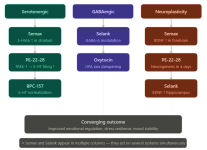
[DIAGRAM: Mechanism route map
Shows: Three-column comparison — serotonergic, GABAergic, and neuroplasticity pathways
Style: Three-column comparison diagram]
What you need to understand first
Mood regulation is not a single system. It is the output of several overlapping networks, and different peptides intervene at different points.
Serotonin (5-HT) is the neurotransmitter most associated with mood in public understanding, largely because SSRIs — the most widely prescribed antidepressants — work by preventing its reuptake. Serotonin is produced primarily in the dorsal raphe nucleus (DRN), a small cluster of neurons in the brainstem. From there, serotonergic projections reach the prefrontal cortex, hippocampus, amygdala, and many other regions involved in emotional regulation. What matters for this article: serotonin firing rate in the DRN is regulated by background potassium currents (this is where TREK-1 channels come in), by autoreceptor feedback loops (5-HT1A receptors), and by the availability of its precursor tryptophan — which is itself influenced by gut health. The gut produces roughly 90% of the body's serotonin, though peripheral serotonin does not cross the blood-brain barrier. What the gut does influence is tryptophan availability and inflammatory signaling that affects central serotonin synthesis.
GABA (gamma-aminobutyric acid) is the brain's primary inhibitory neurotransmitter. When GABA-A receptors are activated, they open chloride channels, hyperpolarize neurons, and reduce excitability. This is the mechanism behind benzodiazepines — and, as it turns out, behind Selank's anxiolytic effects. The key difference: benzodiazepines cause tolerance, dependence, and cognitive impairment. Selank modulates the same system without these drawbacks.
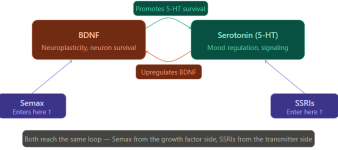
[DIAGRAM: BDNF–serotonin bidirectional loop
Shows: BDNF promotes 5-HT neuron survival ↔ serotonin upregulates BDNF. Semax enters from BDNF side, SSRIs enter from serotonin side.
Style: Dual-pathway with curved bidirectional arrows and entry points]
BDNF (brain-derived neurotrophic factor) is not a neurotransmitter. It is a growth factor — a protein that promotes the survival, growth, and differentiation of neurons. BDNF levels are consistently reduced in depression, and antidepressant treatment (including SSRIs, exercise, and electroconvulsive therapy) consistently raises them. This has led to the "neurotrophin hypothesis" of depression: mood disorders may partly reflect impaired neuroplasticity. BDNF and serotonin interact bidirectionally — BDNF promotes serotonergic neuron survival, and SSRIs upregulate BDNF. Semax acts directly on BDNF expression, which is one reason it has mood-relevant effects despite not being a classical antidepressant.
The HPA axis (hypothalamic-pituitary-adrenal axis) governs the stress response. Chronic activation — sustained high cortisol — damages hippocampal neurons, impairs neurogenesis, and dysregulates serotonin. Oxytocin is one of the endogenous regulators that dampens HPA activity.
The compounds
Semax — BDNF and serotonin, simultaneously
What to expect
You are unlikely to feel a dramatic mood shift from Semax. What users typically report is subtle cognitive clarity and, after several days to weeks, a mild but persistent improvement in emotional tone. The mechanism — BDNF upregulation and serotonin modulation — operates on a timescale of days to weeks, not hours. To verify effects, track cognitive task performance, reaction time, and subjective mood logs over 2–4 weeks rather than looking for acute changes.
Semax is a synthetic analog of ACTH(4-10), the fragment of adrenocorticotropic hormone responsible for its nootropic effects without the adrenal stimulation of the full hormone. It is administered intranasally.
The BDNF mechanism. Intranasal Semax at 50–250 μg/kg produces a rapid increase in BDNF protein levels in the basal forebrain within 3 hours. This is not a downstream consequence of some other process — Semax binds specific, saturable binding sites in the basal forebrain (Kd = 2.4 nM). The BDNF upregulation connects directly to mood because BDNF-serotonin interactions are bidirectional: BDNF promotes serotonergic neuron survival and differentiation, and increased serotonergic activity further upregulates BDNF expression. Semax enters this loop from the BDNF side.
The serotonin mechanism. Separately from BDNF, Semax increases 5-HIAA (the primary serotonin metabolite) in the striatum by ~25% in tissue content, with extracellular levels rising to 180% of baseline within 1–4 hours. This indicates increased serotonin turnover — the system is producing and metabolizing more serotonin. Semax does not directly alter dopamine levels, but it potentiates amphetamine-induced dopamine release, suggesting it modulates dopaminergic transmission indirectly.
Evidence tier: Approved pharmaceutical in Russia for cognitive disorders and stroke recovery. Small Russian studies suggest mood-buffering effects. No Western RCTs for depression specifically.
Bottom line — in plain terms
Semax helps the brain grow and maintain the neurons that produce serotonin, one of the key chemicals involved in mood regulation. It also increases serotonin activity in the brain. Think of it less as a mood booster and more as a long-term investment in the brain's capacity to regulate mood on its own. It works slowly — days to weeks — and the effects are subtle. Theoretical use cases: mild depressive symptoms, emotional blunting, cognitive fog that accompanies low mood. It is not a replacement for antidepressants in clinical depression.
Selank — removing the brake on calm
What to expect
elank is the most "felt" compound in this article for anxiety. Users typically report a reduction in baseline anxiety within 30–60 minutes of intranasal administration, often described as similar to a low-dose benzodiazepine without sedation or cognitive dulling. The anxiolytic effect is the primary subjective experience. The nootropic and serotonergic effects are harder to perceive directly. No dependence, withdrawal, or tolerance has been reported in clinical use.
Selank is a synthetic analog of tuftsin (an immunomodulatory peptide) with a Pro-Gly-Pro extension that improves enzymatic stability. It is administered intranasally.
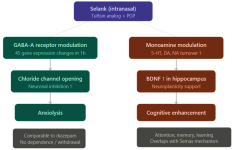
[DIAGRAM: Selank dual mechanism
Shows: Selank branching into GABAergic (anxiolysis) and monoamine (cognitive enhancement) pathways
Style: Dual-pathway branching diagram]
The GABAergic mechanism. Clinical studies have shown Selank's anxiolytic effect is comparable to that of classical benzodiazepines like diazepam. The mechanism appears similar: Selank modulates GABA-A receptor gene expression and can compete for benzodiazepine binding sites on GABA-A receptors. In the frontal cortex of rats, Selank administration produces changes in expression of 45 genes involved in GABAergic neurotransmission within 1 hour, with a positive correlation to the changes produced by GABA itself. The critical difference from benzodiazepines: Selank does not cause amnesia, withdrawal symptoms, or dependence.
The monoamine mechanism. Alongside GABAergic effects, Selank modulates serotonin and dopamine turnover. It influences monoamine metabolism in the frontal cortex and hippocampus, and elevates BDNF expression in the hippocampus — overlapping with Semax's neuroplasticity effects, though through a different upstream mechanism (tuftsin-derived vs. ACTH-derived).
Under chronic unpredictable mild stress conditions in rats, combined Selank and diazepam administration maintained anxiety indicators at pre-stress baseline levels — neither compound alone fully achieved this, suggesting complementary mechanisms.
Evidence tier: Approved anxiolytic in Russia. Human clinical trials (62 patients with GAD and neurasthenia). Strongest clinical evidence of any compound in this article for anxiety.
Bottom line — in plain terms
Selank calms the brain down by enhancing the same inhibitory system that benzodiazepines (like Valium) target — but without the addiction, memory problems, or withdrawal that come with those drugs. On top of the calming effect, it also supports serotonin and dopamine activity and promotes brain cell growth in the hippocampus. It is the fastest-acting compound in this article: most users notice reduced anxiety within an hour. Theoretical use cases: generalized anxiety, stress-driven emotional overload, racing thoughts, situational anxiety. It does not treat depression directly, but anxiety and depression frequently co-occur, and reducing the anxiety component can make depression more manageable.
PE-22-28 — releasing a different brake
What to expect
PE-22-28 is the least-studied compound here in humans. No human clinical data exists. In rodent models, antidepressant-like effects appeared within 4 days — dramatically faster than SSRIs (2–4 weeks). Users in the biohacking community report reduced anhedonia and improved motivation, but these are anecdotal. If you are considering PE-22-28, understand that you are working with preclinical data only.
PE-22-28 is a 7-amino-acid fragment of spadin, itself a cleavage product of the sortilin receptor. Its target is TREK-1 (TWIK-related potassium channel 1), a two-pore-domain potassium channel expressed abundantly in the prefrontal cortex, hippocampus, and dorsal raphe nucleus.
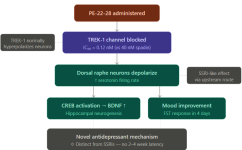
[DIAGRAM: PE-22-28 TREK-1 mechanism
Shows: TREK-1 blockade → dorsal raphe neuron depolarization → serotonin firing increase → CREB/BDNF → neurogenesis
Style: Flowchart with annotation boxes]
Why TREK-1 matters for depression. TREK-1 is a "leak" potassium channel — it holds neurons in a hyperpolarized (less excitable) state. TREK-1 knockout mice display a depression-resistant phenotype across multiple behavioral tests and show increased firing of dorsal raphe serotonin neurons. Four genetic variants of the human TREK-1 locus are associated with resistance to multiple antidepressant drugs. In other words: TREK-1 appears to be a natural brake on serotonergic neurotransmission, and lifting that brake produces antidepressant effects.
How PE-22-28 exploits this. PE-22-28 blocks TREK-1 with an IC50 of 0.12 nM — roughly 300-fold more potent than its parent compound spadin. This blockade depolarizes serotonin neurons in the dorsal raphe, increasing their firing rate. The downstream effect resembles an SSRI (more serotonin in the synapse), but achieved through an entirely different upstream mechanism — channel blockade rather than reuptake inhibition. In mouse models, PE-22-28 induced hippocampal neurogenesis within 4 days and enhanced synaptogenesis (measured by PSD-95 expression). Its duration of action is ~23 hours, compared to ~7 hours for spadin.
The mechanism is distinct from both SSRIs and ketamine. SSRIs block serotonin reuptake transporters. Ketamine blocks NMDA glutamate receptors. PE-22-28 blocks a potassium channel. All three converge on increased serotonergic tone and BDNF-mediated neuroplasticity, but via fundamentally different entry points.
Evidence tier: Preclinical only. No human trials. Mechanism well-characterized in rodent models.
Bottom line — in plain terms
PE-22-28 works by blocking a specific type of potassium channel (TREK-1) that normally keeps serotonin neurons quiet. When that channel is blocked, serotonin neurons fire more — similar to what SSRIs achieve, but through a completely different mechanism. In animal studies, this produced antidepressant effects within 4 days instead of the 2–4 weeks typical for SSRIs, and it triggered new brain cell growth in the hippocampus. The catch: no human has ever been tested with this compound in a clinical trial. Everything known comes from mice and rats. Theoretical use cases: treatment-resistant depression, anhedonia (inability to feel pleasure), motivational deficits. High mechanistic promise, but very early-stage — you are the experiment.
Oxytocin — stress dampening, not a "love drug"
What to expect
Intranasal oxytocin effects are subtle and context-dependent. You may notice mildly warmer social interactions or reduced reactivity to interpersonal stress. You will not feel euphoria or dramatically altered mood. Effects depend heavily on social context — oxytocin amplifies the salience of social cues, which can be positive or negative depending on the situation. Expect nothing in isolation; effects emerge in social settings.
Oxytocin is a 9-amino-acid neuropeptide produced in the hypothalamus (paraventricular and supraoptic nuclei). Its relevance to mood operates through two main channels.
HPA axis modulation. Oxytocin inhibits stress-induced activity of the hypothalamic-pituitary-adrenal axis. It dampens cortisol release and corticitrophin-releasing factor (CRF) signaling. In depressed patients, plasma oxytocin levels correlate negatively with both depression severity (r = −0.58) and anxiety severity (r = −0.61). This does not prove causation — it may reflect that depression suppresses oxytocin, not that low oxytocin causes depression — but the relationship is consistent across studies.
Serotonergic and GABAergic interactions. Oxytocin's anxiolytic effects involve downstream modulation of both serotonergic and GABAergic systems. It is not a direct 5-HT or GABA ligand, but it influences these systems through its effects on the amygdala and prefrontal cortex circuits.
The clinical picture is mixed. A systematic review of 15 RCTs evaluating intranasal oxytocin in anxiety and depressive disorders found no significant effects on core symptomatology. However, neuroimaging substudies showed reduced amygdala hyperreactivity in social anxiety. The disconnect between biomarker changes and symptom scores suggests either underdosing, wrong patient selection, or that oxytocin's effects are modulatory rather than therapeutic on their own.
Evidence tier: Extensive human data for social cognition and stress modulation. Mixed clinical results for depression and anxiety as a standalone treatment. Most promising as an adjunct in contexts involving social stress or attachment disruption.
Bottom line — in plain terms
Oxytocin is a hormone your body already produces, most active during bonding, physical closeness, and trust. Administered as a nasal spray, it turns down the body's stress alarm system (the HPA axis) and reduces cortisol — the main stress hormone. It does not directly fix depression or anxiety, but it can reduce how strongly you react to social stress and make interpersonal interactions feel less threatening. The effects are context-dependent: it amplifies whatever social situation you're in, for better or worse. Theoretical use cases: social anxiety, stress-driven emotional reactivity, attachment difficulties, recovery from interpersonal trauma. Not useful in isolation — its effects emerge in social settings. Do not expect a standalone antidepressant.
BPC-157 — the gut-brain connection
What to expect
You will almost certainly not feel any direct mood effects from BPC-157. Its mood-relevant mechanisms operate through gut repair, neurotransmitter normalization, and anti-inflammatory signaling — none of which produce subjective mood changes you can point to. Users who report mood improvement on BPC-157 may be experiencing downstream effects of reduced gut inflammation, reduced pain, or improved sleep. To verify neurochemical effects, you would need before/after neurotransmitter metabolite testing, which is impractical for most users.
BPC-157 (body protection compound-157) is a 15-amino-acid fragment of a gastric juice protein. Its connection to mood is indirect but mechanistically grounded.
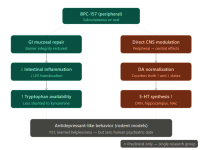
[DIAGRAM: BPC-157 gut-brain axis
Shows: Peripheral BPC-157 → gut repair + direct CNS modulation → serotonin/dopamine normalization
Style: Dual-pathway flowchart with caveat badge]
Dopamine and serotonin normalization. BPC-157 does not simply increase or decrease dopamine or serotonin. In animal models, it counteracts both amphetamine-induced dopamine overstimulation and haloperidol-induced dopamine blockade — it appears to normalize dopaminergic function rather than push it in one direction. For serotonin, α-methyl-L-tryptophan autoradiography shows BPC-157 increases serotonin synthesis rates in specific brain regions (hippocampus, hypothalamus, substantia nigra, dorsal raphe nucleus, nucleus accumbens) after 7 days of peripheral administration. This is notable because the peptide was not injected into the brain — it altered central serotonin synthesis from the periphery.
The gut-brain axis. BPC-157's primary established action is gastrointestinal mucosal repair. The gut microbiome produces a significant portion of tryptophan (serotonin precursor) and influences BDNF levels through inflammatory signaling. By repairing gut integrity and reducing intestinal inflammation, BPC-157 may indirectly support central serotonin synthesis and reduce neuroinflammation that contributes to depressive symptoms.
In behavioral models, BPC-157 shows antidepressant-like effects in forced swim tests and learned helplessness paradigms. These correlate with its ability to modulate dopamine and serotonin signaling without the receptor downregulation seen with chronic SSRI use.
Evidence tier: Preclinical only. No human psychiatric studies. Extensive rodent evidence for neurotransmitter modulation and gut-brain effects.
Bottom line — in plain terms
BPC-157 is primarily a gut-healing peptide. Its connection to mood is indirect: a damaged gut lining produces chronic inflammation that can impair serotonin production in the brain, and BPC-157 addresses that upstream problem. It also appears to normalize both dopamine and serotonin systems — not by cranking them up, but by pushing them back toward baseline when they're disrupted in either direction. You will not feel a mood change from BPC-157 the way you would from Selank. But if gut issues, chronic inflammation, or digestive problems are contributing to your low mood, fixing the gut may remove a barrier that other interventions (including other peptides) struggle to work around. Theoretical use cases: mood issues accompanied by GI symptoms, post-antibiotic gut disruption affecting mood, chronic low-grade inflammation contributing to depressive symptoms.
GH-axis peptides — the sleep-mood bridge
What to expect
CJC-1295 and ipamorelin will not directly improve your mood. What they can do is improve slow-wave sleep architecture, and disrupted sleep is one of the most consistent features of depression. Better deep sleep → improved GH pulsatility → downstream effects on tissue repair, inflammation, and cognitive recovery. You may notice improved sleep quality within days, with mood benefits emerging over weeks as sleep debt resolves.
The connection between growth hormone and depression is well-established but indirect.
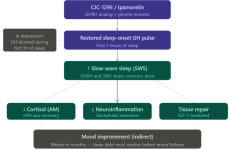
[DIAGRAM: GH-sleep-mood cascade
Shows: CJC-1295/Ipamorelin → GH pulse restored → SWS ↑ → cortisol ↓, neuroinflammation ↓, tissue repair → mood improvement (indirect)
Style: Linear cascade with three-way branch]
Depressed patients consistently show blunted GH secretion during the first three hours of sleep, coinciding with reduced slow-wave sleep. The GHRH-CRH ratio (growth-hormone-releasing hormone vs. corticotrophin-releasing hormone) appears to be a key regulator — in depression, CRH dominance suppresses both SWS and GH release.
CJC-1295 (a GHRH analog) and ipamorelin (a ghrelin-mimetic GH secretagogue) restore physiological GH pulsatility, particularly the sleep-onset pulse that is disrupted in depression. This does not directly treat depression, but it addresses one of its biological substrates: impaired restorative sleep.
Evidence tier: Human data for GH secretagogues and sleep quality. Mood effects are indirect and not studied in clinical depression trials.
Bottom line — in plain terms
Depression almost always disrupts sleep, and disrupted sleep makes depression worse — a vicious cycle. CJC-1295 and ipamorelin restore the body's natural growth hormone release pattern, which is concentrated during deep sleep. Better deep sleep means lower cortisol in the morning, reduced brain inflammation, and improved tissue repair. None of this is a direct mood effect — it is removing one of the substrates that keeps depression entrenched. If your sleep is wrecked and your mood is following it downward, fixing the sleep architecture may be a prerequisite for anything else to work. Theoretical use cases: depression with prominent sleep disruption, chronic fatigue contributing to low mood, recovery from sustained stress or overtraining.
Melanotan II and PT-141 — the melanocortin system
These compounds act on melanocortin receptors (MC3R/MC4R), which are expressed in brain regions involved in motivation, reward, and sexual behavior. Melanotan II produces libido-enhancing and tanning effects through these receptors. PT-141 (bremelanotide) is FDA-approved for hypoactive sexual desire disorder.
The melanocortin system has theoretical relevance to mood — MC4R is expressed in the amygdala and hypothalamus — but the evidence for direct antidepressant effects is thin. Libido improvement can secondarily benefit mood and self-perception, but this is not a primary mood mechanism. Both compounds carry cardiovascular risk concerns (transient hypertension, nausea) that should be weighed against marginal mood benefits.
Evidence tier: Human data for sexual function. Mood effects largely incidental and not well-characterized.
Bottom line — in plain terms
Melanotan II and PT-141 activate brain receptors involved in sexual desire, motivation, and reward. Their most noticeable effect is a significant increase in libido — and for many people dealing with depression or SSRI-induced sexual dysfunction, restored sexual function and desire can meaningfully improve self-perception, relationship quality, and overall emotional state. But this is a secondary mood effect, not a direct antidepressant mechanism. The melanocortin receptors they target are expressed in mood-relevant brain regions (amygdala, hypothalamus), but the evidence for direct antidepressant action is weak. Both compounds also carry real cardiovascular risks — transient blood pressure spikes and nausea — that should not be dismissed. Theoretical use cases: SSRI-induced sexual dysfunction contributing to low mood, loss of libido as a component of depressive symptoms, motivational deficits where sexual health is a contributing factor.
What you won't feel — and what to actually measure
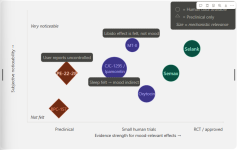
[DIAGRAM: Evidence vs. noticeability matrix
Shows: Each compound plotted on evidence strength (x) vs subjective noticeability

. Circles = human data, diamonds = preclinical only.
Style: Compound map / scatter diagram]
| Compound | Felt effect | Timeline | What to actually track |
|---|
| Semax | Subtle clarity, mild mood buffering | Days to weeks | Cognitive performance tests, mood diary |
| Selank | Reduced anxiety (most noticeable compound here) | 30–60 minutes | Anxiety self-rating scales (GAD-7, STAI) |
| PE-22-28 | Possible reduced anhedonia | Days (preclinical data) | PHQ-9 depression scores, anhedonia subscales |
| Oxytocin | Warmer social interactions, context-dependent | Hours | Social interaction quality, stress reactivity diary |
| BPC-157 | None directly mood-related | Weeks | Gut symptom logs, inflammatory markers (hsCRP) |
| CJC-1295 / Ipamorelin | Better sleep quality | Days to weeks | Sleep tracking (deep sleep %, latency), IGF-1 |
| Melanotan II | Libido increase, tanning | Hours to days | Not recommended for mood-specific tracking |
Core monitoring toolkit
Regardless of which compounds you use:
- Mood diary — daily 1–10 subjective rating, same time each day. Minimum 2 weeks baseline before starting any compound.
- Sleep metrics — track total sleep, deep sleep percentage, and sleep latency via wearable or sleep tracker.
- Anxiety scales — GAD-7 or STAI-S, weekly. These are free, validated, and take 2 minutes.
- Bloodwork — cortisol (AM fasting), DHEA-S, IGF-1 as baseline markers. Full thyroid panel (TSH, fT3, fT4) to rule out thyroid-driven mood disturbance before attributing anything to peptides.
Answering the direct questions
Can peptides improve mood and fight depression? Are there peptides that stimulate serotonin production?
Yes, with caveats. Semax increases serotonin turnover in the striatum and upregulates BDNF — both mechanisms relevant to mood and depression. PE-22-28 increases serotonin neuron firing in the dorsal raphe by blocking TREK-1 channels — mechanistically an upstream SSRI-like effect. BPC-157 normalizes serotonin synthesis rates in multiple brain regions after peripheral administration. None of these peptides "stimulate serotonin production" the way a factory increases output — they modulate the systems that regulate serotonin firing, turnover, and synthesis. The distinction matters because crude serotonin elevation is not what produces antidepressant effects; network-level changes in neuroplasticity and circuit function are what matter, and these take days to weeks to develop.
Which peptides affect the psychoemotional state? How can they help with stress, anxiety, depression, or emotional overload?
For anxiety specifically, Selank has the strongest clinical evidence and the most noticeable subjective effect — it is a registered anxiolytic in Russia with clinical trial data in GAD patients. For depression, the mechanistic evidence is strongest for Semax (BDNF + serotonin), PE-22-28 (TREK-1 → serotonin → neurogenesis), and BPC-157 (neurotransmitter normalization via gut-brain axis), though PE-22-28 and BPC-157 lack human psychiatric data entirely. For stress and emotional overload, oxytocin addresses the HPA axis directly by dampening cortisol release, and GH-axis peptides address the sleep disruption that makes stress tolerance collapse. No single peptide addresses all dimensions of psychoemotional disturbance — these systems are mechanistically distinct.
References
- Eremin KO, Kudrin VS, Saransaari P, Oja SS, Grivennikov IA, Myasoedov NF, Rayevsky KS. Semax, an ACTH(4-10) analogue with nootropic properties, activates dopaminergic and serotoninergic brain systems in rodents. Neurochem Res. 2005;30(12):1493-1500. PMID: 16362768
- Dolotov OV, Karpenko EA, Inozemtseva LS, Seredenina TS, Levitskaya NG, Rozyczka J, et al. Semax, an analogue of ACTH(4-10), binds specifically and increases levels of BDNF protein in rat basal forebrain. Neuroscience. 2006;137(2):549-558. PMID: 16635254
- Martinowich K, Bhatt AS. Interaction between BDNF and serotonin: role in mood disorders. Neuropsychopharmacology. 2008;33(1):73-83. PMID: 17882234
- Volkova A, Shadrina M, Kolomin T, Andreeva L, Limborska S, Myasoedov N, et al. Selank administration affects the expression of some genes involved in GABAergic neurotransmission. Front Pharmacol. 2016;7:31. PMID: 26941649 — Demonstrates Selank's effects on expression of 45 neurotransmission genes in frontal cortex.
- Sarkisova KY, Kozlovskii II, Kozlovskaya MM. Peptide Selank enhances the effect of diazepam in reducing anxiety in unpredictable chronic mild stress conditions in rats. Bull Exp Biol Med. 2015;159(6):729-732. PMID: 26519271
- Djillani A, Pietri M, Moreno S, Heurteaux C, Mazella J, Borsotto M. Shortened spadin analogs display better TREK-1 inhibition, in vivo stability and antidepressant activity. Front Pharmacol. 2017;8:643. PMID: 28955242 — Primary characterization of PE-22-28; IC50 0.12 nM vs 40-60 nM for spadin.
- Heurteaux C, Lucas G, Guy N, El Yacoubi M, Thümmler S, Peng XD, et al. Deletion of TREK-1, a background potassium channel, results in a depression-resistant phenotype. Nat Neurosci. 2006;9(9):1134-1141. PMID: 16906152 — Original demonstration that TREK-1 knockout mice are depression-resistant.
- Neumann ID, Slattery DA. Oxytocin in general anxiety and social fear: a translational approach. Biol Psychiatry. 2016;79(3):213-221. PMID: 26208744
- Scantamburlo G, Hansenne M, Fuchs S, Pitchot W, Maréchal P, Pequeux C, et al. Plasma oxytocin levels and anxiety in patients with major depression. Psychoneuroendocrinology. 2007;32(4):407-410. PMID: 17383107 — Negative correlation between oxytocin levels and both depression (r=−0.58) and anxiety (r=−0.61).
- Sikiric P, Roncevic J, Grgic T, Brecic P, Bjelic AV, Lovric E, et al. Pentadecapeptide BPC 157 and the central nervous system. Neural Regen Res. 2022;17(3):482-487. PMID: 34380874 — Review of BPC-157 effects on dopamine/serotonin/GABA systems and serotonin synthesis rates in nigrostriatal areas.
- Steiger A, Dresler M, Kluge M, Schüssler P. Pathology of sleep, hormones and depression. Pharmacopsychiatry. 2013;46(Suppl 1):S30-S35. PMID: 23599244 — GHRH/CRH ratio imbalance in depression affecting SWS and GH secretion.
- Sakkas PN, Soldatos CR, Bergiannaki JD, Paparrigopoulos TJ, Stefanis CN. Growth hormone secretion during sleep in male depressed patients. Prog Neuropsychopharmacol Biol Psychiatry. 1998;22(3):467-483. PMID: 9612844 — Marked decrease in GH secretion during first 3 hours of sleep in depression.