Every compound you use — testosterone, SARMs, GH, whatever it is — disrupts something else in the process. Testosterone shuts down your natural production. Growth hormone wrecks your insulin sensitivity. Hard training spikes cortisol. And none of this fixes itself automatically when you stop.
Peptides are tools for managing those disruptions. Some keep your testes functional while you're on cycle. Some make your body produce more growth hormone on its own. Others manage stress hormones or sexual function that get knocked sideways by the compounds you're already running. None of them are magic, and several of them won't make you
feel anything at all — but what they do behind the scenes shows up in bloodwork, body composition, and long-term health outcomes.
This article is organized by what matters most if you're actually using PEDs. Part 1 covers the
Peptides and hormones you're most likely to need, plus beginner and intermediate stack recommendations. Part 2 covers the heavier compounds — exogenous HGH, IGF-1 LR3, and insulin — where the stakes get significantly higher.
At a glance — sorted by how likely you are to need this
| Compound | Why it matters for PED users | You'll notice | Evidence |
|---|
| HCG | Keeps testes working on AAS/TRT | Maintained ball size, mood | Decades of clinical use |
| CJC-1295 + Ipamorelin | Boosts your natural GH output | Better sleep, recovery | Human data |
| PT-141 | Fixes libido when testosterone doesn't | Arousal within 1 hr | FDA-approved |
| GHRP-2 / GHRP-6 | Stronger GH push, but messier | Hunger spike, sleep | Human data |
| Selank | Manages stress/cortisol axis | Less anxiety, calmer | Approved drug (Russia) |
| HMG | Restores fertility after long cycles | Nothing felt | Clinical fertility use |
| MOTS-c | Counters insulin resistance from GH | Nothing felt | Preclinical + early human |
| Hexarelin | Strongest GH release, fast burnout | Strong GH surge | Human data (cardiac risk) |
| HGH Frag 176-191 | Fat loss fragment of GH | Maybe modest fat loss | Weak human data |
What you need to understand first — three systems, three problems
Your body runs three hormonal control loops that PED use directly disrupts. You don't need to memorize the biochemistry, but you do need to understand what's getting broken so you know what to fix.
Your testosterone production (HPG axis): Your brain sends a signal (LH) to your testes to make testosterone. When you inject testosterone externally, your brain detects the high levels and stops sending that signal. Your testes shrink and stop making testosterone and sperm. This is not a side effect — it's how the system works. Every single person on exogenous testosterone experiences this.
Your growth hormone output (GH/IGF-1 axis): Your pituitary releases GH in pulses, mostly at night. GH tells the liver to make IGF-1, which is the actual molecule that drives tissue repair and growth. These pulses weaken as you age.
Peptides can make them stronger again, but there's a ceiling to what your pituitary can produce.
Your stress response (HPA axis): Cortisol is your stress hormone. Short bursts are useful — chronic elevation is destructive. It directly opposes testosterone, breaks down muscle, promotes belly fat, and ruins sleep. Hard training, bad sleep, life stress, and some compounds all push cortisol up.
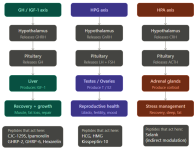
[DIAGRAM: Three hormonal axes overview Shows: HPG, GH/IGF-1, and HPA axes as three parallel flows with disruption points marked Style: three-column comparison diagram]
HCG — the one compound almost every AAS user needs
Why this comes first
If you're on testosterone replacement or cycling AAS, HCG is not optional — it's infrastructure. Without it, your testes atrophy, your intratesticular testosterone drops to near zero, and sperm production stops. These are not "potential side effects" — they are guaranteed consequences of HPG axis suppression.
What to expect
Maintained testicular size within 1–2 weeks. Better mood stability compared to running testosterone alone. If you're coming off cycle, HCG bridges the gap while your natural production restarts. Dose: typically 250–500 IU subcutaneous every 3–4 days on cycle.
How it works (plain language)
HCG mimics LH — the signal your brain normally sends to your testes. When you're on exogenous testosterone, your brain stops making LH because it thinks there's enough testosterone around. HCG replaces that missing signal directly. Your Leydig cells (the testosterone-producing cells in the testes) respond to HCG the same way they respond to real LH.
This does two important things: it keeps the testes producing their own local testosterone (which is needed for sperm production regardless of what's in your blood) and it prevents the physical atrophy that makes recovery harder when you eventually come off.
What HCG doesn't do
It does not restart your full hormonal axis. The upstream signals — GnRH from the hypothalamus, FSH from the pituitary — stay suppressed while you're on exogenous testosterone. HCG is a bandage on one part of the system, not a fix for the whole thing. That's why PCT protocols add SERMs (clomiphene, tamoxifen) to address the upstream suppression.
The timing debate
On-cycle use (recommended approach): 250–500 IU every 3–4 days throughout your cycle. Rationale: it's easier to maintain testicular function than to restart it from complete shutdown. A 2023 survey of 470 AAS users found that those who used PCT reported significantly reduced withdrawal symptoms compared to those who didn't.
PCT-only use: Some protocols reserve HCG for the first 2 weeks of PCT, then transition to SERMs. This works, but the testes may have atrophied more during the cycle, making recovery slower.
Evidence tier: Decades of clinical use in fertility medicine. Well-established mechanism. The most evidence-backed compound on this list.
CJC-1295 + Ipamorelin — the standard GH peptide stack
Why athletes use it
What to expect
Deeper sleep is usually the first thing people notice, within 1–2 weeks. Improved recovery between training sessions at 2–4 weeks. Gradual body composition changes (less fat, slightly fuller muscles) over 2–3 months. You will not feel a "GH rush." Track progress via IGF-1 blood levels and body composition, not by feel.
This is the most commonly used growth hormone peptide combination, and for good reason: it works from two angles with minimal side effects.
How they work together
Your pituitary releases growth hormone in response to two signals, and each of these peptides mimics one of them:
CJC-1295 (no DAC) mimics GHRH — the "go" signal. It binds to the GHRH receptor on your pituitary and tells it to release GH. Think of it as pressing the button.
Ipamorelin mimics ghrelin's effect on the GHSR-1a receptor — the "amplifier." It makes the pituitary's response to that button-press bigger. The key advantage of ipamorelin over older peptides like GHRP-6 is
selectivity: it boosts GH without significantly raising cortisol, prolactin, or appetite.
Together, you get a GH pulse larger than either compound alone. The practical result is higher IGF-1 levels (typically raising from ~150 to ~250 ng/mL in most users), which improves recovery, fat metabolism, and sleep quality.
What this won't do
This stack works within the limits of what your pituitary can produce. If you're expecting exogenous HGH-level results, you won't get them. A healthy pituitary under maximum peptide stimulation cannot match 4 IU of pharmaceutical somatropin. What you get instead is a meaningful improvement in GH output with a fraction of the side effects and cost.
Typical protocol: 100 µg CJC-1295 (no DAC) + 100–200 µg ipamorelin, subcutaneous, before bed. Some users add a second dose pre-workout.
Evidence tier: Multiple human studies. Well-characterized pharmacology. The most data-supported GH peptide combination.
PT-141 (Bremelanotide) — when testosterone fixes the plumbing but not the wiring
Why PED users need this
What to expect
Noticeable increase in sexual desire and arousal within 45–60 minutes of subcutaneous injection. This is not Viagra — it works on your brain, not your blood vessels. Nausea affects roughly 40% of users (usually mild, decreases after first uses). Standard dose: 1.75 mg, max once per 24 hours.
Here's a scenario most PED users will recognize: your testosterone levels are optimized (naturally or via TRT), your estradiol is managed, and you still have reduced libido or arousal. Blood flow isn't the issue — PDE5 inhibitors (sildenafil, tadalafil) help mechanically, but desire itself is flat.
This happens because libido is not just hormonal. It's also neurological — specifically, it depends on dopamine activity in specific brain regions. PT-141 addresses this directly.
How it works
PT-141 activates melanocortin-4 receptors (MC4R) in the hypothalamus — the part of the brain that governs sexual desire and motivation. This triggers dopamine release in the medial preoptic area, which is mapped to
wanting sex, not just
being able to have it.
This is fundamentally different from how PDE5 inhibitors work. Sildenafil makes blood flow to the penis easier after you're already aroused. PT-141 generates the arousal itself. In clinical trials, 67% of men on PT-141 reported improved erections vs. 33% on placebo. In men who didn't respond to sildenafil, 62% still improved with PT-141.
Caution
PT-141 causes transient blood pressure increases. If you have uncontrolled hypertension or cardiovascular disease, this is a real contraindication. Combining PT-141 with sildenafil works (stronger combined effect) but stacks cardiovascular risk.
Evidence tier: FDA-approved as Vyleesi for women. Phase II trials in men. Strong mechanistic and clinical support.
GHRP-2 and GHRP-6 — more GH output, more side effects
When the standard stack isn't enough
What to expect
Both hit harder than ipamorelin for raw GH release. The trade-off: GHRP-6 causes significant hunger (useful for bulking, terrible for cutting). GHRP-2 is slightly cleaner but still raises cortisol and prolactin. Both cause water retention. Effects are felt same day.
These are older ghrelin receptor agonists that work on the same receptor as ipamorelin but are less selective — they activate related hormonal pathways that ipamorelin leaves alone.
GHRP-6: The appetite stimulation is dramatic. This is a genuine benefit if you're in a surplus phase and struggle to eat enough. During a cut, it's a liability. It also raises cortisol and prolactin, which you're probably trying to manage if you're on other compounds.
GHRP-2: Middle ground between ipamorelin and GHRP-6. Stronger GH release than ipamorelin, less appetite stimulation than GHRP-6, but still less selective than ipamorelin on cortisol and prolactin.
The desensitization problem
All GHRPs can downregulate the ghrelin receptor with continuous use. Common cycling approaches (5 on / 2 off) are used to mitigate this, but optimal protocols aren't established in human trials. Hexarelin is the worst offender — it desensitizes within 2–4 weeks (covered below).
Hexarelin — strongest but shortest useful window
Hexarelin produces the largest acute GH spike of any secretagogue. It also desensitizes the ghrelin receptor faster than any other GHRP, making it useless for sustained protocols. Worse, it activates CD36 receptors, which causes coronary vasoconstriction (narrowing of blood vessels around the heart). This effect is mechanistically inseparable from its cardioprotective PPARγ signaling — you can't get one without the other. For anyone with cardiovascular risk factors, hexarelin is a poor choice.
Evidence tier: Well-studied in humans. Decades of pharmacological data.
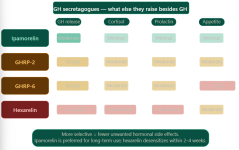
[DIAGRAM: GH peptide selectivity comparison Shows: four GH secretagogues compared on GH release, cortisol, prolactin, and appetite — showing ipamorelin as most selective Style: comparison table with risk indicators]
Selank — managing the axis nobody talks about
Why cortisol management isn't optional
What to expect
Reduced baseline anxiety within 3–7 days. You'll likely feel "less reactive" to stress — not sedated, just steadier. Intranasal delivery. Sleep quality often improves as a secondary effect.
Most PED discussions focus on testosterone and GH while ignoring cortisol entirely. This is a mistake. Chronically elevated cortisol suppresses GnRH (lowering your testosterone), impairs GH secretion, promotes visceral fat storage, breaks down muscle tissue, and destroys sleep quality. If you're training hard, sleeping poorly, and stressed, your cortisol is working against everything else you're doing.
How Selank works
Selank is a synthetic peptide derived from tuftsin (a natural immune-modulating peptide). It's approved in Russia as a prescription drug for generalized anxiety disorder. It modulates GABA-A receptors — the same system benzodiazepines target — but through allosteric modulation rather than direct agonism. The practical difference: it enhances your brain's own calming signals without causing sedation, dependence, or cognitive impairment.
It also stabilizes enkephalins (your body's natural anti-anxiety peptides) by inhibiting the enzyme that breaks them down. Under chronic stress, this enzyme becomes overactive, meaning your natural calming signals get degraded faster. Selank slows that degradation.
For PED users: Selank doesn't directly lower cortisol. What it does is reduce the perceived stress load that drives HPA axis activation. The cortisol reduction is a downstream consequence. This makes it a gentler and more sustainable approach than direct cortisol blockers.
Evidence tier: Human clinical trial data. Approved anxiolytic in Russia. Preclinical data on GABA modulation.
HMG — when you need fertility back
What to expect
You won't feel this working. It's tracked through semen analysis and hormone panels. HMG provides both LH and FSH activity, making it more complete than HCG alone for fertility restoration.
HMG matters specifically for athletes coming off long AAS cycles who want to have children. HCG covers the testosterone production side (via Leydig cells), but FSH — which drives the Sertoli cells that support sperm development — remains suppressed. HMG addresses both.
If your only concern is testicular maintenance during a cycle, HCG alone is typically sufficient. HMG becomes relevant when fertility is an active goal, particularly after extended suppression where both LH and FSH need to be restored.
Evidence tier: Established clinical use in fertility medicine.
MOTS-c — metabolic insurance
What to expect
Nothing subjectively. MOTS-c works on insulin sensitivity and metabolic flexibility at the cellular level. Track via fasting insulin, HOMA-IR, and glucose tolerance testing.
MOTS-c is a 16-amino-acid peptide encoded in mitochondrial DNA. Your body naturally produces more of it during exercise — skeletal muscle levels increase roughly 12-fold after physical activity.
Why PED users should care
Anyone running GH peptides or exogenous HGH is pushing their GH/IGF-1 levels up. Elevated GH directly impairs insulin sensitivity. MOTS-c activates AMPK (the same metabolic pathway exercise activates), which promotes glucose uptake and fat oxidation — potentially counterbalancing the insulin resistance that GH elevation creates.
The research is promising but early. Mouse studies show MOTS-c improves insulin sensitivity, reduces myostatin (which limits muscle growth), and reverses age-related metabolic decline. Human correlational data supports the direction. No large RCTs exist yet.
Evidence tier: Strong preclinical. Early human data. No large clinical trials.
Beginner and intermediate stack recommendations
Beginner: On TRT or first AAS cycle
Goal: Maintain testicular function, optimize recovery, manage basics.
| Compound | Dose | Timing | Why |
|---|
| HCG | 250 IU | Every 3–4 days, subcutaneous | Keeps testes functional while HPG axis is suppressed |
| CJC-1295 (no DAC) + Ipamorelin | 100 µg + 100 µg | Before bed, subcutaneous | Improves GH output → better sleep and recovery |
Monitoring: Total testosterone, free testosterone, estradiol (sensitive), LH/FSH, IGF-1, fasting glucose, lipid panel, CBC with hematocrit. Baseline before starting, then 6–8 weeks in.
Notes: This is the minimum effective stack. HCG is non-negotiable if you care about testicular function or future fertility. CJC/Ipa is optional but low-risk and adds genuine recovery benefit. Get your diet, sleep, and training locked in before adding more compounds — those variables still matter more than any peptide.
Intermediate: Multiple compounds, managing side effects
Goal: Optimize GH axis, manage cortisol, address libido if needed, metabolic protection.
| Compound | Dose | Timing | Why |
|---|
| HCG | 250–500 IU | Every 3–4 days | Testicular maintenance (same as above) |
| CJC-1295 (no DAC) + Ipamorelin | 100 µg + 200 µg | Before bed + optional pre-workout | GH optimization |
| Selank | 300–600 µg | Intranasal, daily | Cortisol/stress management |
| PT-141 | 1.75 mg | As needed, 45 min before activity | If libido is flat despite optimized hormones |
| MOTS-c | 10 mg | Subcutaneous, 3× per week | Metabolic protection if running GH peptides |
Monitoring: All beginner markers plus: fasting insulin, HOMA-IR, prolactin, AM cortisol (fasted). Every 8–12 weeks.
Notes: Selank should be considered if you're in a high-stress period or noticing poor sleep and elevated resting heart rate —
these are cortisol signatures. PT-141 is as-needed, not daily. MOTS-c is insurance against the insulin resistance that GH elevation causes; if your fasting insulin and glucose are fine without it, you can skip it.
What you won't feel — and what to actually measure
| Compound | What you'll feel | Timeline | What to track instead |
|---|
| HCG | Maintained ball size, mood | 1–2 weeks | LH/FSH, semen analysis |
| CJC-1295 + Ipamorelin | Better sleep, recovery | 2–4 weeks | IGF-1, body comp (DEXA) |
| PT-141 | Arousal increase | 45–60 min | Self-reported function |
| GHRP-2 / GHRP-6 | Hunger, sleep improvement | Same day | IGF-1, prolactin |
| Selank | Reduced anxiety | 3–7 days | AM cortisol, sleep tracking |
| HMG | Nothing | Weeks–months | Semen analysis, FSH |
| MOTS-c | Nothing | Weeks–months | Fasting insulin, HOMA-IR |
| Hexarelin | GH surge (short-lived) | Immediate | IGF-1, cardiac markers |
References
- Teichman SL, Neale A, Lawrence B, et al. Prolonged stimulation of growth hormone (GH) and insulin-like growth factor I secretion by CJC-1295, a long-acting analog of GH-releasing hormone, in healthy adults. J Clin Endocrinol Metab. 2006;91(3):799-805. PMID: 16352683
- Raun K, Hansen BS, Johansen NL, et al. Ipamorelin, the first selective growth hormone secretagogue. Eur J Endocrinol. 1998;139(5):552-561. PMID: 9849822
- Wenker EP, Dupree JM, Langille GM, et al. The use of HCG-based combination therapy for recovery of spermatogenesis after testosterone use. J Sex Med. 2015;12(6):1334-1337. PMID: 25904023 Clinical evidence for HCG-based fertility restoration after exogenous testosterone
- Smit DL, de Ronde W, Voogel AJ, van den Heuvel MR. The use of post-cycle therapy is associated with reduced withdrawal symptoms from anabolic-androgenic steroid use: a survey of 470 men. J Endocr Soc. 2023;7(12):bvad145. PMID: 37951896
- Kasian A, Kolomin T, Andreeva L, et al. Peptide Selank enhances the effect of diazepam in reducing anxiety in unpredictable chronic mild stress conditions in rats. Behav Neurol. 2017;2017:5091027. PMID: 28280289
- Lee C, Zeng J, Drew BG, et al. The mitochondrial-derived peptide MOTS-c promotes metabolic homeostasis and reduces obesity and insulin resistance. Cell Metab. 2015;21(3):443-454. PMID: 25738459
- Reynolds JC, Lai RW, Woodhead JST, et al. MOTS-c is an exercise-induced mitochondrial-encoded regulator of age-dependent physical decline and muscle homeostasis. Nat Commun. 2021;12:470. PMID: 33473109
- Diamond LE, Earle DC, Rosen RC, et al. Double-blind, placebo-controlled evaluation of the safety, pharmacokinetic properties and pharmacodynamic effects of intranasal PT-141, a melanocortin receptor agonist, in healthy males and patients with mild-to-moderate erectile dysfunction. Int J Impot Res. 2004;16(1):51-59. PMID: 14963471