Most of the side effects people fear from
Peptides are either exaggerated, misattributed, or completely made up. And most of the side effects people ignore are the ones that actually matter.
This article exists because the peptide conversation has a signal-to-noise problem. On one side, vendors and clinics downplay real risks to sell product. On the other, media outlets and social media accounts manufacture fear around mechanisms they don't understand. Neither is useful. What's useful is knowing which side effects are mechanistically expected, which are dose-dependent and manageable, which are theoretical but unconfirmed, and which are outright fabrications.
The answer depends almost entirely on which compound class you're using. A GH secretagogue, a GLP-1 receptor agonist, and a healing peptide like BPC-157 have almost nothing in common pharmacologically — grouping them under "
Peptides" and asking about "peptide side effects" is roughly as useful as asking about "pill side effects."
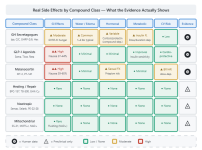
DIAGRAM: Side Effect Classification Matrix
Shows: Real side effects mapped by compound class across GI, water/edema, hormonal, metabolic, CV risk, and evidence level
Style: Evidence matrix / risk table
Overview: Side effects by compound class
| Compound Class | Main side effects | Severity | Evidence Level |
|---|
| GH Secretagogues (Ipamorelin, CJC-1295, GHRP-2/6, Hexarelin) | Water retention, carpal tunnel, insulin resistance, hunger (GHRP-6) | Mild–moderate, dose-dependent | Human clinical data |
| GLP-1 Agonists (Semaglutide, Tirzepatide, Retatrutide) | Nausea, vomiting, constipation, diarrhea, fatigue | Moderate–severe early, resolves | Extensive RCT data |
| Melanocortin (Melanotan II, PT-141) | Nausea, flushing, mole changes, priapism, BP/HR changes | Moderate, dose-dependent | Limited human trial data |
| Healing / Repair (BPC-157, TB-500, GHK-Cu) | Injection site reactions | Minimal | Preclinical only |
| Nootropic (Semax, Selank, PE-22-28) | None consistently reported | None–minimal | Preclinical + Russian clinical (Semax/Selank) |
| GH / IGF-1 Direct (Somatropin, IGF-1 LR3) | Insulin resistance, edema, joint pain, carpal tunnel | Moderate–significant | Extensive human data |
The side effects that are real — and why they happen
GH Secretagogues — water retention, carpal tunnel, and insulin resistance
What to expect
If you use a GH secretagogue (Ipamorelin, CJC-1295, GHRP-2, GHRP-6, Hexarelin), expect 1–4 pounds of water weight in the first two weeks. You may notice puffier hands in the morning, mildly swollen ankles in the evening, or a fuller face. This is not a sign that something is wrong — it's a direct consequence of elevated GH. In most users, compensatory sodium excretion kicks in within 2–3 weeks and the water retention stabilizes or partly resolves. Carpal tunnel symptoms (tingling in thumb, index, and middle fingers) occur in a subset of users on longer protocols and are dose-dependent.
The mechanism is straightforward. Growth hormone increases sodium reabsorption in the kidneys, which pulls water into the extracellular compartment. Clinical studies in athletes show approximately 1.8 kg of extracellular water gain in males and 1.2 kg in females during GH exposure. This is a class effect — it happens with exogenous GH too, and secretagogues produce a milder version because the pituitary's somatostatin feedback limits how high GH can go.
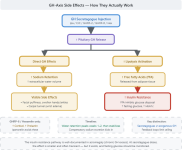
DIAGRAM: GH-Axis Side Effect Mechanism
Shows: GH secretagogue → pituitary GH release → two branches: sodium/water retention (→ edema, carpal tunnel) and lipolysis (→ FFA → insulin resistance)
Style: Flowchart / dual-pathway
The insulin resistance pathway is the one that gets less attention but matters more long-term. GH activates lipolysis — fat breakdown — which releases free fatty acids into circulation. Those FFAs interfere with glucose disposal in muscle tissue, producing a mild insulin-resistant state. In acromegaly (chronic pathological GH excess from a pituitary adenoma), this leads to frank diabetes. At secretagogue doses, the effect is smaller and often transient, but it is real and measurable: fasting glucose rises slightly, and HbA1c can creep up on long protocols. Monitor it.
Compound-specific differences matter here. GHRP-6 and hexarelin stimulate cortisol and prolactin release alongside GH — GHRP-6 also drives significant appetite increases through direct ghrelin receptor activation. Ipamorelin was designed specifically to avoid these off-target effects: it produces a cleaner GH pulse with negligible cortisol or prolactin elevation. CJC-1295 (no DAC), as a GHRH analog rather than a ghrelin mimetic, also avoids cortisol/prolactin effects. The choice of secretagogue determines half the side effect profile.
Hexarelin adds another layer of complexity. Its CD36 receptor activation produces both PPARγ-mediated cardioprotection and coronary vasoconstriction — effects that are mechanistically inseparable. This has been covered in detail in the cardiovascular support article.
Evidence tier: Multiple human studies on GH effects; individual secretagogues have varying levels of clinical data. Ipamorelin and CJC-1295 have the most clinical use history.
GLP-1 Agonists — nausea is the price of admission
What to expect
Nausea is the dominant side effect and occurs in 37–44% of semaglutide users. It peaks during dose escalation (weeks 2–8) and in most cases resolves or becomes manageable by weeks 12–16. About 4.3% of clinical trial participants discontinued due to GI effects. Constipation and diarrhea also occur. These are not signs of toxicity — they are direct GLP-1 receptor effects on gastric motility and central appetite circuits.
GLP-1 receptor agonists (semaglutide, tirzepatide, retatrutide) slow gastric emptying and activate nausea circuits in the brainstem — this is a direct pharmacological effect, not an adverse reaction in the traditional sense. The GI symptoms are the mechanism at work. Tirzepatide may produce somewhat fewer GI side effects than semaglutide at equipotent weight-loss doses, likely because its GIP co-agonism partially counteracts the GLP-1-driven nausea signaling — preclinical data in shrews shows GIP receptor activation blocks emesis from GLP-1R activation while maintaining reduced food intake.
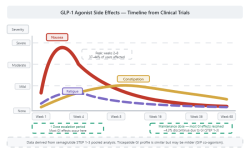
DIAGRAM: GLP-1 Side Effect Timeline
Shows: Severity curves for nausea, constipation, and fatigue across 68 weeks, with dose escalation period marked
Style: Timeline / line chart
The other major side effects — pancreatitis risk (rare but real, reported in post-marketing surveillance), thyroid concerns (C-cell tumors in rodents, not confirmed in humans), and gallbladder issues — exist in the clinical literature but at low incidence rates and primarily in the diabetic population studied in pivotal trials.
Evidence tier: Extensive Phase 3 RCT data (STEP, SURPASS, SURMOUNT trials). Semaglutide and tirzepatide have the most comprehensive human safety datasets of any compounds discussed in this wiki.
Melanocortin peptides — the non-selective problem
What to expect
Melanotan II produces nausea in 30–65% of users (dose-dependent), facial flushing, appetite suppression, and — in males — spontaneous erections that can last hours. Mole darkening occurs in nearly all users and persists after the tan fades. These are not bugs — they are direct consequences of hitting five melanocortin receptor subtypes instead of one.
Melanotan II is a non-selective melanocortin agonist. It hits MC1R (pigmentation), MC3R (energy homeostasis), MC4R (appetite and sexual function), and MC5R (sebaceous glands), producing a constellation of effects that users often don't anticipate. The nausea is MC4R-mediated and is worst at loading doses. The sexual effects (priapism in males, increased arousal in females) are MC4R/MC3R-mediated. PT-141 (bremelanotide), a derivative, was designed to isolate the MC4R sexual function effect and has FDA approval for hypoactive sexual desire disorder — its side effect profile is narrower but still includes nausea and flushing.
The more serious concern with MT-II is dermatological. Case reports document melanoma emerging during or after MT-II use (Hjuler et al., 2014; Brennan et al., 2017). Whether MT-II caused those melanomas or simply made pre-existing lesions more visible is unresolved. What is established: MT-II stimulates melanocyte proliferation and makes clinical melanoma surveillance harder because drug-induced mole changes mimic the warning signs dermatologists screen for.
Cardiovascular effects — transient increases in heart rate and blood pressure — are documented at standard doses and are not clinically significant in healthy users, but become relevant in users with pre-existing hypertension or cardiovascular disease.
Evidence tier: One Phase I clinical trial (Dorr et al., 1996). Multiple case reports on adverse events. No long-term safety data.
Healing and repair peptides — the quiet ones
What to expect
BPC-157, TB-500, and GHK-Cu have minimal reported side effects in the published literature. Injection-site irritation (redness, mild stinging) is the most common complaint. You will not feel BPC-157 or GHK-Cu working — their effects (tissue repair, collagen remodeling) are not subjectively perceptible.
The near-absence of reported side effects from healing
Peptides is partly genuine (these are small peptides with narrow targets) and partly an artifact of having almost no controlled human safety data. BPC-157's side effect profile looks clean in 30+ years of preclinical research — but those are rat and mouse studies, conducted overwhelmingly by one research group (Sikiric et al.), and the longest human exposure data comes from small, unblinded clinic trials.
This does not mean these peptides are dangerous. It means the safety profile is incomplete. The distinction matters.
Evidence tier: BPC-157 — preclinical only, no published Phase 2/3 data. TB-500 — limited Phase 2 human data (generally well-tolerated). GHK-Cu — topical safety established; injectable data limited.
The myths — and where they come from
"BPC-157 causes cancer"
This is the most viral peptide safety claim and the most poorly evidenced. The logic chain runs: BPC-157 promotes angiogenesis → tumors need blood vessels → therefore BPC-157 feeds tumors. Each step is individually true, but the conclusion doesn't follow from the premises.
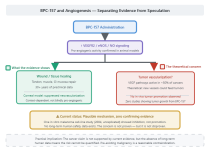
DIAGRAM: BPC-157 Angiogenesis — Evidence vs Speculation
Shows: Dual pathway from BPC-157's VEGFR2 activation — left branch (documented healing) vs right branch (theoretical tumor concern), with current evidence status
Style: Dual-pathway diagram
The actual evidence: no preclinical study has shown BPC-157 causing or accelerating tumor growth. A corneal injury model (PMID 25912999) showed BPC-157
suppressing neovascularization in that context — suggesting context-dependent angiogenic behavior rather than blanket pro-angiogenic action. A 2004 in vitro study on melanoma cell lines showed growth inhibition, not promotion. The Sikiric group argues this demonstrates anti-tumor properties; independent reviewers (Józwiak et al., 2025) correctly note that a single unreplicated in vitro study is insufficient to support anti-cancer claims.
The honest status: BPC-157 activates VEGFR2 signaling. VEGF pathways are active in roughly half of human cancers. The theoretical mechanism for tumor vascularization exists. Zero confirming in vivo evidence exists. No long-term human data exists to settle the question. Pre-existing malignancy is a reasonable contraindication — not because the risk is proven, but because the data to exclude it doesn't exist.
"GH peptides will give you acromegaly"
This is mechanistically implausible. Acromegaly requires sustained, unregulated GH secretion — typically from a pituitary adenoma that produces GH continuously, bypassing somatostatin feedback. GH secretagogues work
through the pituitary and are subject to somatostatin feedback — the same negative feedback loop that prevents endogenous GH from reaching pathological levels. A secretagogue cannot override this ceiling. You will not develop acromegalic bone changes from ipamorelin.
That said, chronic supraphysiological IGF-1 levels from aggressive secretagogue stacking are not benign. They can produce soft tissue changes (the "GH look" — thickened skin, slightly enlarged features over years) and metabolic consequences. This is not acromegaly — it's a milder version of chronic GH elevation that resolves when use stops.
"GLP-1 agonists destroy all your muscle"
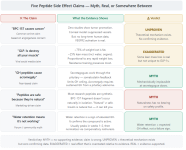
DIAGRAM: Myth vs Reality Comparison
Shows: Five common claims with the actual evidence and verdict (Myth / Exaggerated / Unproven)
Style: Three-column comparison
This claim exploded on social media and contains a real kernel inside a large exaggeration. In clinical trials, approximately 25% of total weight lost on semaglutide and tirzepatide is lean mass — which includes muscle but also water, organ tissue, and connective tissue. Roughly 75% of weight lost is fat. This ratio is consistent with any rapid weight loss method — it is not unique to GLP-1 agonists.
A 2024 systematic review of tirzepatide specifically found that reductions in fat-free muscle volume were small and within expected ranges based on UK Biobank reference data, and that muscle fat infiltration actually improved (less intramuscular fat). The framing of "muscle destruction" is not supported by the evidence.
The real concern: in sedentary, older, or protein-deficient individuals losing large amounts of weight rapidly, the absolute lean mass loss can be functionally significant — equivalent to roughly 20 years of age-related muscle loss over 68 weeks. This is a genuine clinical concern. It is addressed by adequate protein intake and resistance training, not by avoiding GLP-1 agonists.
"Peptides are safe because they're natural"
Most research peptides are synthetic. BPC-157 is a 15-amino-acid fragment of a larger protein found in gastric juice — the fragment itself does not occur naturally in isolation. Melanotan II is a synthetic analog of α-MSH. Ipamorelin is entirely synthetic. Even compounds that mimic endogenous peptides are pharmacological agents with dose-response relationships, off-target effects, and potential for harm.
Insulin is natural. It kills people. "Natural" is not a safety category.
The risk nobody talks about enough — what's in the vial
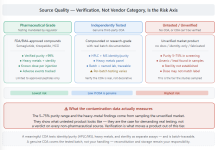
DIAGRAM: Source Quality Tiers
Shows: Three-tier comparison by verification status (pharmaceutical / independently tested / untested), with the contamination data attached to the untested tier
Style: Three-column comparison with risk callout
The variable that actually predicts contamination is not which legal category a product falls into — it's whether that specific product was independently tested. This distinction gets lost in most "peptides are dangerous" coverage, which treats everything outside a pharmacy as uniformly toxic. The data doesn't support that framing.
Here is what the data does show. A systematic screening of the ten most commonly sold peptides on the unregulated Belgian market found purity ranging from 5% to 75%, and multiple samples exceeded injectable safety limits for arsenic and lead. A separate analysis of online "research chemical" peptides found some samples containing less than 50% of the labeled content. Critically, these studies sampled the
unverified end of the market — vendors selling without meaningful third-party analysis. They demonstrate what happens with untested product. They are not a measurement of every non-pharmaceutical source, and they are precisely the reason independent testing exists.
Why this matters at the injection site: when you inject subcutaneously, you bypass every protective barrier your body has — skin, gut lining, first-pass hepatic metabolism. Whatever is in the vial enters circulation directly. A meaningful fraction of "side effects" reported in community forums — unusual injection-site reactions, systemic inflammatory responses, inconsistent potency — may not be reactions to the peptide at all, but to contaminants, residual synthesis solvents, or endotoxin in an unverified product.
This is why verification, not vendor category, is the axis that matters. A research-grade or compounded peptide accompanied by genuine third-party analysis sits in a very different risk tier than an identical-looking vial with no documentation.
What a meaningful COA actually contains
A certificate of analysis (COA) is only useful if it tests the things that can hurt you, and if it's real. The difference between a meaningful COA and a decorative one:
- Identity and purity — by HPLC, ideally confirmed by mass spectrometry. This tells you the vial contains the peptide claimed, at the stated purity (reputable analysis typically reports >98%). A COA showing only a chromatogram peak with no purity percentage is incomplete.
- Heavy metals panel — separate testing for arsenic, lead, cadmium, mercury. Purity testing does not cover this; it's a distinct assay. Its absence is the single most common gap.
- Sterility / endotoxin — relevant for injectables; again a separate test from purity.
- Batch-specific and traceable — the COA should reference the lot number on your vial and come from a named, independent lab you can verify, not an unsourced PDF. Fabricated COAs exist; a lab name and batch you can cross-check is what separates a real one.
The limits of even a good COA
Verification reduces risk; it does not eliminate it. A COA covers the batch that was tested, which is not necessarily the vial in your hand if the vendor doesn't test per-batch. Reconstitution and storage introduce their own variables — bacteriostatic water choice, contamination during handling, degradation from temperature or light. And a clean purity result says nothing about whether the dose is appropriate for you. Source quality is the largest single variable in your risk profile, more than the peptide's pharmacology itself — but it is a floor, not a guarantee.
What you won't feel — and what to actually measure
| Compound | Felt effect | Timeline | What to actually track |
|---|
| Ipamorelin / CJC-1295 | Better sleep (subtle), water retention | Days–weeks | IGF-1 levels (q8–12 weeks), fasting glucose, HbA1c |
| Semaglutide / Tirzepatide | Appetite suppression, nausea | Days | Weight, body composition (DEXA), metabolic panel |
| Melanotan II | Tanning, nausea, libido changes | Days | Dermatological exam (mole mapping baseline), BP/HR |
| BPC-157 | None | N/A | Imaging of injured tissue if available; functional assessment |
| TB-500 | None | N/A | Same as BPC-157 |
| GHK-Cu | None | N/A | Skin/wound assessment; not measurable via bloodwork |
| Semax / Selank | Mild anxiolysis (Selank), subtle focus (Semax) — or nothing | Days–weeks | Cognitive testing if desired; no standard biomarker |
| HGH Fragment 176-191 | None | N/A | Body composition; fasting glucose (confirm no IR) |
| Hexarelin | GH flush, hunger | Minutes–hours | IGF-1, cortisol, prolactin, cardiac markers (if CV risk) |
| Exogenous GH | Sleep, recovery, water retention | Days–weeks | IGF-1, fasting glucose, HbA1c, lipid panel |
| HCG / HMG | Testicular fullness (on TRT) | Days | LH/FSH (if applicable), testosterone, estradiol |
Core monitoring toolkit
Regardless of which peptide you're using, the following should be your baseline and periodic monitoring panel:
- Fasting glucose + HbA1c — any GH-axis compound can move these
- IGF-1 — confirms GH-axis compounds are active; target 70–200 ng/mL
- Lipid panel — baseline and periodic
- CBC with hematocrit — especially if combining with AAS
- Comprehensive metabolic panel — liver, kidney function
- Dermatological screening — mandatory before and during any melanocortin use
References
- Wilding JPH, Batterham RL, Calanna S, et al. Once-weekly semaglutide in adults with overweight or obesity. N Engl J Med. 2021;384(11):989–1002. PMID: 33567185
— STEP 1 pivotal trial; primary source for semaglutide GI side effect rates.
- Jastreboff AM, Aronne LJ, Ahmad NN, et al. Tirzepatide once weekly for the treatment of obesity. N Engl J Med. 2022;387(3):205–216. PMID: 35658024
— SURMOUNT-1 trial; tirzepatide efficacy and side effect profile.
- Prado CM, Phillips SM, Engelen MPKJ, et al. Strategies for minimizing muscle loss during use of incretin-mimetic drugs for treatment of obesity. Obesity. 2024;32(Suppl 2). PMID: 39295512
— Review of lean mass changes during GLP-1 agonist use; 25/75 lean/fat loss ratio.
- Dorr RT, Lines R, Levine N, et al. Evaluation of melanotan-II, a superpotent cyclic melanotropic peptide in a pilot phase-I clinical study. Life Sci. 1996;58(20):1777–1784. PMID: 8637402
— Phase I MT-II trial; nausea rates and dose-limiting toxicity data.
- Hjuler KF, Lorentzen HF. Melanoma associated with the use of melanotan-II. Dermatology. 2014;228:34–36. PMID: 24355990
— Case report linking MT-II use to melanoma development.
- Sikiric P, et al. Stable gastric pentadecapeptide BPC 157 as a therapy and safety key: a special beneficial pleiotropic effect controlling and modulating angiogenesis and the NO-system. Pharmaceuticals. 2025;18(10):1450.
— Sikiric group's defense of BPC-157 angiogenesis profile; claims bidirectional vessel control.
- Józwiak M, et al. Reply to Sikiric et al. — BPC 157 therapy: targeting angiogenesis and nitric oxide's cytotoxic and damaging actions. Pharmaceuticals. 2025.
— Independent rebuttal noting no in vivo tumor data exists for BPC-157; flags single-group replication concern.
- Freda PU. Insulin resistance in patients with acromegaly. Front Endocrinol. 2019;10:509. PMID: 31379749
— Comprehensive review of GH-induced insulin resistance mechanisms via lipolysis/FFA pathway.
- Gillis RB, et al. Analysis of research peptides: variability in purity and potency of online-sourced products. 2020.
— Found some grey-market peptides contained <50% labeled content.
- ScienceInsights analysis of Belgian market peptide screening. 2026.
— Systematic screening finding purity 5–75%, arsenic and lead above injectable safety limits.