Blood Tests While Using Peptides — What to Measure and Why
Most people running peptide protocols have no idea whether their compounds are doing anything measurable. They rely on how they feel — which, as the previous article covered, often tells you very little. Bloodwork is the only way to get objective data on what's actually happening inside your body.
This isn't about fear. The goal isn't to find something wrong — it's to confirm things are working, catch problems early if they arise, and have data to compare against later. A single blood test taken mid-cycle, with no baseline to compare against, tells you almost nothing. The real value is in the pattern over time.
This article covers what to test, when to test it, and what the results actually mean — organized by peptide class, since different compounds affect different systems.
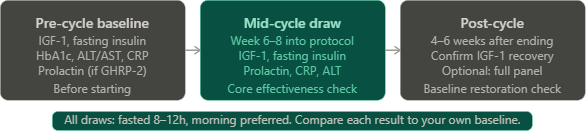
DIAGRAM: Monitoring timeline. Shows three-phase timeline: Pre-cycle baseline → Mid-cycle draw (wk 6–8) → Post-cycle
Start With a Baseline — Before You Begin
The single most common mistake is starting a protocol without any pre-cycle bloodwork. Once you're mid-cycle and something looks off, you have no way of knowing whether that change existed before you started or is protocol-related.
A useful baseline panel before any peptide use covers:
- IGF-1 (for GH-axis Peptides)
- Fasting glucose and fasting insulin (for any GH-axis peptide, and useful generally)
- HbA1c — a 3-month average of blood sugar levels
- ALT and AST — liver enzymes that indicate hepatic stress if elevated
- Prolactin (if planning to use GHRP-2, hexarelin, or GHRP-6)
- CRP (C-reactive protein) — a general marker of systemic inflammation
This panel gives you a snapshot of your metabolic health and hormonal environment before the protocol begins. Everything measured during and after the cycle can then be compared against it.
GH-Axis Peptides: The Core Monitoring Panel
Peptides covered: Ipamorelin, CJC-1295, GHRP-2, GHRP-6, Hexarelin, Sermorelin, Tesamorelin
IGF-1 — The primary effectiveness marker
When GH is secreted, it travels to the liver and signals it to produce
IGF-1 (Insulin-like Growth Factor-1 — a downstream hormone that carries out most of GH's anabolic effects on muscle, bone, and tissue). Because GH itself is released in short pulses that are gone from the blood within minutes, measuring GH directly is not practical for monitoring purposes. IGF-1, by contrast, has a half-life of around 20 hours and remains stable throughout the day, making it a reliable proxy for overall GH activity [1].
A successful GH-axis peptide cycle should produce a measurable rise in IGF-1. If IGF-1 doesn't move after 6–8 weeks of consistent use, one of the following is likely: the peptide isn't dosed correctly, the protocol timing is wrong (injecting post-meal, for example), sleep quality is suppressing the GH response, or the source is unreliable. A non-responder on paper is a diagnostic, not just a disappointment.
When to measure: Fasting, morning blood draw. Test at baseline, then at 6–8 weeks into a cycle. Testing more frequently is rarely informative.
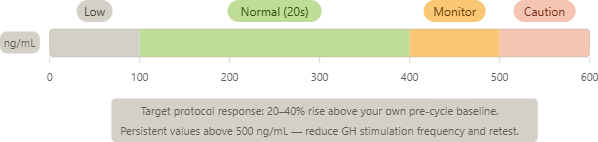
DIAGRAM: IGF-1 reference zones. Horizontal zone bar showing Low / Normal (20s) / Monitor / Caution ranges (0–600 ng/mL), with teal bracket marking typical protocol target (+20–40% above baseline
Reference ranges: Age-dependent. For adults in their 20s, roughly 150–400 ng/mL is normal; for 30s, approximately 115–355 ng/mL. Values vary by lab assay, so always compare against your own baseline rather than treating population reference ranges as hard cutoffs.
Rough thresholds — use with caution: These are not clinical limits. They're rough signals worth paying attention to, and individual variation is significant — one person's normal high-end IGF-1 is another's protocol concern depending on baseline, age, body composition, and other hormonal context.
- Target zone: A 20–40% rise above your personal baseline is what a working protocol looks like. If your baseline was 180 ng/mL and you're now at 240–250 ng/mL, that's a meaningful, likely useful response.
- Worth watching: IGF-1 above the upper age-appropriate reference range (e.g. above ~400 ng/mL for someone in their 20s). This doesn't mean stop — it means reduce frequency or dose and retest.
- Be cautious: Sustained IGF-1 above 500 ng/mL without a known clinical reason (GH deficiency treatment, etc.). Chronically supraphysiological IGF-1 carries theoretical risk around cellular proliferation. No definitive human evidence establishes a danger threshold, but this level warrants reducing stimulation.
- No movement at all: If IGF-1 is unchanged after 8 weeks, something in the protocol is wrong before you worry about over-stimulation.
Fasting glucose, fasting insulin, and HOMA-IR
Growth hormone is counter-regulatory to insulin — it competes with insulin's effects at the tissue level, particularly in fat and muscle. Elevated GH levels, whether from exogenous GH or from peptide-stimulated secretion, can reduce insulin sensitivity. Most clinical studies show that low-dose GH stimulation (similar in magnitude to peptide-induced increases) causes a rise in fasting insulin without significant changes in fasting glucose or HbA1c in healthy individuals [2]. However, this is not universal, and pre-existing insulin resistance makes the effect more pronounced.
HOMA-IR (Homeostatic Model Assessment of Insulin Resistance) is a calculated estimate of insulin resistance using fasting glucose and fasting insulin: HOMA-IR = (fasting glucose in mmol/L × fasting insulin in mIU/L) ÷ 22.5. If your lab reports glucose in mg/dL, convert first: divide by 18. You don't need a separate test — the calculation uses values you're already measuring.
HbA1c reflects average blood glucose over the previous 2–3 months. In most GH peptide users, HbA1c doesn't shift significantly even when fasting insulin rises, because the pancreas compensates [2]. But it's worth tracking as a longer-term safety check, particularly if you're running extended protocols or stacking compounds.
Rough thresholds: Again, these are population-level signals. Someone who exercises heavily may have low fasting insulin even while on a GH protocol; someone with pre-existing metabolic syndrome will hit concerning numbers faster. These numbers are a starting point for awareness, not a clinical decision tree.
- Fasting glucose: Below 5.6 mmol/L (100 mg/dL) — normal. 5.6–6.9 mmol/L (100–125 mg/dL) — impaired fasting glucose, worth watching and adjusting carbohydrate timing. Above 7.0 mmol/L (126 mg/dL) on two separate draws — clinically concerning, pause any GH-stimulating protocol.
- Fasting insulin: Below 10 mIU/L — insulin sensitive. 10–15 mIU/L — mildly elevated, review meal timing around injections. Above 20 mIU/L — meaningfully elevated; if this is new since starting the protocol, reduce GH stimulation and retest.
- HOMA-IR: Below 1.5 — good insulin sensitivity. 1.5–2.5 — moderate resistance, monitor. Above 2.5 — significant resistance; if this is a change from your baseline, take it seriously.
- HbA1c: Below 5.7% — normal. 5.7–6.4% — pre-diabetic range, be cautious with anything that further reduces insulin sensitivity. Above 6.5% — clinical diabetes territory; GH-stimulating Peptides should not be run without close metabolic monitoring.
When to measure: Fasting blood draw at baseline, mid-cycle, and post-cycle.
Prolactin and cortisol — compound-specific
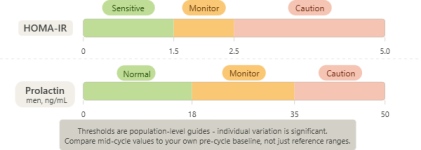
DIAGRAM: Key threshold zones. Two-row zone bar: HOMA-IR (0–5) and Prolactin/men (0–50 ng/mL), each divided into Normal / Monitor / Caution bands
Not all GHRPs are equivalent on this front.
Ipamorelin is highly selective for GH release and does not meaningfully raise prolactin, cortisol, or ACTH even at doses 200× its effective GH-releasing dose [3]. GHRH analogs like CJC-1295 and sermorelin similarly do not raise these hormones.
GHRP-2 and hexarelin are a different story. Both produce significant acute elevations in prolactin and cortisol alongside GH release — ACTH/cortisol responses to hexarelin are comparable in magnitude to corticotropin-releasing hormone in clinical studies [4]. Chronically, these acute spikes appear to diminish with repeated dosing, and 16-week studies of twice-daily hexarelin showed no sustained elevation in urinary cortisol or prolactin above baseline [5]. But the acute response is real and relevant, particularly for users concerned about cortisol's effects on sleep, recovery, and muscle tissue.
If you're using GHRP-2, GHRP-6, or hexarelin: measure prolactin at baseline and mid-cycle. Prolactin reference ranges: roughly 2–18 ng/mL for men, 2–29 ng/mL for women (non-pregnant). These vary by lab.
Rough thresholds: Individual variation in prolactin is considerable — some people run naturally higher, some lower, and stress and sleep affect it acutely.
- Within reference range: No concern.
- Mildly above reference (e.g. 20–35 ng/mL in men): Watch for symptoms — reduced libido, mood changes. Retest in 4–6 weeks. Consider switching to ipamorelin.
- Significantly elevated (above 35 ng/mL in men, 50 ng/mL in women) sustained over multiple draws: Meaningful elevation that warrants switching compounds. Sustained hyperprolactinaemia suppresses gonadal hormone production and affects dopamine signaling. Switch to ipamorelin, which does not raise prolactin at any standard dose [3].
BPC-157 and TB-500: Liver and Inflammatory Markers
Peptides covered: BPC-157, TB-500
The monitoring rationale here is different. BPC-157 is not suspected of organ toxicity — in fact, animal studies consistently show it to be
hepatoprotective, reducing ALT and AST elevation in models of induced liver injury rather than causing it [6]. TB-500 has no known hepatic or metabolic effects of concern in preclinical data.
So why monitor? Two reasons.
First, peptide sourcing is not regulated, and contaminants in an impure product can cause the liver stress that the peptide itself doesn't. If ALT or AST rises during a BPC-157 cycle, product quality is the most likely culprit, not the compound. This is only detectable if you have a baseline to compare against.
Second, these
Peptides are used primarily for tissue repair, and the biological environment matters.
CRP (C-reactive protein) is a useful tracking marker: BPC-157's anti-inflammatory mechanisms should, over time, move CRP downward in someone with elevated baseline inflammation. If it doesn't, the systemic inflammatory state is significant enough that it may be limiting the tissue environment these peptides are trying to work in.
What to test: ALT, AST, CRP at baseline and mid-cycle. No need for extensive panels unless something looks unusual.
Rough thresholds for ALT/AST: Normal upper limit is roughly 40–56 U/L for men, 31–45 U/L for women depending on the lab. These ranges vary — always check your lab's specific reference range.
- Within reference range: No concern. Baseline variation in liver enzymes is normal.
- 1–2× upper limit of normal (ULN): Mildly elevated. Investigate sourcing quality and concurrent hepatic load (alcohol, NSAIDs, acetaminophen, high-dose niacin). Retest in 4 weeks.
- 2–3× ULN: Significant elevation. Stop the current cycle and identify the cause before resuming. This level warrants taking seriously regardless of how you feel.
- Above 3× ULN: Pause everything peptide-related and consult a physician. This level of elevation is clinically meaningful independent of context.
These thresholds apply to changes from baseline. If your ALT was already 50 U/L before starting (common in people who train hard), your interpretation shifts accordingly — which is exactly why a baseline draw matters.
Semax and Selank: Limited Direct Biomarkers
Peptides covered: Semax, Selank
This is the most difficult category to monitor biochemically. Both peptides work through neurological pathways — BDNF upregulation, GABA modulation, neurotransmitter system effects — and serum BDNF testing exists but is expensive, highly variable between labs and assays, and not standardized for this use case. A single BDNF result is nearly uninterpretable without a consistent assay method and multiple time points.
The practical monitoring approach for Semax and Selank is therefore indirect:
- Cortisol (morning serum, fasting): useful as a stress-load proxy. If you're running Semax specifically because you're in a high-stress period, tracking cortisol tells you whether the HPA axis is actually settling. A downward trend over 4–6 weeks supports the idea that stress load is reducing.
- Cognitive and mood tracking: structured, not anecdotal. Use a simple daily or weekly log: sleep quality (0–10), mood (0–10), focus/concentration (0–10), anxiety (0–10). Tracked over 6–8 weeks, a consistent pattern is more informative than any biomarker currently available for these compounds.
These peptides don't have a "did it work" blood test equivalent. The monitoring is about ruling out the obvious (cortisol remaining elevated despite attempts to manage stress) and tracking subjective outcomes systematically enough to distinguish signal from noise.
GHK-Cu: Copper and Inflammatory State
Peptides covered: GHK-Cu
GHK-Cu's mechanism depends on copper availability — the peptide binds Cu²⁺ and delivers it to enzymatic systems that require it for collagen cross-linking, antioxidant defense, and tissue repair [7]. The monitoring angle is therefore primarily nutritional.
Serum copper is measurable and straightforward. Normal range is roughly 70–140 µg/dL for adults. Subclinical low copper — not frank deficiency, but the low end of normal — may limit the copper-delivery function of GHK-Cu. This is particularly relevant for people supplementing with high-dose zinc (above ~40 mg/day zinc competes with copper absorption) or eating very low animal protein diets.
CRP is again useful here. GHK-Cu works partly through Nrf2-mediated antioxidant gene expression and has anti-inflammatory effects in tissue models. If you're running it in a context of high oxidative stress or inflammation, CRP over time is the closest available signal for whether the inflammatory environment is shifting.
There are no specific safety concerns with GHK-Cu that require monitoring beyond baseline metabolic panels.
Timing: When to Actually Draw Blood
Poor timing undermines otherwise good monitoring. A few rules:
Always fasted for morning draws. IGF-1, glucose, insulin, and HbA1c should all be collected after 8–12 hours of fasting. Eating beforehand suppresses GH and distorts glucose/insulin values.
6–8 weeks into a cycle for effectiveness markers. IGF-1 changes meaningfully over this timeframe with GH-axis peptides. Testing at week 2 is too early and will show incomplete response. Testing at week 10+ is valid but delays feedback.
Don't test during acute stressors. CRP, cortisol, glucose, and insulin are all elevated by illness, extreme training load, or sleep disruption. A blood draw taken the morning after four hours of sleep will give you stress-state values, not protocol-relevant values. Aim for a representative week.
Post-cycle baseline restoration. If you want to understand your off-cycle state, test 4–6 weeks after ending the protocol, when IGF-1 and other parameters have returned to baseline.
Summary: What to Test by Compound
| Compound class | Baseline | Mid-cycle | Post-cycle |
|---|
| GH peptides (ipamorelin, CJC) | IGF-1, fasting glucose, fasting insulin, HbA1c, ALT/AST | IGF-1, fasting glucose, fasting insulin | IGF-1 (confirm return to baseline) |
| GHRP-2 / Hexarelin | Above + prolactin, cortisol | IGF-1, prolactin, fasting insulin | IGF-1, prolactin |
| BPC-157 / TB-500 | ALT, AST, CRP | ALT, AST, CRP | Optional |
| Semax / Selank | Cortisol | Cortisol at 4–6 weeks | Optional |
| GHK-Cu | Serum copper, CRP | CRP at 6–8 weeks | Optional |
The single most important test for anyone using GH-axis peptides is IGF-1 with a pre-cycle baseline. Everything else builds on that foundation.
References
- Bidlingmaier M, Freda PU. Measurement of human insulin-like growth factor-1 in clinical samples. Anal Bioanal Chem. 2010;397(5):1713–1720. PMID: 25937392 (Supporting ref: clinical assays for IGF-1 quantification — stable marker advantage over GH)
- Jørgensen JO, Møller N, Lauritzen T, Alberti KG, Orskov H, Christiansen JS. Evening versus morning injections of growth hormone in GH deficient patients: effects on 24-hour patterns of circulating hormones and metabolites. J Clin Endocrinol Metab. 1990. — Supporting review: Savas M, Mehta S, et al. Growth hormone therapy and its relationship to insulin resistance, glucose intolerance and diabetes mellitus: a review of recent evidence. J Endocrinol Invest. 2001;24(3):196–207. PMID: 11945115
- Raun K, Hansen BS, Johansen NL, et al. Ipamorelin, the first selective growth hormone secretagogue. Eur J Endocrinol. 1998;139(5):552–561. PMID: 9849822
- Arvat E, di Vito L, Maccagno B, et al. Effects of GHRP-2 and hexarelin, two synthetic GH-releasing peptides, on GH, prolactin, ACTH and cortisol levels in man. Peptides. 1997;18(6):885–891. PMID: 9285939
- Leal-Cerro A, Torres E, Frieze-Moraes R, et al. The effect of chronic hexarelin administration on the pituitary-adrenal axis and prolactin. Clin Endocrinol. 1999;51(1):125–130. PMID: 10341859
- Vasireddi N, Mobin S, Wasyliw C, et al. Emerging use of BPC-157 in orthopaedic sports medicine: a systematic review. JBJS Open Access. 2025;10. PMC12313605 (BPC-157 hepatoprotective preclinical data, ALT/AST reduction in injury models)
- Pickart L, Margolina A. Regenerative and protective actions of the GHK-Cu peptide in the light of the new gene data. Int J Mol Sci. 2018;19(7):1987. PMC6073405