The Heavier Compounds: HGH, IGF-1, and Insulin
Part 1 covered the compounds that work
with your body's hormonal systems —
Peptides that amplify natural GH pulses, protect testicular function, and manage stress. These operate within physiological boundaries, have manageable side effect profiles, and most of them can't seriously hurt you even if you get the dosing wrong.
Part 2 is different. The compounds here bypass your natural systems entirely. You are injecting the hormone itself, at levels your body would never produce on its own. The effects are more dramatic, the body composition changes are more visible, and the risks are in a completely different category.
A clarification on terminology: exogenous HGH (somatropin) and insulin are full-size protein hormones, not
Peptides in the traditional sense. They appear here because PED-using athletes use them alongside peptide protocols, and understanding where the risk profile changes from "manageable" to "can kill you" is exactly the kind of information this wiki exists to provide.
At a glance — Part 2 compounds
| Compound | Why athletes use it | You'll notice | Risk level |
|---|
| Exogenous HGH (2–4 IU) | Body composition, recovery beyond what Peptides achieve | Fat loss, skin quality, recovery — over months | Moderate (insulin resistance, water retention) |
| Exogenous HGH (4–10+ IU) | Serious bodybuilding-level growth | All of above + joint pain, carpal tunnel, organ growth | High (requires metabolic management) |
| IGF-1 LR3 | Direct growth factor injection, skips the GH step | Muscle pump, fullness | High (cancer signal, no human trials) |
| HGH Fragment 176-191 | Fat loss without GH side effects | Possibly modest fat loss | Low (but weak evidence it works) |
| Exogenous insulin | Most powerful anabolic — nutrient forcing | Dramatic muscle fullness | Very high — can kill you from one mistake |
Exogenous HGH (Somatropin) — beyond what peptides can deliver
Why athletes move from peptides to HGH
What to expect
Fat loss and improved skin quality within 4–8 weeks. Better recovery. At 2–4 IU/day, side effects are usually limited to mild water retention and some joint stiffness. At higher doses: carpal tunnel symptoms, numbness in hands, elevated fasting glucose. Body composition changes become significant at 3+ months.
CJC-1295 + ipamorelin makes your pituitary release more of its own GH. The problem: your pituitary has a ceiling. It can only produce so much, and that ceiling drops with age. Exogenous HGH bypasses the pituitary entirely. You inject pharmaceutical-grade growth hormone, and your blood GH and IGF-1 rise to whatever the dose dictates.
This is why HGH produces results secretagogues can't match. A CJC/Ipa stack might push your IGF-1 from 150 to 250 ng/mL. Exogenous HGH at 3–4 IU/day can reach 350–500+ ng/mL. At the upper end of bodybuilding doses (8+ IU/day), you're well outside any physiological range.
Two pathways, two sets of consequences
HGH does two things in your body, and the benefits and risks split along these lines:
Direct effects (GH itself): Fat breakdown (lipolysis), water and sodium retention, insulin resistance. The fat loss is the most consistent benefit. The insulin resistance is the most important risk.
Indirect effects (via IGF-1): GH signals the liver to produce IGF-1. IGF-1 drives muscle protein synthesis, tissue repair, bone density — and cell proliferation in
all tissues, not just muscle. This is where the cancer risk signal comes from.
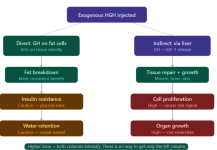
[DIAGRAM: HGH dual pathway
Shows: HGH splitting into direct fat loss/insulin resistance pathway and indirect IGF-1/tissue growth/cancer risk pathway
Style: dual-pathway branching diagram]
The side effects — what actually happens at athletic doses
Water retention and carpal tunnel (2+ IU/day): GH causes sodium retention. Puffy face, tight rings, stiff fingers. At higher doses, carpal tunnel syndrome (nerve compression from fluid buildup in the wrist) becomes common. Usually reversible when you reduce dose.
Insulin resistance (the big one): GH directly opposes insulin's ability to push glucose into cells. Your body compensates by producing more insulin. If your pancreas can't keep up, fasting glucose climbs toward pre-diabetic territory. This is predictable, dose-dependent, and the primary reason high-dose HGH users add exogenous insulin — which creates a whole new set of problems (covered below).
Acromegalic features (high dose, long-term): Growth of jaw, brow, hands, feet, and internal organs. The distended gut ("GH gut") seen in some professional bodybuilders is partly visceral organ enlargement from chronic high-dose GH + insulin. These changes are not fully reversible.
Cancer risk (theoretical but mechanistically real): Elevated IGF-1 is associated with increased colorectal, prostate, and breast cancer risk in epidemiological data. This doesn't mean HGH causes cancer. It means if pre-cancerous cells exist, more IGF-1 gives them a stronger growth signal. There is no established safe threshold.
Realistic dose-to-risk table
| Dose | Use case | What goes wrong | What to monitor |
|---|
| 1–2 IU/day | Anti-aging, mild recovery | Usually well-tolerated | IGF-1, fasting glucose, insulin |
| 2–4 IU/day | Serious body recomp | Insulin resistance likely, water retention | Above + HbA1c, lipids |
| 4–8 IU/day | Competitive bodybuilding | Carpal tunnel, acromegalic onset, significant insulin resistance | All above + consider glucose meter |
| 8+ IU/day | Pro-level bodybuilding | Often requires exogenous insulin, organ growth risk | Everything — you need full metabolic supervision |
Evidence tier: Decades of clinical data in GH-deficient patients. A systematic review in the
Annals of Internal Medicine found that GH increases lean mass but limited evidence for improved
Athletic Performance specifically. A 2022 BMC case report documented the first lethal case of acute HGH toxicity in an athlete.
IGF-1 LR3 — the downstream hormone, directly
Skipping the middleman
What to expect
Increased muscle pump and fullness. Possible hypoglycemia (IGF-1 has insulin-like activity). Joint and muscle pain are commonly reported. You won't be able to confirm it's working without blood tests, and standard IGF-1 assays may not accurately measure LR3 specifically because of its structural modifications.
Instead of injecting HGH and waiting for your liver to convert it to IGF-1, some athletes inject IGF-1 directly. IGF-1 LR3 is a modified version with an extended N-terminus and an amino acid substitution that prevents binding proteins from mopping it up. The result: an active half-life of 20–30 hours (vs. minutes for natural IGF-1) with no buffering from the normal regulatory system.
What it does
IGF-1 LR3 activates the PI3K/Akt/mTOR pathway — the same cascade that drives muscle protein synthesis. It also promotes hyperplasia (creation of new muscle cells), which is mechanistically different from what AAS alone can do (AAS primarily cause hypertrophy — enlargement of existing cells).
Why the risk is worse than it seems
Cancer: This is not a maybe. IGF-1 is a mitogen — it makes cells divide. All cells, not selectively muscle. Elevated IGF-1 is epidemiologically linked to colorectal, prostate, breast, and thyroid cancers. IGF-1 LR3, because it evades the binding proteins that normally regulate IGF-1, creates an unregulated, sustained mitogenic signal. No long-term safety studies exist in humans. This compound was developed for laboratory cell culture, not injection into people.
No human trial data: Unlike HGH (decades of clinical data), IGF-1 LR3 has essentially zero controlled human research for performance use. The evidence base is animal studies and bodybuilding self-reports. You are the experiment.
Source quality: IGF-1 LR3 is exclusively available from research chemical suppliers. There is no pharmaceutical-grade product. Purity, sterility, and accurate dosing are not guaranteed.
Evidence tier: Strong preclinical mechanistic data. Zero controlled human trials for athletic use.
HGH Fragment 176-191 — the fat-loss-only fragment
What to expect
If it works as intended: modest fat loss without the hormonal side effects of full HGH — no water retention, no insulin resistance, no IGF-1 elevation. If it doesn't work: nothing. Both outcomes are realistic possibilities based on the current evidence.
HGH Fragment 176-191 is the last 16 amino acids of the growth hormone molecule — the portion thought to be responsible for the fat-burning effect, isolated from the parts that cause insulin resistance and tissue growth.
The evidence problem
The human evidence is weak. One 3-month trial with AOD-9604 (differs by one amino acid) showed modest fat loss vs. placebo. A 2007 follow-up did not replicate the result. No large, well-controlled human trial has demonstrated clinically meaningful fat loss from this fragment alone.
Bodybuilding community reports are mixed: some users notice fat loss, many notice nothing. The placebo effect in self-reported fat loss is large.
Practical take: Low risk (benign side effect profile in limited data), but potentially low reward. A calorie-controlled diet with a GLP-1 agonist (semaglutide, tirzepatide) or even a CJC/Ipa stack has stronger evidence behind it for body composition.
Evidence tier: Preclinical data is promising. Human data is weak. Not clinically approved.
Exogenous Insulin — the compound that kills people
This section exists because harm reduction saves lives
What to expect
Dramatic nutrient uptake into muscle cells within 15–30 minutes. Massive muscle fullness when combined with high-carb, high-protein intake post-injection. If you miscalculate carbohydrate intake, dose too high, or fall asleep after injecting: seizures, coma, death. This is not theoretical. People have died.
Insulin is the most acutely dangerous PED in common use. No other compound in this wiki — or in bodybuilding generally — has the property where a single dosing error on a single day can kill you within hours.
Why it's used at all
Insulin is the most powerful anabolic hormone in the body. It drives glucose, amino acids, and fatty acids into cells. Combined with a high-protein, high-carb post-workout meal, exogenous insulin forces more nutrients into muscle tissue than your body would deliver naturally. Over time, this means more glycogen storage, fuller muscles, and — in combination with AAS and HGH — the extreme mass seen at professional levels.
There's also a direct metabolic reason: HGH causes insulin resistance (covered above). At high GH doses, your own insulin output can't keep up. Exogenous insulin "solves" this — while simultaneously adding another potent anabolic effect. This is the logic behind the AAS + HGH + insulin stack that dominates high-level bodybuilding.
How it kills
When you inject rapid-acting insulin (Humalog, Novorapid), blood sugar drops whether you've eaten enough or not. If there isn't enough glucose available, your brain — which depends entirely on glucose — stops functioning.
The progression: shakiness and sweating → confusion and slurred speech → seizures → loss of consciousness → coma → death. The window between "I feel off" and "I can't help myself" can be
15–30 minutes with rapid-acting insulin.
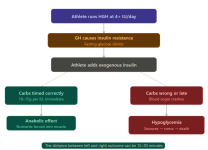
[DIAGRAM: HGH + insulin interaction and danger pathway
Shows: HGH causing insulin resistance → athlete adds insulin → two outcomes: correct carb match (anabolic effect) vs. insufficient carbs (hypoglycemia → death)
Style: flowchart with critical danger annotation]
Harm reduction — non-negotiable rules
This is not an endorsement. People use insulin for bodybuilding regardless of what any article says. Fewer deaths is better than more deaths.
Rules that are not flexible:
- Never inject insulin before sleep. Hypoglycemia during sleep is a primary cause of insulin-related death in non-diabetic users. You can't recognize symptoms while unconscious.
- Have fast-acting carbs within arm's reach. Glucose tablets, juice, candy. Not complex carbs. Minimum 10–15 grams of simple carbs per IU of insulin injected — and this is a starting approximation, not a guarantee.
- Own and use a glucometer. Check blood sugar before injection, at 30 minutes, and at 2 hours. Below 70 mg/dL (3.9 mmol/L) = eat immediately.
- Never use insulin alone. Someone nearby must know what you've taken and where the glucose source is. If you become confused, you cannot help yourself.
- Start at the lowest possible dose (2–5 IU). Assess your individual response before increasing. Sensitivity varies dramatically between individuals.
- Only use rapid-acting analogs (Humalog, Novorapid). These peak at ~1 hour and clear by ~4 hours. Long-acting insulin (Lantus, Levemir) creates a sustained hypoglycemia window that is far harder to manage and much more dangerous.
- Never combine with alcohol. Alcohol suppresses liver glucose production and masks hypoglycemia symptoms.
Monitoring
- Fasting glucose (target: 70–100 mg/dL)
- Fasting insulin levels
- HbA1c every 3 months (should stay below 5.7%)
- Glucometer readings around every injection
Evidence tier: Exhaustively characterized pharmacology from diabetes medicine. Non-diabetic bodybuilding use documented in case reports and clinical harm reduction reviews. Multiple hospitalizations and deaths reported.
Expert stack recommendation
For experienced users managing multiple compounds
Goal: Maximum body composition effect with metabolic protection and harm awareness. This assumes the user is already running AAS + the beginner/intermediate compounds from Part 1.
| Compound | Dose | Timing | Why |
|---|
| HCG | 500 IU | Every 3 days | Testicular maintenance (non-negotiable) |
| CJC-1295 + Ipamorelin | 100 µg + 200 µg | Before bed | GH optimization (may reduce or drop if running exogenous HGH) |
| Exogenous HGH | 2–4 IU/day | Morning or split AM/PM | Body composition, recovery beyond peptide capacity |
| MOTS-c | 10 mg | 3× per week, subcutaneous | Metabolic protection against GH-induced insulin resistance |
| Selank | 300–600 µg | Intranasal, daily | Cortisol management |
| PT-141 | 1.75 mg | As needed | If libido is impaired |
| HMG | Per protocol | If transitioning off for fertility | Full HPG axis restoration |
Monitoring (mandatory at this level): Total/free testosterone, estradiol (sensitive), LH/FSH, IGF-1, fasting insulin, fasting glucose, HbA1c, HOMA-IR, prolactin, AM cortisol, CBC with hematocrit, comprehensive lipid panel. Every 8–12 weeks minimum.
If adding exogenous insulin (Tier 5 — highest risk):
- All of the above monitoring, plus glucometer with every injection
- Pre-injection blood glucose check mandatory
- Fast-acting carbs physically present at every injection
- A second person aware of what you're doing and trained in basic hypoglycemia response
- Start at 2–5 IU maximum. Do not increase until you've confirmed your response over multiple sessions
- This is the only compound on this list where a mistake can kill you the same day
When to NOT escalate
If your fasting glucose is above 100 mg/dL or your HbA1c is above 5.7%, you do not add more GH and you absolutely do not add insulin. Fix the metabolic baseline first. If your blood pressure is uncontrolled, PT-141 and high-dose GH carry elevated cardiovascular risk. If your hematocrit is above 54%, adding more testosterone or GH without addressing this is inviting a stroke.
More compounds do not fix a broken foundation. Sleep, nutrition, training, and stress management still account for the majority of your results, regardless of what you're injecting.
The complete risk ladder
| Tier | Compounds | Risk | Reality check |
|---|
| 1 — Support | CJC/Ipa, Selank, MOTS-c, HGH Frag | Low | Working within your body's capacity. Hard to hurt yourself. |
| 2 — Replacement | HCG, HMG, PT-141 | Low–moderate | Replacing missing signals. Well-studied. Predictable. |
| 3 — Mild supraphysiological | HGH 2–4 IU/day | Moderate | Real metabolic consequences begin. Monitor or regret it. |
| 4 — Aggressive supraphysiological | HGH 4+ IU, IGF-1 LR3, aggressive GHRPs | High | Insulin resistance requires active management. Cancer risk signal from sustained IGF-1. |
| 5 — Lethal margin | Exogenous insulin | Very high | The only compound here where one bad day can end your life. |
The practical principle: Exhaust each tier before moving to the next. Most recreational athletes will get 80–90% of what they're after from Tiers 1–3, with a fraction of the cost, complexity, and danger of Tiers 4–5.
References
- Holt RI, Ho KK. The use and abuse of growth hormone in sports. Endocr Rev. 2019;40(4):1163-1185. PMID:31180479 Comprehensive review of GH doping — mechanisms, detection, health consequences
- Liu H, Bravata DM, Olkin I, et al. Systematic review: the effects of growth hormone on Athletic Performance. Ann Intern Med. 2008;148(10):747-758. PMID: 18347346 Meta-analysis: GH increases lean mass but limited evidence for improved Athletic Performance
- Erfanifar A, Mahjani M, Gohari S, Hassanian-Moghaddam H. Fatal overdose from injection of human growth hormone; a case report and review of the literature. BMC Endocr Disord. 2022;22(1):277. PMID: 36348360 First published lethal HGH toxicity case
- Bonnecaze AK, O'Connor T, Burns CA. Harm reduction in male patients actively using anabolic androgenic steroids (AAS) and performance-enhancing drugs (PEDs): a review. J Gen Intern Med. 2021;36(7):2055-2064. PMID: 33948794 Clinical harm reduction framework including insulin monitoring
- Kamal F, Daniels A, Ghatak PD. Severe hypoglycemia due to cryptic insulin use in a bodybuilder. J Emerg Med. 2019;56(3):e47-e49. PMID: 30527564 Case report of insulin-induced hypoglycemia in a non-diabetic athlete
- Wu Z, Ng FM. Antilipogenic action of synthetic C-terminal sequence 176-191 of human growth hormone. Biochem Mol Biol Int. 1993;30(5):945-951. PMID: 8220239 Original HGH fragment 176-191 lipolytic activity data