Article type: Thematic — multiple compound classes
Main question: Which
Peptides genuinely support cardiovascular health, which carry hidden risks, and how should that change based on your baseline?
Most people think of cardiovascular health as something managed through diet, exercise, and prescribed medication.
Peptides rarely enter that conversation. But the heart and blood vessels express receptors for a surprising range of compounds — including receptors found on cardiomyocytes (heart muscle cells), vessel-wall endothelium, and the coronary vasculature itself. This means compounds people take for entirely different reasons — GH release, body composition, tissue repair — are simultaneously acting on cardiac tissue, for better or worse.
This article maps the cardiovascular effects across the compound classes most commonly found in self-research stacks: which ones protect, which are neutral, which carry real risk, and how that risk changes depending on your cardiovascular baseline. Whether you have hypertension, LV hypertrophy from AAS use, or are in good cardiovascular health changes the picture substantially for several of these compounds.
Quick overview — what each compound does for the heart
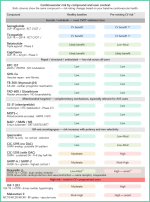

Why baseline matters more than compound identity
The same compound can be protective in one person and genuinely dangerous in another. The key variables:
- Stage 1–2 hypertension: dramatically increases sensitivity to any vasoconstrictive mechanism
- Atherosclerosis / reduced coronary lumen: removes the safety margin for coronary vasospasm
- LV hypertrophy (from AAS, chronic hypertension, or other causes): shifts any GH-axis or IGF-1 compound from adaptive to pathological
- Vasculogenic ED: a reliable clinical marker of generalized endothelial dysfunction — the same upstream problem BPC-157, GHK-Cu, and glutathione address
- Active AAS use: independently impairs cardiac mitochondrial function, making SS-31 and NAD⁺ particularly relevant
Compounds that protect and repair
These share a favorable profile across both healthy and compromised users. No vasoconstriction, no hormonal disruption. Effects are structural and slow — weeks to months, not hours.
BPC-157
BPC-157 is a 15-amino acid peptide derived from a naturally occurring sequence in gastric juice. Most people know it as a healing and tissue repair compound. Its cardiovascular relevance is less discussed but mechanistically real.
What to expect
BPC-157 produces no perceptible cardiovascular effect. You will not notice a change in blood pressure, heart rate, or exercise capacity in the short term. What it does is structural: it helps blood vessel walls dilate more effectively, supports endothelial repair, and promotes the formation of new small vessels in areas with poor blood flow. This operates over weeks to months. The practical use case for cardiovascular support is someone with documented endothelial dysfunction — often indicated by vasculogenic ED, resting hypertension, or poor peripheral circulation — used as part of a longer-term repair stack alongside GHK-Cu. Track blood pressure trends and HRV over 8–12 weeks rather than looking for an acute effect.
The central mechanism is activation of
eNOS (endothelial nitric oxide synthase — the enzyme in vessel walls that produces nitric oxide, which causes blood vessels to relax). Normally eNOS is held inactive by a protein called caveolin-1. BPC-157 releases this brake via Src kinase phosphorylation, increasing NO production and producing endothelium-dependent vasodilation — confirmed in isolated rat aorta by Hsieh et al. (2020). It also upregulates VEGFR2, a receptor that promotes the formation of new blood vessels (angiogenesis), supporting recovery in ischemic tissue.
A notable property: BPC-157 appears to normalize blood pressure in both directions — lowering it in hypertensive models, stabilizing it in hypotensive ones — suggesting modulation rather than simple vasodilation. Over 80% of BPC-157 studies originate from one research group, which limits confidence. No controlled human cardiovascular trials exist.
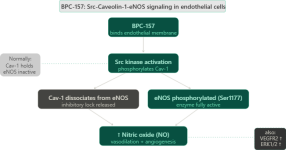
[DIAGRAM: BPC-157 eNOS activation pathway Shows: BPC-157 → Src kinase → phosphorylates Cav-1 → releases eNOS → NO production → vasodilation. Parallel branch: VEGFR2 upregulation → angiogenesis. Side note: "Cav-1 normally holds eNOS inactive — BPC-157 releases the brake." Style: Flowchart with two downstream branches]
Risk profile: Low across all user contexts.
GHK-Cu
GHK-Cu (glycyl-L-histidyl-L-lysine bound to copper) is a tripeptide present naturally in human plasma, declining from around 200 ng/mL at age 20 to about 80 ng/mL by age 60. It is widely used for skin and hair, but its cardiovascular biology is about something more fundamental: maintaining the physical structure of blood vessel walls.
What to expect
GHK-Cu produces no perceptible cardiovascular effect. Its role is slow structural maintenance. Blood vessels are built from collagen and elastin — GHK-Cu stimulates both, and counteracts the fibrotic stiffening that accumulates with chronic hypertension, aging, and AAS use. Think of it as anti-aging maintenance for vessel walls rather than an acute treatment. The payoff is measured over months, in blood pressure trends, arterial stiffness indices, and echocardiographic markers of diastolic function — not in anything you'll feel. Best used continuously as part of a long-term stack, alongside BPC-157 for endothelial function.
GHK-Cu stimulates collagen and elastin synthesis, promotes controlled tissue remodeling via MMP/TIMP enzyme regulation (enzymes that break down and rebuild extracellular matrix without excessive scarring), and drives new vessel formation through VEGF signaling. The anti-fibrotic action is most relevant for cardiovascular support: cardiac fibrosis — stiffening of the heart muscle from excess scar tissue — accumulates with chronic hypertension, aging, and AAS use. GHK-Cu works against this process.
Risk profile: Low across all user contexts.
TB-500 (thymosin β4)
TB-500 is the synthetic analog of thymosin β4 (Tβ4), a peptide naturally upregulated in cardiac tissue after injury and during fetal heart development. Among compounds in common self-research use, it has the most direct cardiac repair evidence.
What to expect
TB-500 is a non-felt compound. There is no perceptible acute effect on the cardiovascular system. Its application is as a post-injury or preventive cardiac repair support — particularly relevant for anyone who has had a cardiac event, runs high AAS loads, or is concerned about cumulative cardiac stress. The mechanism is fundamentally different from the other repair compounds: rather than working on vessel walls, it acts on the heart muscle itself, reactivating dormant stem-like cells in the outer cardiac layer. Effects operate over weeks to months. The strongest evidence comes from preclinical infarction models, where it reduced heart attack damage by 30–50%. It has reached Phase 2 human trials for ischemic heart disease — the furthest clinical progression of any compound in this category.
Tβ4 works by reactivating
epicardial progenitor cells — dormant stem-like cells in the outer cardiac layer that are normally only active during embryonic development. In adult mice, systemic Tβ4 caused these cells to divide and contribute to neovascularization and partial cardiomyocyte renewal. The downstream signaling runs through ILK (integrin-linked kinase) → Akt phosphorylation → cardiomyocyte survival under hypoxic stress. Infarct size reductions of 30–50% have been independently replicated across multiple laboratories.
Risk profile: Low. No vasoconstrictive mechanism, no hormonal effects.
TAD-600 / Glutathione
Glutathione (GSH) is the body's most abundant intracellular antioxidant — a tripeptide (Glu-Cys-Gly) produced mainly in the liver. TAD-600 is its injectable reduced form, commonly stacked alongside other performance compounds.
What to expect
Glutathione produces no perceptible cardiovascular effect. Its cardiovascular value is protective rather than therapeutic: it maintains the nitric oxide bioavailability that keeps blood vessels relaxed and blood pressure normal. The reason to use it in a performance context is straightforward — AAS use, heavy training, alcohol, and metabolic syndrome all deplete glutathione faster than the liver can regenerate it, which is one mechanism through which these factors elevate blood pressure and impair endothelial function. Restoring GSH restores the NO system. It won't lower blood pressure dramatically in someone with structural hypertension, but it removes a biochemical contributor to it. Zero cardiovascular risk. Practically the safest compound in this article.
The cardiovascular mechanism is direct:
GSH depletion → increased superoxide → superoxide scavenges nitric oxide → reduced NO bioavailability → vasoconstriction and elevated blood pressure. Restoring GSH breaks this chain. Low glutathione peroxidase-1 activity (the enzyme that uses GSH to neutralize reactive oxygen species) independently predicts cardiovascular events in CAD patients, regardless of traditional risk factors (
NEJM, 2003).
Risk profile: Essentially zero cardiovascular risk. No vasoactive properties, no hormonal effects.
Mitochondrial-targeted compounds
The heart is the highest energy-demanding organ per unit mass in the body and runs almost entirely on mitochondrial ATP production. Three compounds in common use target mitochondrial function directly, through distinct mechanisms that complement rather than duplicate each other.
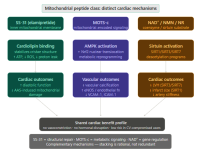
[three-column structural diagram: SS-31 / MOTS-c / NAD⁺, each column showing mechanism → cardiac outcome → shared benefit footer]
SS-31 (elamipretide)
SS-31 is a small synthetic peptide (D-Arg-Dmt-Lys-Phe-NH₂) that concentrates specifically in the inner mitochondrial membrane. If you are running AAS long-term, this compound deserves specific attention.
What to expect
SS-31 is a non-felt compound with no perceptible acute effect. Its specific application is AAS-associated diastolic dysfunction — the impaired cardiac relaxation that accumulates silently with long-term anabolic steroid use and is one of the most common cardiac consequences in this population. Long-term AAS use causes mitochondrial damage in cardiomyocytes (heart muscle cells) — specifically to a molecule called cardiolipin — which impairs the heart's energy production and relaxation capacity. SS-31 is the only compound in common self-research use that directly addresses this specific lesion. In aged mouse hearts, 8 weeks of SS-31 reversed pre-existing diastolic dysfunction — not just slowed its progression, but reversed it. Track with echocardiography (diastolic function measurements) over 3–6 months.
SS-31 binds
cardiolipin — the structural phospholipid that scaffolds the electron transport chain complexes on the inner mitochondrial membrane. Without intact cardiolipin, the respiratory complexes disorganize, electron leakage increases, ROS production rises, and ATP output falls. SS-31 stabilizes cardiolipin, restores Complex V (ATP synthase) function, reduces proton leak, and improves ADP sensitivity. SS-31 has undergone Phase 2/3 clinical trials in Barth syndrome — a genetic cardiomyopathy driven by defective cardiolipin remodeling — where it produced measurable improvements in cardiac function and exercise capacity.
Risk profile: No hemodynamic effects, no hormonal disruption. Clean safety profile at all evidence tiers.
MOTS-c
MOTS-c is a 16-amino acid peptide encoded in mitochondrial DNA — part of a recently discovered class of mitochondria-derived
Peptides (MDPs) that act as systemic stress signals. Unlike most peptides discussed in this space, it is encoded not in the cell's nucleus but in the mitochondria themselves, and it travels to other tissues to regulate metabolism and vascular function.
What to expect
MOTS-c produces no perceptible acute cardiovascular effect. It works as a metabolic signaling molecule that improves how endothelial cells (the cells lining blood vessels) function and suppresses the early events in atherosclerotic plaque formation. Circulating MOTS-c is measurably lower in people with coronary endothelial dysfunction and type 2 diabetes — suggesting it is a genuine physiological signal that declines under metabolic stress. The cardiovascular case for using it is strongest in someone with documented endothelial dysfunction, early vascular calcification, or metabolic syndrome. All evidence is preclinical; it is expensive relative to its current human evidence base. Think of it as a complement to SS-31, not a substitute — they act through different mechanisms.
Its cardiac action runs through
AMPK (AMP-activated kinase — the cell's master energy sensor). AMPK activation drives eNOS and NO production, improving coronary blood flow. MOTS-c also suppresses NF-κB-driven inflammation, reducing VCAM-1 and ICAM-1 — the adhesion molecules that initiate monocyte recruitment into vessel walls during early atherosclerosis. In rodent models it attenuated vascular calcification, reduced cardiac fibrosis after pressure overload, and improved myocardial mechanical efficiency in exercised rats.
Risk profile: Low. No vasoconstriction, no hormonal effects.
NAD⁺ precursors (NMN / NR)
NAD⁺ is a coenzyme, not technically a peptide. But NMN (nicotinamide mononucleotide) and NR (nicotinamide riboside) are bought and stacked in identical contexts to performance peptides, and their cardiac biology belongs in this article.
What to expect
NMN and NR produce no perceptible acute cardiovascular effect. Their cardiac value comes from a specific mechanism: NAD⁺ is the obligate substrate for a family of enzymes called sirtuins (SIRT1, SIRT3, SIRT7) that regulate which genes the heart expresses. When NAD⁺ falls — as it does with aging, AAS use, and oxidative stress — these sirtuin programs fail, allowing pathological hypertrophic gene expression to proceed unchecked. NMN/NR restore the substrate that keeps these programs active. In rodents, NMN reversed age-related arterial stiffness, reduced infarct size after coronary ligation, and attenuated pressure-overload hypertrophy. Oral NMN at 500 mg/day raises cellular NAD⁺ in human trials. Injectable NMN has not been shown to meaningfully outperform oral. This is one of the most cost-effective compounds in the entire list when taken orally.
Cardiac NAD⁺ levels fall with aging and fall further under AAS-driven oxidative load — specifically because PARPs (DNA repair enzymes) consume NAD⁺ rapidly when reactive oxygen species are high. SIRT3 suppresses pathological hypertrophy via AMPK signaling; SIRT7 deacetylates GATA4, suppressing hypertrophic gene programs; SIRT1 mediates ischemic preconditioning and reduces infarct size. Human trials confirm oral NMN at 500 mg/day raises NAD⁺ levels in circulating cells, though direct cardiac endpoint data in humans is absent.
Risk profile: No cardiovascular risk documented. NMN/NR do not share niacin's flushing side effect.
GH-axis compounds: a spectrum of cardiac risk
All GHRH analogs and GHRPs elevate GH and IGF-1. Their cardiovascular risk divides into two questions: does the compound have direct cardiac receptor activity beyond GH elevation, and does the GH elevation pattern risk driving pathological cardiac hypertrophy?
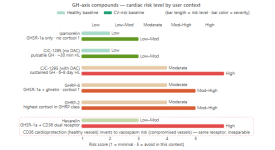
[horizontal bar chart showing cardiac risk level for each GH-axis compound across healthy and CV-risk baselines]
Ipamorelin
Ipamorelin is the most selective GHRP — it stimulates GH release via the ghrelin receptor (GHSR-1a) without meaningfully raising cortisol, prolactin, or ghrelin. No direct cardiac receptor activity has been identified beyond GH elevation.
What to expect
Mild water retention is the most commonly noticed effect, especially in the first few weeks. Blood pressure and heart rate are essentially unaffected at standard doses. For anyone wanting GH-axis stimulation alongside a cardiac support stack, ipamorelin is the appropriate GHRP — it adds the GH pulse without the cortisol disruption, aldosterone-mediated fluid retention at higher doses, or vasoconstrictive risk that other GHRPs carry.
Risk profile: Low across all user contexts.
CJC-1295
CJC-1295 is a GHRH analog — it works via the GHRH receptor at the pituitary, amplifying GH pulse amplitude. The cardiovascular distinction is entirely about the DAC modification.
What to expect Without DAC
Maintains pulsatile GH (half-life ~30 min). Mild water retention. The cardiac risk from sustained GH elevation is low because the pattern remains physiological.
With DAC: half-life extends to 6–8 days, producing persistent elevated GH that mirrors early acromegaly — chronic GH elevation associated with LV wall thickening and diastolic dysfunction. In someone already carrying AAS-associated LVH, CJC-1295 with DAC adds a second independent hypertrophic driver. Choose the non-DAC variant for cardiovascular safety; if DAC is already in use, echocardiography at baseline and after 3 months is not optional.
A Phase II trial of CJC-1295 DAC was discontinued after one participant death, attributed to pre-existing asymptomatic CAD rather than the compound — but the trial was halted as a precaution regardless.
Risk profile: No DAC — Low/Low-Mod. With DAC — Moderate (healthy) / High (existing LVH).
GHRP-2 and GHRP-6
Both produce higher cortisol and prolactin responses than ipamorelin, and neither has the CD36 anti-atherogenic activity that hexarelin carries. From a cardiovascular standpoint, they offer moderate hormonal disruption without any offsetting cardiac benefit.
What to expect
GHRP-6 produces a notable hunger spike from ghrelin receptor activation. Both raise cortisol and prolactin more than ipamorelin. Neither will improve cardiovascular markers. For someone building a cardiac-conscious GH-axis stack, both are less favorable than ipamorelin as the GHRP component.
Risk profile: Moderate (healthy) / Mod–High (CV-risk baseline).
Hexarelin: the compound where context determines everything
Hexarelin is the most pharmacologically unusual compound in the GHRP class. Unlike all other GHRPs, it binds a second cardiac receptor —
CD36 — expressed directly on cardiomyocytes and macrophages. This gives it genuine cardioprotective properties. It also gives it a vasoconstrictive risk that you cannot separate from those benefits.
What to expect
In a healthy person with intact coronary vessels: hexarelin in short cycles may offer genuine anti-atherogenic benefit alongside GH release — reduced foam cell formation in vessel walls, less cardiac fibrosis, improved ejection fraction. You will not feel these effects; they are structural. The GH-related effects (improved recovery, body composition) you may notice.
In someone with hypertension, documented coronary artery disease, atherosclerosis, or AAS-driven vascular compromise: hexarelin is the wrong compound. The CD36-mediated vasoconstriction it produces is real, dose-independent, and mechanistically inseparable from the cardioprotection. You cannot dial out the vasospasm risk while keeping the benefit — they share the same receptor.
The specific CD36 mechanism: hexarelin binding activates
PPARγ (a nuclear receptor governing anti-inflammatory gene expression) → suppresses foam cell formation (the early step in atherosclerotic plaques) → reduces cardiac fibrosis → suppresses cardiomyocyte apoptosis. In rat ischemia-reperfusion models, hexarelin reduced infarct size 25–40%. This protection was abolished in CD36-knockout mice but preserved in GHSR-1a knockouts — confirming it runs through CD36, not GH release, and does not desensitize away.
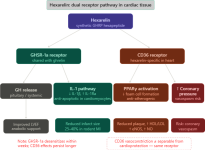
[DIAGRAM: Hexarelin — dual receptor pathway in cardiac tissue Shows hexarelin binding GHSR-1a (left: IL-1 modulation → cardiomyocyte survival, LVEF ↑) and CD36 (right: PPARγ → anti-atherogenic, anti-fibrotic). Red callout from CD36: coronary vasoconstriction. Footer: "Cardioprotection and vasoconstriction share the same CD36 receptor — inseparable." Style: Two-column parallel flowchart with danger callout on right branch]
Additional risks: Highest cortisol/prolactin response in the GHRP class. Rapid GHSR-1a desensitization — cycling required (8–10 weeks on, 4–6 off).
Who should avoid it: Stage 2 hypertension, diagnosed CAD, documented coronary vasospasm, significant atherosclerosis.
Risk profile: Low–Mod (healthy baseline) / High — avoid (CV-risk baseline).
Incretin-class peptides: the most clinically validated
No compound class in this article has stronger cardiovascular outcome data than the GLP-1 receptor agonists. These have undergone large-scale, blinded, event-driven trials (CVOTs) in tens of thousands of patients — a fundamentally different evidence tier from the preclinical-dominant literature behind the repair and mitochondrial compounds.
What to expect
The GLP-1 class is the only group in this article where you will notice cardiovascular benefit in real time. Weight loss, blood pressure reduction, and improved exercise capacity typically become apparent within weeks of reaching a stable dose. The longer-term benefits — reduced heart attack risk, heart failure hospitalization — require months to years of use and are captured in the outcome trials. For someone with established cardiovascular risk (hypertension, obesity, pre-diabetes, prior cardiac event), these compounds are the highest-priority addition to any cardiac-conscious stack, with far stronger evidence than anything else listed here.
GLP-1 receptor activation improves the cardiovascular system through converging mechanisms: direct GLP-1R activation on cardiomyocytes reduces apoptosis; renal GLP-1R drives natriuresis and BP reduction without reflex tachycardia; systemic NF-κB suppression reduces vascular inflammation; weight and visceral fat loss reduce cardiac mechanical load.
| Compound | Receptors | Key trial evidence | Best suited for |
|---|
| Semaglutide | GLP-1R | SELECT: −20% MACE in non-diabetic obese | Established CV disease; HFpEF |
| Tirzepatide | GLP-1R + GIP-R | SUMMIT: −38% HF events; SURPASS-CVOT: non-inferior | LVH + dyslipidemia; best lipid profile |
| Retatrutide | GLP-1R + GIP-R + Glucagon-R | Phase 2: −27% non-HDL-C, −41% TG, −14 mmHg SBP | HTN + dyslipidemia; no CVOT yet |
| CagriSema | GLP-1R + Amylin/Calcitonin-R | REDEFINE 1: −10.9 mmHg SBP, −69% hsCRP | Highest weight loss; resistant HTN |
All GLP-1-based therapies raise resting heart rate modestly (+2–5 bpm). Monitor in anyone with pre-existing tachyarrhythmia. Retatrutide raises it slightly more via glucagon receptor agonism.
Compounds with unfavorable profiles
IGF-1 LR3
IGF-1 LR3 drives cardiomyocyte hypertrophy via IGF-1R/PI3K/Akt/mTOR — the same pathway that AAS activates. In someone already on testosterone with documented LV wall thickening, this stacks a second independent hypertrophic driver on top of an existing problem. Pathological hypertrophy increases arrhythmia risk. Echocardiography is not optional if using this compound alongside AAS.
What to expect in terms of risk: No acute cardiac symptom. The danger accumulates silently over months in wall thickness, which you cannot feel. You need imaging to monitor it.
Melanotan II
MT-II produces blood pressure spikes and can trigger simultaneous hypertension and erection — an acute cardiovascular stress state. It is not appropriate for anyone with Stage 1–2 hypertension or pre-existing cardiac vulnerability.
A note on Khavinson peptides
Epitalon, Pinealon, Vesugen, Cortexin and the broader bioregulator class are marketed heavily for cardiovascular and longevity support. The claims — telomerase activation by a 4-amino acid peptide, 20–40% lifespan extension, cardiac restoration — originate almost entirely from one research group with minimal independent replication, and the cited "trials" are largely unblinded cohort studies. These compounds are probably inert at commercial doses rather than harmful. Spending on them when BPC-157, SS-31, NMN, or GHK-Cu have mechanistically coherent actions with at least partial independent evidence is a poor allocation.
What you won't feel — and what to actually measure
The cardiovascular compounds in this article divide cleanly into two categories: those where benefit is felt within weeks (GLP-1 class), and everything else, which operates silently over months and requires objective measurement.
| Compound | Felt effect | Timeline | What to actually track |
|---|
| BPC-157 | None | Months | Resting BP trend, HRV over 8–12 weeks |
| GHK-Cu | None | Months | Arterial stiffness, BP, echo if available |
| TB-500 | None | Months | Echocardiography (LVEF, diastolic function) |
| Glutathione | None | Weeks–months | Resting BP, HRV |
| SS-31 | None | Months | Echocardiography — diastolic function specifically |
| MOTS-c | None | Months | Endothelial function markers, BP |
| NMN / NR | None | Months | Arterial stiffness, BP, echocardiography |
| Ipamorelin | Mild water retention at high dose | Days | IGF-1 levels, BP if prone to retention |
| Hexarelin | None cardiovascular | Short-term | BP monitoring — critical in anyone with HTN |
| GLP-1 class | Weight loss, BP drop, improved exercise capacity | Weeks | BP, lipid panel, HbA1c, echo annually |
Core monitoring toolkit regardless of which compounds you use:
- Resting blood pressure + HRV — most sensitive early indicators of endothelial change and autonomic tone
- Echocardiography — only way to directly assess LV wall thickness, LVEF, and diastolic function; essential for anyone using GH-axis compounds or AAS long-term
- Lipid panel with LDL-P and apoB — sensitive to atherosclerotic risk, especially relevant with tirzepatide/retatrutide
- hsCRP and IL-6 — inflammatory markers that shift with BPC-157, GHK-Cu, or GLP-1 use over months
- Erectile function quality — in men, a functional proxy for endothelial health; improvement over months is a real vascular signal
References
- Bodart V, et al. Identification and characterization of a new growth hormone-releasing peptide receptor in the heart. Circ Res. 1999;85(9):796. PMID: 10532947
- Ong H, et al. CD36 mediates the cardiovascular action of growth hormone-releasing peptides in the heart. Circ Res. 2002;90(8):e82. PMID: 11988484
- Mao Y, Tokudome T, Kishimoto I. The cardiovascular action of hexarelin. J Geriatr Cardiol. 2014;11(3):253. PMID: 25278975
- Hsieh MJ, et al. Modulatory effects of BPC 157 on vasomotor tone and the activation of Src-Caveolin-1-eNOS pathway. Sci Rep. 2020;10(1):17078. PMID: 33051481
- Pickart L, Vasquez-Soltero JM, Margolina A. The human tripeptide GHK-Cu in prevention of oxidative stress and degenerative conditions of aging. Oxid Med Cell Longev. 2012;2012:324832. PMID: 22666523
- Bock-Marquette I, et al. Thymosin beta4 activates integrin-linked kinase and promotes cardiac cell migration, survival and cardiac repair. Nature. 2004;432:466. PMID: 15565145
- Dai DF, et al. Mitochondria-targeted antioxidant elamipretide (SS-31) reverses cardiac aging. Elife. 2020;9:e55513. PMID: 32648543
- Wei M, et al. Mitochondrial-derived peptide MOTS-c attenuates vascular calcification via AMPK signaling. Cardiorenal Med. 2020;10(1):42. PMID: 31694019
- Deng H, et al. Nicotinamide mononucleotide: research process in cardiovascular diseases. Int J Mol Sci. 2024;25(17):9526. PMID: 39273473
- Lincoff AM, et al. Semaglutide and cardiovascular outcomes in obesity without diabetes (SELECT). N Engl J Med. 2023;389(24):2221. PMID: 37952131
- Nicholls SJ, et al. Cardiovascular outcomes with tirzepatide versus dulaglutide in type 2 diabetes (SURPASS-CVOT). N Engl J Med. 2025;393:2409.
- Kosiborod MN, et al. Semaglutide in patients with HFpEF and obesity (STEP-HFpEF). N Engl J Med. 2023;389(12):1069. PMID: 37622681
- Jastreboff AM, et al. Triple-hormone-receptor agonist retatrutide for obesity. N Engl J Med. 2023;389(6):514. PMID: 37366315
- Garvey WT, et al. Coadministered cagrilintide and semaglutide (REDEFINE 1). N Engl J Med. 2025;393:635.
- Blankenberg S, et al. Glutathione peroxidase 1 activity and cardiovascular events in patients with coronary artery disease. N Engl J Med. 2003;349(17):1605. PMID: 14573733
- Józwiak M, et al. Multifunctionality and possible medical application of the BPC 157 peptide. Pharmaceuticals. 2025;18(2):185. PMID: 40006000