Most people think of a GLP-1 medication as a course of treatment: you start, you lose weight, you stop. The trial data point to a different picture. Obesity behaves like a chronic condition, and the medications that treat it work while you take them. When you stop, much of the biology that drove the weight gain in the first place is still there.
This article covers semaglutide, tirzepatide and retatrutide. Other GLP-1 drugs, such as liraglutide, are not covered. Retatrutide is investigational and not approved.
This does not mean everyone must stay on treatment forever. Reaching your goal weight is the point where one strategy ends and a second begins. The article explains why, what the trials show about stopping and continuing, and how to build a maintenance strategy based on how your own body responds.
"GLP-1 is a tool I can use as part of a long-term weight-management strategy. The first phase may focus on losing excess weight, but once I reach my goal, I need a separate maintenance strategy based on how my body responds over time."
Note: This article summarizes clinical trials and prescribing information. It is not medical advice and does not provide a dosing protocol. Decisions about continuing, reducing or stopping treatment belong with your prescribing physician.
Overview
| Semaglutide | Tirzepatide | Retatrutide |
|---|
| Mechanism | GLP-1 agonist | GIP/GLP-1 dual agonist | GIP/GLP-1/glucagon triple agonist |
| Status | Approved (Wegovy) | Approved (Mounjaro) | Investigational |
| Weight loss in key trials | −15.2% at 104 weeks (STEP 5)² | −15.0% to −20.9% at 72 weeks (SURMOUNT-1)³ | −24.2% at 48 weeks (phase 2, 12 mg)⁴; −28.3% at 80 weeks (TRIUMPH-1 topline)⁵ |
| After stopping | Regain (STEP 4, STEP 1 extension) | Regain (SURMOUNT-4) | No stopping data found |
1. Excess Weight Usually Accumulates Over Years
Gaining an extra 20 to 30 kg rarely happens quickly. A small but persistent energy surplus adds fat gradually over months and years. The World Obesity Federation describes the underlying process as an interaction between environment (abundant energy-dense food, low physical activity) and individual genetic susceptibility, which together produce a sustained positive energy balance. The metabolic and inflammatory products of this fat can then damage the heart, arteries, liver, muscle and pancreas.¹
The body is not a calorie calculator, though. Appetite and energy expenditure shift with body weight, activity, diet and weight loss itself. A plan that only counts calories tends to underestimate how hard maintenance can be.
Evidence tier: Position statement (expert consensus), not a trial. It supports the chronic-disease framing used throughout this article.
2. Phase One: Active Weight Loss
During the first phase, a GLP-1 medication makes it easier to eat less and keep an energy deficit.
- Semaglutide. In STEP 5, 304 adults without diabetes took semaglutide 2.4 mg or placebo for 104 weeks, both with lifestyle counseling. Mean weight change was −15.2% versus −2.6%.²
- Tirzepatide. In SURMOUNT-1 (2,539 adults, 72 weeks), mean losses were 15.0%, 19.5% and 20.9% at 5, 10 and 15 mg, against 3.1% with placebo. These are treatment-regimen figures, which include people who stopped the drug.³
- Retatrutide. In a phase 2 trial (338 adults), the 12 mg dose produced a mean loss of 24.2% at 48 weeks (placebo 2.1%).⁴ Topline phase 3 results (TRIUMPH-1, 2,339 adults, 80 weeks) reported 28.3% at 12 mg.⁵ The phase 3 figures come from a manufacturer announcement, not a peer-reviewed paper.
What substantial weight loss can improve
In STEP 5, semaglutide reduced waist circumference (−14.4 cm versus −5.2 cm), systolic blood pressure (−5.7 versus −1.6 mmHg) and HbA1c (−0.4% versus −0.1%). Among participants with prediabetes, 79.7% on semaglutide had normal glucose status at week 104, compared with 37.0% on placebo.² In SURMOUNT-1, participants with prediabetes followed for 176 weeks progressed to type 2 diabetes in 1.2% of the tirzepatide group and 12.6% of the placebo group.⁶
These are average results in trial populations who also received lifestyle counseling. A GLP-1 medication does not automatically correct every metabolic problem, and individual responses vary.
3. Reaching Your Goal Weight Is Not the End
Once you reach your target, the goal changes from weight loss to weight maintenance. You no longer need to push appetite down as far as possible. The question becomes: what does it take to hold the result? The trial data suggest that for many people the answer includes some form of continued treatment or support.
4. Why Weight Can Return
The biology after weight loss
Weight loss activates compensatory biological changes that work against maintaining the lower weight. The authors of the STEP 1 extension describe this as part of why weight regain is common even with continued lifestyle intervention.⁸ I am not citing older diet-only studies of hormonal or metabolic adaptation here, because I could only read them as secondary summaries.
What happens when the medication stops
When you stop a GLP-1 medication, its appetite-suppressing effect stops too. The trials show what follows.
Semaglutide, STEP 1 extension. STEP 1 randomized 1,961 adults to semaglutide 2.4 mg or placebo for 68 weeks. At week 68, treatment and the lifestyle intervention were stopped. A subset of 327 participants was followed for another year.⁸ In this subset, mean weight loss at week 68 was 17.3% with semaglutide (placebo 2.0%). By week 120, semaglutide participants had regained 11.6 percentage points, about two-thirds of their loss, leaving a net loss of 5.6% (placebo 0.1%). Blood pressure and HbA1c followed weight back toward baseline. Systolic pressure averaged 129 mmHg at baseline, 121 at week 68 and 131 at week 120. HbA1c averaged 5.7%, 5.2% and 5.6%. C-reactive protein and lipids also rose again after treatment ended.⁸ Still, 48.2% kept a weight loss of at least 5% at week 120.⁸
Limits of this extension: all analyses were exploratory, the subset was not randomly selected, no power calculation was done, and adverse events were not systematically collected.⁸ The trial was funded by Novo Nordisk, and several authors are employees.
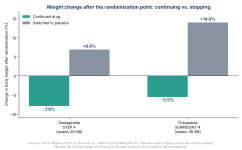
Semaglutide, STEP 4. All participants took semaglutide for 20 weeks, then were randomized to continue or switch to placebo for 48 weeks. According to the Wegovy label, weight changed by −7.9% with continued semaglutide and +6.9% after the switch to placebo.⁷ I have these figures from the label, not from the original paper.
Tirzepatide, SURMOUNT-4. In SURMOUNT-4, 783 adults took tirzepatide at 10 or 15 mg for 36 weeks and lost a mean of 20.9%. Of these, 670 were randomized to continue or to switch to placebo for 52 weeks. From week 36 to week 88, weight changed by −5.5% with continued tirzepatide and rose by about 14% on placebo (difference −19.4 percentage points, 95% CI −21.2 to −17.7). Across the full 88 weeks, weight was down 25.3% with tirzepatide and 9.9% with placebo. Among those who continued, 89.5% kept at least 80% of their lead-in weight loss, compared with 16.6% on placebo.⁹ The Mounjaro label reports slightly different numbers for the same trial (−6.7% versus +14.8%) because it uses a different analysis method.⁶ I read the JAMA summary, not the full paper, and the funding statement was not visible; several authors are affiliated with Eli Lilly.
Across drugs, BMJ 2026 meta-analysis. This review pooled 37 studies (63 intervention arms, 9,341 participants) of weight management medications. Pooled across all medications, people regained a mean of 0.4 kg per month after stopping, and the authors projected a return to pre-treatment weight after about 1.7 years (95% CI 1.3 to 2.1). For the newer, more effective drugs (semaglutide and tirzepatide; 10 arms, 1,776 participants), the monthly regain was faster, 0.8 kg (0.7 to 0.9), with a projected return to baseline weight after about 1.5 years (1.0 to 1.9). Average regain in the first year after stopping was 9.9 kg for these drugs, after a mean loss of 14.7 kg during treatment. Regain was faster than after stopping behavioral programs, independent of the weight lost. The authors judged the certainty of the regain-rate estimate to be moderate. Blood pressure, glucose, cholesterol and triglycerides were projected to return to baseline within about 1.4 years, but the authors lacked enough data to analyze these markers for semaglutide and tirzepatide separately.¹⁰
Limits: data for the newer drugs extended at most 52 weeks after stopping, the long-term projections are extrapolations, and the review included single-arm and observational studies besides randomized trials.¹⁰ Funding came in part from the National Institute for Health and Care Research (NIHR); I did not see industry funding stated for the review itself.
Retatrutide. I found no published data on what happens after stopping retatrutide. Its mechanism overlaps with the other drugs, but you should not assume the same regain pattern, or a different one, until data exist.
This is not a willpower problem
Regain after stopping does not mean you lack discipline or that the treatment failed. The STEP 1 extension authors conclude that their findings confirm the chronicity of obesity and suggest that ongoing treatment is required to maintain improvements in weight and health.⁸ That is an interpretation by industry-funded authors, but the data in SURMOUNT-4 and the BMJ review point the same way.
5. Strategy One: Stop and Observe
After reaching your target, stopping treatment can be an option when it fits your medical situation and your physician agrees. If you try this, watch the overall trend instead of waiting until a lot of weight has returned.
| Measure | What to look for |
|---|
| Body weight | The trend over weeks, not daily swings |
| Appetite and food intake | How much hunger returns, and when |
| Physical activity | Whether your activity level holds |
| Waist circumference | Fat regain can show here before the scale moves |
| Metabolic markers | Blood pressure, HbA1c, lipids, as advised by your physician |
This period gives you information: can you hold the new weight without medication, how much does appetite return, and how fast does weight rise? The BMJ figures give a rough sense of the pace: an average of 0.8 kg per month for semaglutide and tirzepatide, though individual courses vary.¹⁰
I deliberately do not give a threshold such as "restart after gaining 3 kg." No trial has validated a single number, and daily weight fluctuates for normal reasons. What matters is a consistent trend over weeks or months.
6. Strategy Two: Long-Term Maintenance Therapy
If stopping leads to a significant return of appetite and persistent weight regain, continued treatment is something to discuss with your physician. In STEP 5, weight loss was −15.6% at week 52 and −15.2% at week 104, so the curve stayed flat while therapy continued.² In STEP 4 and SURMOUNT-4, people who continued held or extended their loss, while those who stopped regained.⁷˒⁹
The lowest effective treatment
A reasonable goal is the lowest effective treatment that maintains the result, not simply the highest dose you can tolerate. The evidence allows only limited statements, so it helps to separate three situations.
Approved options. The Mounjaro label lists 5, 10 and 15 mg as maintenance doses; in SURMOUNT-1, mean loss was 15.0% at 5 mg and 20.9% at 15 mg.³˒⁶ Your physician can choose within that range. The Wegovy label specifies 2.4 mg as maintenance, with 7.2 mg as an option for some adults, and allows lowering the dose when symptoms or response call for it.⁷
Dose changes for tolerability. Both labels describe delaying escalation or stepping back to a previous dose when side effects are significant.⁶˒⁷ This addresses tolerability, not long-term maintenance strategy.
Individual lower-dose or longer-interval strategies. I found no randomized evidence in the sources reviewed here supporting a dose below the approved range, or less frequent injections, as a maintenance method. Such approaches are off-label. This article therefore does not suggest any dose-reduction scheme or extended injection interval. If your physician proposes one, ask for the reasoning and how your response will be monitored.
Safety over the long term
Long-term use means long-term exposure to side effects. For retatrutide, topline results reported dose-related stomach and bowel symptoms, with discontinuation due to adverse events in 4.1%, 6.9% and 11.3% of participants at 4, 9 and 12 mg in TRIUMPH-1.⁵ In the phase 2 trial, nausea was more common with a higher starting dose, which is one reason escalation is gradual.⁴ The topline figures need confirmation in a peer-reviewed publication.
7. GLP-1 as a Tool You Learn to Manage
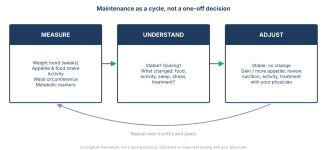
Over time, you should learn what is happening to your weight, why, and what intervention, if any, it calls for:
Measure → Understand → Adjust
| What you see | What it may mean | A reasonable next step |
|---|
| Weight stable | Current approach is working | No change may be needed; keep measuring |
| Consistent weight gain over weeks | Something has changed | Identify the cause: food, activity, sleep, stress, medication changes |
| Increasing appetite | Biology or routine is shifting | Review nutrition, activity and treatment strategy with your physician |
| Another period of weight loss | You may be below your goal | Return to maintenance once the goal is reached |
GLP-1 therapy is neither something you must use forever at the highest dose nor something you must abandon the moment you reach your goal. The right answer depends on how your body responds.
8. Think in Years, Not Weeks
If your excess weight built up over years, managing it should also be measured in years. Instead of asking only "When can I stop?", ask "What is my long-term strategy for keeping a healthy weight?" One person may hold the result through lifestyle changes after treatment ends. Another may need ongoing medical support or continued pharmacotherapy. The aim is sustainable weight and good health with the minimum intervention necessary.
What the Evidence Does Not Yet Show
- Retatrutide stopping data. None found. Phase 3 results are topline only.
- Long follow-up after stopping. For semaglutide and tirzepatide, the BMJ review had at most 52 weeks of follow-up.¹⁰
- Maintenance at reduced doses. No randomized evidence found.
- Funding. The semaglutide, tirzepatide and retatrutide trials were funded by the manufacturers.
- Population. STEP 5 participants were mostly women (77.6%) and mostly white (93.1%) and did not have diabetes.²
References
- Bray GA, Kim KK, Wilding JPH. Obesity: a chronic relapsing progressive disease process. A position statement of the World Obesity Federation. Obes Rev. 2017;18(7):715-723. DOI: 10.1111/obr.12551. Abstract-level read.
- Garvey WT, Batterham RL, Bhatta M, et al. Two-year effects of semaglutide in adults with overweight or obesity: the STEP 5 trial. Nat Med. 2022;28:2083-2091. DOI: 10.1038/s41591-022-02026-4. Funded by Novo Nordisk.
- Jastreboff AM, Aronne LJ, Ahmad NN, et al. Tirzepatide once weekly for the treatment of obesity (SURMOUNT-1). N Engl J Med. 2022;387:205-216. DOI: 10.1056/NEJMoa2206038. Funded by Eli Lilly; full text read.
- Jastreboff AM, Kaplan LM, Frías JP, et al. Triple-hormone-receptor agonist retatrutide for obesity: a phase 2 trial. N Engl J Med. 2023;389:514-526. DOI: 10.1056/NEJMoa2301972. Funded by Eli Lilly; full text read.
- Eli Lilly and Company. Retatrutide TRIUMPH-1 topline results. Press release, 2026 (read via media coverage). No DOI. Manufacturer announcement, not peer-reviewed.
- Mounjaro (tirzepatide), Summary of Product Characteristics. European Medicines Agency, sections 4.2 and 5.1. No DOI. Holder: Eli Lilly.
- Wegovy (semaglutide), Summary of Product Characteristics. European Medicines Agency, sections 4.2 and 5.1. No DOI. Source of the STEP 4 figures. Holder: Novo Nordisk.
- Wilding JPH, Batterham RL, Davies M, et al. Weight regain and cardiometabolic effects after withdrawal of semaglutide: the STEP 1 trial extension. Diabetes Obes Metab. 2022;24:1553-1564. DOI: 10.1111/dom.14725. Funded by Novo Nordisk; full text read.
- Aronne LJ, Sattar N, Horn DB, et al. Continued treatment with tirzepatide for maintenance of weight reduction in adults with obesity: the SURMOUNT-4 randomized clinical trial. JAMA. 2024;331(1):38-48. DOI: 10.1001/jama.2023.24945. Read via the journal page summary; funding not seen, likely Eli Lilly.
- West S, Scragg J, Aveyard P, et al. Weight regain after cessation of medication for weight management: systematic review and meta-analysis. BMJ. 2026;392:e085304. DOI: 10.1136/bmj-2025-085304. Full text read; funded in part by NIHR.