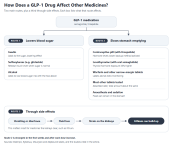
Almost every interaction covered here comes from one of those two effects. Through blood sugar, the medicines to watch are the ones that also lower it, mainly insulin and sulfonylureas. Through the stomach, the medicines to watch are tablets and capsules, because they pass through the stomach before the body absorbs them.
This article covers semaglutide (Ozempic, Wegovy, Rybelsus) and tirzepatide (Mounjaro, Zepbound). For most medicines that were tested with them, the studies found no change that matters in practice. For a few, the official drug labels ask for extra care. Alcohol gets its own section at the end.
Key points
- Insulin and sulfonylureas carry the clearest risk: together with a GLP-1 drug they can push blood sugar too low. The labels say the prescriber may lower the dose of these medicines when the GLP-1 drug is started.
- Slower stomach emptying can change how quickly tablets are absorbed. For most medicines tested, total absorption stayed the same.
- Two documented exceptions: tirzepatide lowers the level of the contraceptive pill, and oral semaglutide (the tablet) raises the level of levothyroxine (thyroid hormone).
- Narrow therapeutic index medicines such as warfarin, levothyroxine and lithium get closer monitoring, especially in the first weeks and after each dose increase.
- Alcohol adds to the low blood sugar risk for people on insulin or sulfonylureas, and alcohol is a known cause of pancreatitis, which is a listed warning for GLP-1 drugs.
At a glance: who needs to pay most attention
| Situation | Main concern | When it matters most |
|---|
| On insulin or a sulfonylurea | Low blood sugar (hypoglycaemia) | Starting the GLP-1 drug, dose increases |
| Taking the contraceptive pill with tirzepatide | Pill may work less well | 4 weeks after starting and after each dose step |
| Taking levothyroxine with oral semaglutide | Higher thyroid hormone levels | Ongoing; thyroid blood tests |
| Taking warfarin or lithium | Level changes; lithium can build up if you get dehydrated | First weeks, dose steps, any vomiting or diarrhoea |
| Planned surgery, endoscopy or sedation | Food left in the stomach during anaesthesia | Before any procedure |
Two ways a GLP-1 drug affects other medicines
Route 1: blood sugar
GLP-1 is a hormone the gut releases after a meal. It tells the pancreas to release insulin (the hormone that moves sugar out of the blood into cells) and holds back glucagon (the hormone that raises blood sugar). GLP-1 medications copy this hormone, and tirzepatide also acts on a second gut hormone receptor (GIP) [1, 3].
The key detail is that this insulin release is
glucose-dependent: it happens when blood sugar is raised. The Ozempic label describes semaglutide as stimulating insulin release "in the presence of elevated blood glucose concentrations" [2]. As blood sugar falls back toward normal, the signal weakens. This built-in brake is why a GLP-1 drug on its own is less likely to cause low blood sugar. The risk comes from medicines that lack it.
Route 2: the stomach
GLP-1 also slows down how fast food leaves the stomach [1]. A tablet swallowed at the same time sits in the stomach longer before it reaches the small intestine, where most medicines are absorbed.
This effect is strongest at the start. In the tirzepatide studies, the slowdown was largest after the first 5 mg dose and became smaller with later doses: after the first dose, peak levels of paracetamol (used as a marker of stomach emptying) were about 50% lower and arrived about an hour later, while after several weeks of treatment there was no meaningful effect [3, 4]. So the weeks after starting, and after each dose increase, are the periods to watch.
Shows: A GLP-1 drug splits into two routes. Route 1 (blood sugar) leads to insulin, sulfonylureas and alcohol. Route 2 (slower stomach emptying) leads to oral medicines, the contraceptive pill, levothyroxine, narrow therapeutic index drugs, and anaesthesia. A side branch shows vomiting/diarrhoea leading to dehydration, which affects kidney-cleared drugs such as lithium.
Insulin and sulfonylureas: the main low blood sugar risk
What to expect
- Who this applies to: people with type 2 diabetes who already take insulin or a sulfonylurea (for example gliclazide, glimepiride, glipizide, glibenclamide).
- When: the labels focus on the start of treatment; dose increases lower blood sugar further.
- What may happen: episodes of low blood sugar, including severe ones, according to the semaglutide and tirzepatide labels [2, 3, 4].
- What to track: blood sugar readings, especially fasting values and any readings with symptoms.
Why the combination is different
Sulfonylureas make the pancreas release insulin
whatever the blood sugar level is. Injected insulin works whether blood sugar is high or low. Neither of them has the glucose-dependent brake that GLP-1 drugs have.
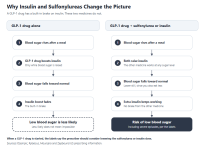
When a GLP-1 drug is added, blood sugar drops further, and appetite falls. A sulfonylurea or insulin dose that was right before can now be too much, and the GLP-1 drug's brake does not help, because the extra insulin comes from the other medicine.
The labels for semaglutide and tirzepatide say the same thing: when starting the GLP-1 drug, the prescriber should consider lowering the dose of the sulfonylurea or insulin to reduce the risk of low blood sugar [2, 3, 4, 5]. The Zepbound label adds that all patients should be told about the risk and the warning signs [4].
How much to lower the dose, or whether to stop the sulfonylurea, depends on current blood sugar control and how low readings have been. That decision is made with the prescriber, ideally before the first GLP-1 dose.
Recognising low blood sugar
The patient information for semaglutide and tirzepatide lists these signs: shakiness, sweating, a fast heartbeat, hunger, feeling jittery, anxiety, irritability or mood changes, dizziness, headache, weakness, blurred vision, slurred speech, confusion and drowsiness [2, 3].
Shows: Two side-by-side columns. Left: GLP-1 drug alone. Blood sugar high, then insulin released, then blood sugar falls, then insulin signal weakens (brake). Right: GLP-1 drug plus sulfonylurea or insulin. Blood sugar high, then insulin released, then blood sugar falls, then insulin keeps coming from the other medicine (no brake), then risk of low blood sugar.
Oral medicines and slower stomach emptying
What usually happens
Slower stomach emptying mostly changes
when a medicine is absorbed, not
how much. Peak levels can be lower and later, while total exposure (the amount the body takes in over time) often stays about the same. Studies in healthy volunteers tested this directly:
- Injectable semaglutide (1 mg) did not change metformin, warfarin, atorvastatin or digoxin to a clinically relevant degree. Warfarin's effect on blood clotting (INR) was also unchanged [6].
- Oral semaglutide (tablet) did not change lisinopril, warfarin or digoxin. Metformin exposure rose by 32%, which the authors judged not clinically relevant because metformin has a wide safety margin [7].
- The oral semaglutide label lists no clinically significant changes for the contraceptive pill (ethinyl estradiol and levonorgestrel), furosemide or rosuvastatin [5].
A 2025 review of all approved GLP-1 drugs and tirzepatide reached the same overall conclusion: most stomach-emptying interactions studied so far were not clinically significant, with two clear exceptions [9].
Exception 1: tirzepatide and the contraceptive pill
In a study with a single 5 mg dose of tirzepatide, peak levels of the hormones in a combined contraceptive pill fell by 55 to 66%, and total exposure fell by 20 to 23% [3, 4]. Whether this makes the pill less reliable has not been tested directly, but because it might, the Mounjaro and Zepbound labels advise women on oral contraceptives to switch to a non-oral method or add a barrier method (such as condoms) for
4 weeks after starting tirzepatide and for
4 weeks after each dose increase [3, 4]. The labels state that non-oral hormonal methods (implant, injection, patch, ring, hormonal coil) should not be affected [3, 4].
Exception 2: oral semaglutide and levothyroxine
Oral semaglutide (Rybelsus) increased total exposure to thyroid hormone (T4) by 33% when taken together with levothyroxine [8]. Both medicines are taken on an empty stomach in the morning, which is part of why they end up together. The label recommends considering extra monitoring, in practice thyroid blood tests (TSH and free T4), when both are used [5]. Whether the levothyroxine dose changes is decided based on those results.
The same study found that taking oral semaglutide with several other tablets lowered semaglutide exposure by 34%, which is why the tablet has strict dosing instructions [8].
The tirzepatide labels also ask for monitoring of oral medicines "dependent on threshold concentrations for efficacy", meaning medicines that only work once they reach a certain level [3, 4].
Surgery, endoscopy and sedation
If the stomach still holds food during general anaesthesia or deep sedation, it can be breathed into the lungs (pulmonary aspiration). The semaglutide and tirzepatide labels list this as a warning and ask patients to tell their care team about any planned procedure [2, 3, 4, 5].
A 2024 guidance from five US anaesthesia, surgery and gastroenterology societies sees higher risk in people still in the dose-increase phase or with ongoing nausea, vomiting, bloating or constipation. For them it suggests options such as a liquid-only diet for 24 hours beforehand, and whether to pause the GLP-1 drug is decided case by case [10]. The team needs to know well before the appointment, not on the day.
Medicines with a narrow therapeutic index
A medicine has a
narrow therapeutic index when the gap between a dose that works and a dose that harms is small, so these medicines are usually checked with blood tests. The semaglutide tablet and tirzepatide labels ask for increased monitoring of oral drugs in this group [3, 4, 5]. They can be affected through absorption, and through dehydration caused by side effects.
Warfarin and other coumarin anticoagulants
Warfarin keeps blood from clotting too easily, and its effect is measured with the INR blood test. In the studies above, semaglutide did not change warfarin absorption or INR [6, 7]. Even so, the EU product information for Ozempic recommends frequent INR checks when semaglutide is started in people on warfarin or similar drugs, and notes reports of decreased INR with acenocoumarol (a related anticoagulant) [11]. The tirzepatide labels name warfarin as an example of a drug to monitor [3, 4].
Eating much less can also shift INR, because vitamin K in food affects warfarin. This is reasoning, not data from GLP-1 studies.
Levothyroxine
A 33% rise in thyroid hormone exposure is documented with oral semaglutide [8]. For injectable semaglutide and tirzepatide no comparable study was found, so the general monitoring advice applies.
Digoxin
Digoxin (a heart medicine) was tested with both injectable and oral semaglutide, and neither changed its levels [6, 7].
Lithium and dehydration
Nausea, vomiting and diarrhoea are among the most frequent GLP-1 side effects listed on the labels, and they can lead to fluid loss [2, 3]. The semaglutide and tirzepatide labels warn of
acute kidney injury caused by dehydration and recommend checking kidney function in people with these side effects [2, 3, 4, 5].
This matters most for medicines the kidneys clear, such as lithium, whose levels depend on kidney function and fluid status [12]. A 2026 review counted six published reports of lithium levels rising or lithium toxicity after a GLP-1 drug or tirzepatide was started, switched or increased. It also reports that the European Medicines Agency's safety committee opened a signal review in June 2026 [12]. In a small Italian cohort of 23 people on lithium who started tirzepatide, two had lithium levels above 1.2 mmol/L and one developed symptoms of toxicity [13]. The review describes this as an uncontrolled signal, not a confirmed interaction, and the cause is not settled [12].
For people on lithium, the authors recommend structured blood level checks and a plan for "sick days" (what to do when vomiting or unable to drink) [13]. Any lithium dose change is made by the prescriber based on blood levels.
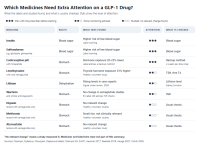
Shows: Table of nine medicines (insulin, sulfonylureas, contraceptive pill with tirzepatide, levothyroxine with oral semaglutide, lithium, warfarin, digoxin, metformin, atorvastatin) with the route involved, what the label or study found, a three-dot attention scale, and what is usually checked.
Alcohol
The US labels for semaglutide and tirzepatide give no specific guidance on alcohol. The concerns below come from known effects of alcohol that overlap with known GLP-1 warnings, not from studies of the combination.
Low blood sugar
Australian diabetes guidelines state that alcohol interferes with the action of insulin, insulin secretagogues (such as sulfonylureas) and glucagon, increasing the risk of low blood sugar in people taking these medicines, and that alcohol reduces awareness of low blood sugar [14].
For someone on a GLP-1 drug plus insulin or a sulfonylurea, alcohol adds a third factor to a combination that already carries this risk. Eating less on a GLP-1 drug also makes drinking on a near-empty stomach more likely. Signs of low blood sugar such as confusion and slurred speech can be mistaken for being drunk.
Pancreatitis
Acute pancreatitis (inflammation of the pancreas) is a warning on every GLP-1 label, with advice to stop the drug if it is suspected [2, 3, 4, 5]. Alcohol is one of the most common causes of acute pancreatitis [15]. There is no study showing that alcohol and GLP-1 drugs together raise the risk more than either alone. But both are relevant risk factors, and heavy drinking or a past episode of pancreatitis is something the prescriber needs to know about.
The labels describe the warning sign as severe pain in the stomach area that does not go away, with or without vomiting, sometimes felt through to the back [2, 3].
Nausea and dehydration
Alcohol can add to nausea and fluid loss, which overlap with the GLP-1 side effects, especially early in treatment. This is reasoning rather than tested data, but it points to the same dehydration and kidney risk described above, which matters most for people also on lithium or other kidney-cleared medicines.
What the research on drinking less shows
Animal and observational studies suggested that GLP-1 drugs may reduce alcohol intake, which led to randomised trials [16].
- In a 2025 trial of 48 adults with alcohol use disorder who were not seeking treatment, low-dose semaglutide (up to 1 mg weekly, 9 weeks) reduced the amount of alcohol consumed in a lab drinking test, drinks per drinking day, and craving. It did not change the number of drinking days or average drinks per day [16].
- In a 2022 trial of 127 people with alcohol use disorder, weekly exenatide (an older GLP-1 drug) did not reduce heavy drinking days overall. An exploratory analysis found reductions only in participants with obesity [17].
These are early results, and no GLP-1 drug is approved for alcohol use disorder. They do not show that drinking on a GLP-1 drug is safer, and they are not a reason to start one.
What to track, and when to talk to the prescriber
The periods to watch are the first weeks after starting and after each dose increase, when stomach emptying slows most [3, 4].
| If you take | What is usually checked | Why |
|---|
| Insulin or a sulfonylurea | Blood sugar readings, especially fasting and with symptoms | Low blood sugar risk [2, 3] |
| Contraceptive pill (with tirzepatide) | Backup method for 4 weeks after starting and after each dose step | Lower hormone levels [3, 4] |
| Levothyroxine (with oral semaglutide) | TSH and free T4 | 33% higher T4 exposure [8] |
| Warfarin or similar | INR, more often at the start | Label recommendation [11] |
| Lithium | Lithium blood levels, kidney function, sick-day plan | Reports of rising levels [12, 13] |
| Any medicine, with ongoing vomiting or diarrhoea | Kidney function, fluid intake | Dehydration-related kidney injury [2, 3] |
| Planned surgery or sedation | Tell the procedure team in advance | Aspiration risk [10] |
Dose changes to insulin, sulfonylureas, levothyroxine, warfarin or lithium are made with the prescriber, based on readings and blood tests.
References
- Drucker DJ. Mechanisms of action and therapeutic application of glucagon-like peptide-1. Cell Metab. 2018;27(4):740-756. PMID: 29617641 (https://pubmed.ncbi.nlm.nih.gov/29617641/)
- Novo Nordisk. OZEMPIC (semaglutide) injection, US prescribing information. Revised 07/2026. DailyMed (https://dailymed.nlm.nih.gov/dailymed/drugInfo.cfm?setid=42bdd912-2393-44c4-b7e0-47672ca28991)
- Eli Lilly. MOUNJARO (tirzepatide) injection, US prescribing information. Revised 07/2026. DailyMed (https://dailymed.nlm.nih.gov/dailymed/drugInfo.cfm?setid=0818426a-53eb-4db7-9609-bbae1e7a3964)
- Eli Lilly. ZEPBOUND (tirzepatide) injection, US prescribing information. Revised 08/2026. DailyMed (https://dailymed.nlm.nih.gov/dailymed/drugInfo.cfm?setid=487cd7e7-434c-4925-99fa-aa80b1cc776b)
- Novo Nordisk. RYBELSUS / OZEMPIC (semaglutide) tablets, US prescribing information. Revised 01/2026. DailyMed (https://dailymed.nlm.nih.gov/dailymed/drugInfo.cfm?setid=27f15fac-7d98-4114-a2ec-92494a91da98)
- Hausner H, Derving Karsbøl J, Holst AG, et al. Effect of semaglutide on the pharmacokinetics of metformin, warfarin, atorvastatin and digoxin in healthy subjects. Clin Pharmacokinet. 2017;56(11):1391-1401. PMID: 28349387 (https://pubmed.ncbi.nlm.nih.gov/28349387/)
- Bækdal TA, Borregaard J, Hansen CW, Thomsen M, Anderson TW. Effect of oral semaglutide on the pharmacokinetics of lisinopril, warfarin, digoxin, and metformin in healthy subjects. Clin Pharmacokinet. 2019;58(9):1193-1203. PMID: 30945118 (https://pubmed.ncbi.nlm.nih.gov/30945118/)
- Hauge C, Breitschaft A, Hartoft-Nielsen ML, Jensen S, Bækdal TA. Effect of oral semaglutide on the pharmacokinetics of thyroxine after dosing of levothyroxine and the influence of co-administered tablets on the pharmacokinetics of oral semaglutide in healthy subjects: an open-label, one-sequence crossover, single-center, multiple-dose, two-part trial. Expert Opin Drug Metab Toxicol. 2021;17(9):1139-1148. PMID: 34289755 (https://pubmed.ncbi.nlm.nih.gov/34289755/)
- Min JS, Jo SJ, Lee S, et al. A comprehensive review on the pharmacokinetics and drug-drug interactions of approved GLP-1 receptor agonists and a dual GLP-1/GIP receptor agonist. Drug Des Devel Ther. 2025;19:3509-3537. PMID: 40330819 (https://pubmed.ncbi.nlm.nih.gov/40330819/)
- Kindel TL, Wang AY, Wadhwa A, et al. Multisociety clinical practice guidance for the safe use of glucagon-like peptide-1 receptor agonists in the perioperative period. Surg Obes Relat Dis. 2024;20(12):1183-1186. PMID: 39482213 (https://pubmed.ncbi.nlm.nih.gov/39482213/)
- European Medicines Agency. Ozempic (semaglutide): Summary of Product Characteristics, section 4.5. (https://www.ema.europa.eu/en/documents/product-information/ozempic-epar-product-information_en.pdf)
- Cotrik E, da Silva AG, Soares JC. Lithium and GLP-1-based therapies in bipolar disorder: an emerging pharmacovigilance signal and monitoring considerations. Int Clin Psychopharmacol. 2026;41(6):365-370. PMID: 42542974 (https://pubmed.ncbi.nlm.nih.gov/42542974/)
- Rescalli MB, Fagiolini A, Carmellini P, et al. Tirzepatide initiation in lithium-treated bipolar disorder: renal biomarker trajectories and lithium safety signals over 12 months in a real-world cohort. Hum Psychopharmacol. 2026;41(6):e70066. PMID: 42803597 (https://pubmed.ncbi.nlm.nih.gov/42803597/)
- Royal Australian College of General Practitioners. Management of type 2 diabetes: a handbook for general practice. Lifestyle interventions: alcohol consumption. 2024. (https://www.racgp.org.au/clinical-r...or-the-management-of-type/alcohol-consumption)
- Mederos MA, Reber HA, Girgis MD. Acute pancreatitis: a review. JAMA. 2021;325(4):382-390. PMID: 33496779 (https://pubmed.ncbi.nlm.nih.gov/33496779/)
- Hendershot CS, Bremmer MP, Paladino MB, et al. Once-weekly semaglutide in adults with alcohol use disorder: a randomized clinical trial. JAMA Psychiatry. 2025;82(4):395-405. PMID: 39937469 (https://pubmed.ncbi.nlm.nih.gov/39937469/)
- Klausen MK, Jensen ME, Møller M, et al. Exenatide once weekly for alcohol use disorder investigated in a randomized, placebo-controlled clinical trial. JCI Insight. 2022;7(19):e159863. PMID: 36066977 (https://pubmed.ncbi.nlm.nih.gov/36066977/)