Your cells are constantly being damaged — and constantly repairing themselves. That balance is what keeps you healthy. When damage starts outpacing repair, you age faster, recover slower, and become more vulnerable to disease. Most people address this with vitamin C or a general antioxidant supplement. The compounds in this article work at a more fundamental level — some go directly inside the cell's power generators to reduce damage at the source, others trigger the cell's own built-in protective programs. Understanding the difference helps you decide what's actually relevant for you.
One important note before the overview: none of these compounds produce a perceptible effect. You will not feel antioxidant protection happening. The value shows up in bloodwork, long-term health, and objective measurements — not in anything you can sense day to day-
What oxidative stress actually is — and why it matters
Every cell produces energy inside small structures called
mitochondria — the cell's power generators. That process works cleanly most of the time, but it also creates unstable molecules called
free radicals as a byproduct. In small amounts, free radicals are actually useful — they help cells communicate, adapt to exercise, and fight infections. The problem starts when they accumulate faster than the body can neutralize them.
When free radical levels get too high — due to aging, chronic stress, poor sleep, inflammation, or heavy training — they start damaging the cell itself: the fats in cell membranes, proteins, and even DNA. Over time, damage adds up faster than the body can repair it. This state is called
oxidative stress, and it is one of the central drivers of cellular aging and many chronic diseases.
The body has its own defense system. A protein called
Nrf2 acts as a master switch: when it detects high free radical levels, it activates genes that produce protective enzymes specifically designed to neutralize free radicals and repair damage. The compounds in this article either support this system directly or address the source of excess free radical production at an even earlier stage.
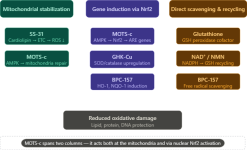
[DIAGRAM: Three routes — going directly inside mitochondria to reduce free radical production (SS-31, MOTS-c), activating antioxidant gene programs (MOTS-c, GHK-Cu, BPC-157), and directly neutralizing free radicals and recycling antioxidants (Glutathione, NAD⁺) Style: three-column pathway diagram]
SS-31 — stopping the problem at the source
SS-31 is a small synthetic peptide that works in a fundamentally different way to most antioxidants. Instead of neutralizing free radicals after they have formed, it fixes the structural problem inside mitochondria that causes excess production in the first place.
What to expect You will feel nothing from SS-31. No energy boost, no stimulation, no perceptible change. Its effects are structural and slow — they appear in measurements over weeks to months, not in how you feel. The people most likely to see meaningful change are those with confirmed mitochondrial dysfunction, cardiovascular disease, long-term anabolic steroid use (which specifically damages mitochondria in heart muscle), or conditions like heart failure. In healthy people the benefits exist but are harder to detect without objective testing. What to track: resting heart rate and exercise capacity over 8–12 weeks; a cardiac ultrasound (echocardiography) if heart function is a specific concern.
Inside every mitochondrion, the machinery that generates energy needs to be held in a precise arrangement to work properly. A molecule called
cardiolipin — found almost exclusively in this inner layer — acts as the structural glue that keeps that machinery in place. When free radicals damage cardiolipin, the machinery loses its structure, starts running inefficiently, and produces even more free radicals as a result. It becomes a self-reinforcing cycle that gets worse over time.
SS-31 concentrates in the mitochondrial membrane and stabilizes damaged cardiolipin. With the structural foundation restored, the energy-generating machinery returns to its correct arrangement, free radical production drops, and the cycle of worsening damage is broken.
SS-31 has completed Phase 2/3 human trials. In Barth syndrome — a rare genetic condition where cardiolipin is malformed from birth — it produced measurable improvements and received FDA approval under the name Forzinity. A larger trial in a different mitochondrial disease did not meet its primary goals in the overall patient group, and results in heart failure have been mixed. The compound works best when the underlying problem is specifically cardiolipin-related.
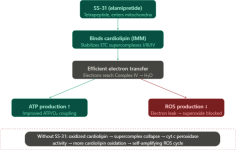
[DIAGRAM: SS-31 mechanism at inner mitochondrial membrane Shows: Cardiolipin → ETC supercomplexes → electron flow → ATP vs. ROS leak pathway Style: flowchart with dual-outcome branch]
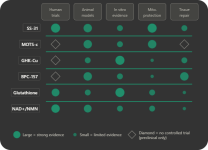
Evidence tier: Phase 2/3 human trial data for specific mitochondrial disease indications.
MOTS-c — a warning signal from the mitochondria themselves
MOTS-c is a small peptide that the mitochondria themselves produce — it is not encoded in the main DNA like most proteins. When a cell is under oxidative or metabolic stress, MOTS-c travels from the mitochondria to the cell nucleus (its control centre) and activates antioxidant gene programs there.
What to expect No subjective effect. MOTS-c activates gene programs that help cells handle oxidative and metabolic stress. The people most likely to see measurable benefit are those with insulin resistance, elevated inflammation, or declining metabolic function with age. Circulating MOTS-c levels decline with age and fall further in metabolic conditions — suggesting this internal warning system genuinely weakens over time. What to track: fasting blood glucose, insulin resistance markers (HOMA-IR, available from a standard blood panel), CRP (a general inflammation marker), and exercise capacity over 4–8 weeks. Human dosing is not established — the self-research community typically uses 5–10 mg subcutaneously several times weekly, but no human dose-response data exists.
The signaling works like this: when the power generators detect worsening conditions, they send MOTS-c as a distress signal to the control room. The control room responds by switching on protective programs. This makes MOTS-c unusual — most cellular signaling goes outward from the nucleus, not inward from the mitochondria. When MOTS-c levels fall with age, this early warning system becomes less responsive, and protective programs activate less readily under stress.
Evidence tier: Extensive preclinical data. Human observational data on declining MOTS-c in disease. No completed human therapeutic RCTs.
GHK-Cu — copper delivery and cellular maintenance
GHK-Cu is a small tripeptide — just three amino acids bound to a copper ion — that occurs naturally in the body and declines significantly with age. It works through several distinct mechanisms, none of which overlap much with the other compounds in this article.
What to expect No subjective effect. GHK-Cu works slowly — enzyme activation and tissue changes take weeks to months to accumulate. The most relevant people for its antioxidant use are those with chronic inflammation, documented oxidative stress, or accelerated tissue breakdown. It is most commonly used alongside BPC-157 in repair-focused stacks. What to track: CRP, IL-6 (an inflammation marker in standard bloodwork), and wound healing rate where relevant.
Several of the body's most important antioxidant enzymes cannot function without copper. GHK-Cu acts as a targeted delivery vehicle, getting copper into cells so those enzymes can operate at full capacity. Without adequate copper, these enzymes are present but inactive — supplementing them doesn't help if the cofactor they need isn't there.
Beyond copper delivery, GHK-Cu neutralizes the toxic damage products that free radicals leave behind in tissue. Free radicals don't just cause harm in the moment — they produce a trail of secondary byproducts that continue damaging nearby cells long after the original radical has been neutralized. GHK-Cu mops up several of these downstream molecules. It also keeps iron locked in its storage form, which matters because loose iron converts a mild cellular waste product into one of the most destructive reactive molecules in biology.
GHK-Cu also appears to influence gene expression broadly, shifting the behavior of aged, dysfunctional cells toward patterns more characteristic of younger cells. This has been documented in cell studies, though what it means for a living person over time is still being worked out.
Evidence tier: In vitro and animal data; some human skin aging data. No systemic human RCTs.
BPC-157 — situational cellular protection
BPC-157 is a 15-amino acid peptide originally isolated from a protective protein found in gastric juice. Most people know it for tissue healing and gut protection. Its antioxidant role is secondary to those functions but mechanistically real — particularly in acute damage contexts.
What to expect No subjective antioxidant effect. BPC-157's protective action is most relevant during active tissue damage, injury recovery, or chronic inflammatory conditions — not as a permanent baseline antioxidant supplement. Think of it as a compound that becomes more useful when the cell is under direct stress, rather than one you run continuously for general defense. What to track: tissue healing rate and inflammatory markers in the relevant injury or condition context.
BPC-157 contributes to antioxidant defense in two ways. First, its molecular structure allows it to directly capture and neutralize free radicals in tissue — particularly in locations that other antioxidants may not easily reach. Second, it activates a set of protective enzymes inside cells, increasing the cell's own capacity to handle oxidative damage. One of these enzymes breaks down a harmful molecule called heme and produces antioxidant compounds as a byproduct of doing so. The overall effect in damaged tissue models is a meaningful improvement in the balance between oxidative damage and protective capacity.
Evidence tier: Preclinical only. No completed human RCTs for antioxidant outcomes. Well-tolerated in a Phase IIa gut trial.
Glutathione (TAD-600) — the cell's primary antioxidant
Glutathione is not exotic — every cell makes it continuously, and it is the most abundant antioxidant molecule inside human cells, present in concentrations that dwarf vitamins C and E at the cellular level. TAD-600 is the injectable reduced form used in clinical and self-research contexts.
What to expect No subjective effect. The goal of supplementation is restoring levels that have declined with age, not exceeding normal. By age 60, tissue glutathione has dropped by 30–50% from young adult values — not because production stopped, but because the recycling system that regenerates it slows down. Oral glutathione supplements largely break down in the gut before being absorbed; IV forms, liposomal preparations, or precursor supplementation using NAC combined with glycine (sold as GlyNAC) are the approaches that actually raise tissue levels. What to track: CRP, liver enzymes, and blood pressure over 8–12 weeks.
Glutathione neutralizes free radicals directly. After doing so, it converts from its active form into a spent form — and then gets recycled back to active by an enzyme that requires a helper molecule generated from NAD⁺. This creates a direct dependency between glutathione and NAD⁺: when NAD⁺ levels fall with age, the recycling slows, spent glutathione accumulates, and antioxidant capacity drops — even if you are supplementing glutathione directly. This is why addressing both together is more effective than either alone.
Glutathione also serves as a cofactor for several detoxifying enzymes, neutralizes lipid peroxides that accumulate in cell membranes, and provides specific protection inside mitochondria — where it shields the same structural fat (cardiolipin) that SS-31 targets from a different angle.
Evidence tier: Extensive human data in liver disease, critical illness, and HIV. Age-related decline well documented. Human RCT data for GlyNAC supplementation in healthy older adults (Kumar et al., 2021).
NAD⁺ / NMN / NR — the upstream regulator
NAD⁺ is a molecule found in every cell that enzymes throughout the body need to function. It is not itself an antioxidant — it doesn't neutralize free radicals directly. What it does is power three separate protective systems that all matter for oxidative stress, which is why its steady decline with age has broad downstream consequences.
What to expect No acute antioxidant effect you will feel. NR at high doses may produce mild flushing — the niacin flush response, not a safety concern. Human trials confirm that NR at 1,000 mg/day and NMN at 500–1,000 mg/day raise NAD⁺ levels by 40–90%. Measurable outcomes to follow are inflammation markers, insulin sensitivity, and exercise capacity over 8–16 weeks. Oral forms perform well — injectable NMN has not been shown to outperform oral meaningfully. This is one of the most cost-effective compounds in the antioxidant category when taken orally.
The three routes it supports:
Gene regulation. NAD⁺ powers a family of enzymes called sirtuins, which act as regulators of protective gene programs — including the Nrf2 antioxidant switch. When NAD⁺ falls, these regulators go quiet, and the cell's gene-level protection becomes less responsive to oxidative stress.
DNA repair. The enzymes that fix oxidative DNA damage are heavy consumers of NAD⁺. Under chronic oxidative stress, they can deplete NAD⁺ faster than the cell replaces it, simultaneously collapsing energy production and antioxidant recycling. Restoring NAD⁺ breaks this cycle before it becomes self-sustaining.
Glutathione recycling. As covered in the glutathione section: NAD⁺ is required to recycle spent glutathione back to active form. Without adequate NAD⁺, the cell's primary antioxidant accumulates in its inactive state regardless of how much is being supplemented.
Evidence tier: Human RCT data for NAD⁺ repletion with NR and NMN. Mechanistic links to antioxidant defense well-established.
Brief notes on the remaining compounds
TB-500 (thymosin β4) is primarily a healing and anti-inflammatory compound. Its contribution to oxidative stress is indirect — less inflammation means fewer activated immune cells generating free radicals as a side effect. It is not a primary choice for antioxidant support specifically.
GH-axis peptides (ipamorelin, CJC-1295, GHRP-2/6, hexarelin) all raise growth hormone, which over time supports the creation of new mitochondria and improves metabolic efficiency — both of which reduce oxidative burden. These are broad systemic effects, not direct antioxidant mechanisms.
Semax and Selank are primarily nootropic and anxiolytic compounds. Semax supports production of BDNF (a protein that helps neurons survive and grow), which provides some brain-specific protection. This is not a basis for using either compound for general antioxidant purposes.
What you won't feel — and what to actually measure
| Compound | Felt effect | Timeline | What to actually track |
|---|
| SS-31 | None | Weeks–months | Resting HR, exercise capacity, cardiac ultrasound if relevant |
| MOTS-c | None | 4–8 weeks | Fasting glucose, HOMA-IR, CRP, exercise capacity |
| GHK-Cu | None | 4–12 weeks | CRP, IL-6, wound healing rate |
| BPC-157 | None (antioxidant) | Context-dependent | Tissue healing rate, inflammatory markers |
| Glutathione | None | Acute (IV) to weeks | CRP, liver enzymes, blood pressure |
| NAD⁺ / NMN | Occasional mild warmth (NR only) | 4–8 weeks | CRP, HbA1c, exercise capacity |
Core monitoring toolkit regardless of compound:
- High-sensitivity CRP — the most accessible general marker of systemic inflammation; responds to most antioxidant interventions over weeks to months
- Fasting glucose and insulin — oxidative stress impairs how cells respond to insulin; sustained improvement here is a real signal
- Blood pressure — damage to the lining of blood vessels raises blood pressure; a sustained decline over months reflects genuine vascular improvement
- Lipid panel — free radicals modify LDL cholesterol into a more harmful form; tracking this shows whether oxidative burden on the vascular system is improving
Stacking logic
These compounds address different parts of the same problem and can be combined without obvious conflict.
Start here — the foundation: Glutathione/GlyNAC + NAD⁺ precursor (NMN or NR). These support the recycling systems that all other antioxidant mechanisms depend on. They have the strongest human data in the category and are the most cost-effective starting point.
Add SS-31 if the focus is specifically mitochondrial function, energy production, or aging-related cellular decline. It targets cardiolipin integrity, which neither NAD⁺ nor glutathione directly address.
Add MOTS-c if the context involves insulin resistance, metabolic syndrome, or elevated systemic inflammation. It activates antioxidant gene programs through a different route than the foundation tier.
Add GHK-Cu and BPC-157 when the goal is active tissue recovery or managing a specific injury or inflammatory condition. These are most useful as targeted additions rather than permanent baseline compounds.
References
- Szeto HH. First-in-class cardiolipin-protective compound as a therapeutic agent to restore mitochondrial bioenergetics. Br J Pharmacol. 2014;171(8):2029–2050. PMID: 24117165
- Thompson RW, Hornby B, Manuel R, et al. A phase 2/3 randomized clinical trial to evaluate elamipretide in Barth syndrome. Genet Med. 2021;23(3):471–478. PMID: 33257863
- Karaa A, Bertini E, Carelli V, Cohen BH, et al. Efficacy and safety of elamipretide in individuals with primary mitochondrial myopathy: the MMPOWER-3 randomized clinical trial. Neurology. 2023;101(3):e238–e252. PMID: 37268435
- Campbell MD, Duan J, Samuelson AT, et al. Improving mitochondrial function with SS-31 reverses age-related redox stress and improves exercise tolerance in aged mice. Free Radic Biol Med. 2019;134:268–281. PMID: 30597195
- Lee C, Zeng J, Drew BG, et al. The mitochondrial-derived peptide MOTS-c promotes metabolic homeostasis and reduces obesity and insulin resistance. Cell Metab. 2015;21(3):443–454. PMID: 25738459
- Wan W, Zhang L, et al. Mitochondria-derived peptide MOTS-c: effects and mechanisms related to stress, metabolism and aging. J Transl Med. 2023;21(1):36. PMID: 36670507
- Pickart L, Vasquez-Soltero JM, Margolina A. GHK-Cu may prevent oxidative stress in skin by regulating copper and modifying expression of numerous antioxidant genes. Cosmetics. 2015;2(3):236–247.
- Pickart L, Margolina A. The human tripeptide GHK-Cu in prevention of oxidative stress and degenerative conditions of aging: implications for cognitive health. Oxid Med Cell Longev. 2012;2012:324832. PMID: 22666519
- Jóźwiak P, et al. Multifunctionality and possible medical application of the BPC 157 peptide — literature and patent review. Pharmaceuticals. 2025;18(2):185.
- Kumar P, Liu C, Hsu JW, et al. Glycine and N-acetylcysteine (GlyNAC) supplementation in older adults improves glutathione deficiency, oxidative stress, mitochondrial dysfunction, inflammation, insulin resistance, endothelial dysfunction, genotoxicity, muscle strength, and cognition. Clin Transl Med. 2021;11(3):e372. PMID: 33783984