Your body already knows how to heal. The problem is speed — and whether you end up with functional tissue or scar tissue.
After any injury, your body launches the same three-step repair process: first, it cleans up the damage (inflammation). Then, it builds new tissue to fill the gap (proliferation). Finally, it remodels that tissue from a rough draft into something structurally strong (remodeling). Every step depends on three things: enough blood reaching the injury, enough energy inside the cells doing the work, and the right chemical signals telling those cells what to do.
Peptides used for healing don't bypass this process. They remove the bottlenecks within it — growing blood vessels faster, pulling repair cells to the injury sooner, increasing collagen production, and making sure cells have the energy to follow through.
What to track
Regardless of protocol, monitor these: range of motion at the injury site, strength as % of pre-injury baseline, pain on a consistent scale, and sleep quality. For blood work: IGF-1, PINP (a marker of collagen synthesis — if it's going up, your body is making more collagen), CRP or ESR (markers of inflammation — if they're dropping, the injury is resolving), and a basic metabolic panel.
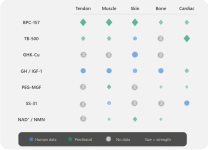
[DIAGRAM: Evidence matrix for tissue healing
Peptides Shows: Compound × tissue type matrix with circles (human data) and diamonds (preclinical) Style: Evidence matrix with size encoding strength]
At a glance:
| Compound | Role | You'll notice | Timeline | Evidence |
|---|
| BPC-157 | Builds new blood vessels to the injury | Less pain/swelling | 1–2 weeks | Extensive animal data; 3 small human studies |
| TB-500 | Gets repair cells to the injury faster | Less stiffness, better mobility | 2–4 weeks | Animal + Phase II/III human trials |
| GHK-Cu | Improves quality of new collagen | Better skin (topical); nothing (injected) | 4–8 weeks | Human trials (topical); animal (systemic) |
| Ipamorelin + CJC-1295 | Increases collagen production body-wide | Better sleep, water retention | 4–8 weeks | Well-studied GH secretagogues |
| PEG-MGF | Wakes up muscle stem cells | Improved gym recovery | 1–2 weeks | Animal studies; human cell data |
| SS-31 | Restores energy production inside cells | Better exercise tolerance | 2–4 weeks | Phase II/III human trials (cardiac) |
| NAD⁺ / NMN | Fuel for all repair enzymes | Nothing directly | Weeks | Animal (skin, bone) |
| TAD-600 | Protects new tissue from damage | Nothing | — | Established biology; no wound trials |
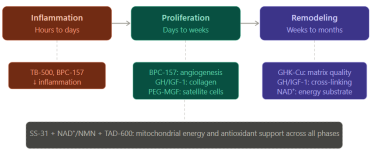
[DIAGRAM: Tissue healing phases overview Shows: Three-phase cascade (inflammation → proliferation → remodeling) with peptide intervention points Style: Flowchart with annotation boxes]
The core healing pair: BPC-157 + TB-500
These two are the foundation of most peptide healing protocols. They target complementary bottlenecks — blood supply and cell migration — which is why they're often stacked together.
BPC-157 — the blood vessel builder
BPC-157 is a 15-amino-acid peptide originally found in human stomach juice. Its main job is growing new blood vessels to the injury site — a process called angiogenesis. Injured tissue can't heal without blood supply, because blood carries the oxygen, nutrients, and repair cells that do the actual rebuilding. Tendons and ligaments heal slowly precisely because they have poor natural blood supply. Anything that increases vascularization there has an outsized impact.
How it works: BPC-157 increases production of a molecule called nitric oxide (NO). Nitric oxide does two things that matter for healing — it widens existing blood vessels (so more blood reaches the injury) and it triggers the growth of entirely new blood vessels into the damaged area.
What makes BPC-157 unusual is that it reaches this endpoint through two separate pathways that work independently of each other:
Route 1 — BPC-157 causes cells to produce more of a growth signal called VEGF (vascular endothelial growth factor — essentially a "build blood vessels here" signal). VEGF lands on receptors on the surface of blood vessel cells and kicks off a chain reaction inside those cells. That chain reaction ends with the activation of an enzyme called eNOS, which is the enzyme that actually produces nitric oxide. Think of VEGF as a work order, the receptor as the foreman receiving it, and eNOS as the worker who actually does the job.
Route 2 — BPC-157 also activates eNOS through a completely different route that doesn't need VEGF at all. Inside cells, eNOS is normally kept locked up by a protein called caveolin-1 — think of it as a cage. BPC-157 triggers a different enzyme (Src kinase) that unlocks that cage, releasing eNOS to produce nitric oxide independently.
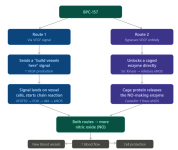
[DIAGRAM: BPC-157 dual pathway mechanism Shows: Two routes converging on nitric oxide → angiogenesis, vasodilation, cytoprotection Style: Dual-pathway flowchart]
Having two independent routes to the same result is why BPC-157 is so consistent in animal studies — blocking one pathway doesn't eliminate the effect, because the other one is still running.
There's a second mechanism worth knowing: BPC-157 makes tendon cells more sensitive to growth hormone. Specifically, it increases the number of growth hormone receptors on tendon fibroblasts (the cells that build tendon tissue). This means if you're also running GH secretagogues, your tendons will respond to that growth hormone more strongly than they otherwise would — BPC-157 effectively amplifies the signal.
In animal models, BPC-157 has accelerated healing of cut Achilles tendons, severed muscle-tendon junctions, torn ligaments, crushed muscle, burns, diabetic ulcers, and bone fractures. It works via injection, oral, and topical routes — unusual for a peptide, since most are destroyed by stomach acid. BPC-157 was originally isolated from gastric juice, so acid stability makes sense biologically.
The caveat: only three small human pilot studies exist as of 2026. The animal evidence is unusually consistent and large, but formal large-scale human trials have not been done.
TB-500 — the cell traffic coordinator
TB-500 is a synthetic fragment of thymosin beta-4, a protein found in nearly every cell in your body. Where BPC-157 builds the roads (blood vessels), TB-500 moves the traffic (repair cells).
How it works: every cell in your body has an internal skeleton made of a protein called actin. This skeleton determines whether a cell can move or not — cells rearrange their actin to push themselves forward, similar to how an amoeba moves. TB-500 binds to individual actin molecules and helps them assemble into the filament structures cells need for movement. The result: repair cells physically migrate to injury sites faster.
This matters because healing depends on getting the right cells to the right place. Endothelial cells (which build blood vessels), keratinocytes (which rebuild skin), and stem cells all need to travel to the injury before they can do anything useful. TB-500 accelerates that commute.
TB-500 also shifts inflammatory signaling in an important way. After an injury, your immune system produces inflammatory signals called cytokines — molecules that coordinate the cleanup and repair process. Early on, pro-inflammatory cytokines dominate (they recruit immune cells to clear debris). Later, the balance needs to shift toward anti-inflammatory and pro-resolution signals so actual rebuilding can begin. TB-500 helps push this transition forward — not by suppressing the immune response (which would be counterproductive), but by helping the body move through the inflammatory phase faster and into the rebuilding phase.
Additionally, TB-500 reduces cell death at the injury margin. When tissue is damaged, cells at the edges of the injury often die from the stress — a process called apoptosis. Fewer cells dying means more viable material available for the repair process to work with.
BPC-157 builds the roads, TB-500 moves the traffic. Roads without traffic are empty infrastructure. Traffic without roads starves. This is why the combination — sometimes called the "Wolverine stack" — makes mechanistic sense: they address complementary bottlenecks.
TB-500 has stronger human data than BPC-157. Phase I safety trials showed it was safe at IV doses up to 1,260 mg/day for 14 days — roughly 250–600× higher than typical subcutaneous doses, indicating a wide safety margin. Phase II trials showed accelerated healing of chronic venous ulcers and pressure ulcers. A Phase III trial demonstrated improved corneal healing.
Do they actually synergize?
The non-overlapping mechanisms make the combination logically sound. Rodent studies using both compounds showed better collagen organization and blood vessel density than either compound alone. Whether this constitutes true pharmacological synergy (combined effect exceeding the sum of individual effects) versus simple additive benefit hasn't been rigorously tested — but the rationale is real, not marketing.
Collagen quality: GHK-Cu
GHK-Cu enters the picture later — during the remodeling phase, when the body is replacing its initial rough collagen with organized, functional tissue.
After an injury, the body first lays down type III collagen — a quick, disorganized patch job. Over weeks to months, this gets gradually replaced with type I collagen — the strong, organized structural protein that gives tendons their tensile strength and skin its elasticity. This remodeling phase determines whether you end up with functional tissue or a stiff scar.
How it works: GHK is a tiny three-amino-acid peptide naturally circulating in your blood, complexed with copper ions. It's present at birth and declines roughly 60% by age 60. It stimulates fibroblasts (the cells that build connective tissue) to produce collagen, along with decorin — a molecule that acts as a collagen organizer, arranging fibers into proper parallel bundles instead of random tangles.
What makes GHK-Cu different from simple growth factors: it doesn't just tell cells to build more. It simultaneously manages the breakdown of damaged, disorganized matrix (using enzymes called metalloproteinases) while promoting the deposition of organized new matrix. It's a quality controller — cleaning up bad tissue and laying down good tissue at the same time.
In wound chamber experiments, GHK-Cu increased collagen content up to 538% versus controls. Human trials using topical GHK-Cu showed increased skin thickness, better elasticity, and more collagen production. One practical limitation: enzymes in the bloodstream (carboxypeptidases) rapidly break GHK-Cu down, making injected systemic bioavailability uncertain. Topical application is better supported by the data.
When to add it: after the injury has moved past the acute phase into remodeling. If the bottleneck is still "not enough tissue," BPC-157 is doing the relevant work. If scar quality matters — visible scars, adhesions, tendon stiffness — that's GHK-Cu's window.
Growth infrastructure: the GH/IGF-1 axis
BPC-157 and TB-500 tell the body to repair faster. But the body still needs raw materials to build with — primarily collagen. That's what the growth hormone axis provides.
How it works: your pituitary gland (a small gland at the base of your brain) releases growth hormone (GH) in pulses, primarily during deep sleep. GH travels to the liver and tells it to produce IGF-1 (insulin-like growth factor 1). IGF-1 then circulates body-wide and tells fibroblasts to synthesize collagen — the structural protein that tendons, ligaments, skin, and bone are built from.
A study in healthy men showed that 14 days of GH administration increased tendon collagen production while leaving muscle protein synthesis unchanged — GH preferentially targets connective tissue. Direct IGF-1 injection into patellar tendons increased collagen synthesis rate in humans.
Ipamorelin is a peptide that triggers your pituitary to release GH — selectively, without also spiking cortisol (the stress hormone)
or prolactin.
CJC-1295 no DAC amplifies those GH pulses, making each one larger. Together, they produce a natural GH release pattern rather than flooding the system with exogenous hormone, resulting in fewer side effects (less insulin resistance, less water retention) than injecting GH directly.
IGF-1 LR3 skips the GH step entirely and delivers IGF-1 directly, with a longer half-life than the body's own version. Evidence for tendon collagen stimulation is solid, but systemic IGF-1 carries risks around insulin sensitivity and potential tumor promotion that secretagogues largely avoid.
PEG-MGF is muscle-specific. Along every muscle fiber sit dormant stem cells called satellite cells. When muscle is damaged, these cells wake up, multiply, and fuse with the injured fibers to restore them — essentially donating new nuclei that the fiber needs to rebuild. Without satellite cell activation, muscle repair capacity hits a ceiling regardless of how much protein or growth factor is available. PEG-MGF (pegylated mechano growth factor) activates this process. The PEGylation extends its lifespan in the body from minutes to hours. Important distinction: PEG-MGF tells satellite cells to wake up and multiply. IGF-1 tells those cells to mature into functional muscle fibers. These are sequential steps — don't run them simultaneously.
Energy foundation: SS-31, NMN, TAD-600
These compounds don't repair tissue. They make sure cells have the energy and protection to execute the repair signals from everything above.
Every cellular process — building collagen, migrating to an injury, dividing to produce new cells — runs on ATP, the energy currency produced by mitochondria (the power generators inside every cell). Every defense against oxidative damage depends on substrates like NAD⁺ and glutathione. In young, healthy individuals, these are usually adequate. But in anyone over ~35, chronically inflamed, sleep-deprived, or metabolically stressed, the energy supply is already running low. Adding more repair signals on top of an energy deficit is like hiring more construction workers when there's no electricity on the job site.
SS-31 (Elamipretide) targets the mitochondria directly. It binds to a molecule called cardiolipin in the inner mitochondrial membrane — cardiolipin is the structural lipid that holds the energy-producing machinery (the electron transport chain) in its proper configuration. When cardiolipin is damaged (by age, inflammation, or oxidative stress), the machinery falls apart and ATP output drops. SS-31 stabilizes it, restoring energy production. Preclinical data shows restored mitochondrial structure within 48 hours. Phase II/III human trials are active for cardiac and mitochondrial conditions.
NAD⁺ / NMN — NAD⁺ (nicotinamide adenine dinucleotide) is a molecule required by virtually every repair enzyme in the body. Sirtuins (enzymes that regulate DNA repair and aging) need NAD⁺. PARPs (enzymes that fix DNA damage) need NAD⁺. Collagen regulation pathways need NAD⁺. The problem: NAD⁺ levels decline with age and are rapidly consumed by inflammation. NMN (nicotinamide mononucleotide) is its most efficient precursor — the body converts NMN into NAD⁺. In aged mice, NMN supplementation restored wound healing capacity. In fracture models, it enhanced bone callus formation.
TAD-600 provides the raw material for glutathione — the body's main intracellular antioxidant. During tissue repair, inflammation produces reactive oxygen species (essentially molecular shrapnel) that damage newly forming tissue as fast as it's built. Glutathione neutralizes this damage. TAD-600 ensures the supply doesn't run out during the repair process.
Who needs this layer: young, metabolically healthy individuals probably don't. It becomes relevant if you're over 35–40, metabolically compromised, dealing with chronic inflammation, or finding that direct repair
Peptides aren't producing expected results — in which case the bottleneck may be cellular energy, not signaling.
Theoretical healing stack
Think of the stack as a construction project. Layer 1 is the crew on the ground doing the actual building — patching walls, laying pipe, pouring foundation. Layer 2 is the supply chain delivering raw materials to the site. Layer 3 is the power grid keeping the lights on and the equipment running. All three matter, but you can't pour a foundation without concrete (Layer 2), and you can't mix concrete without electricity (Layer 3).
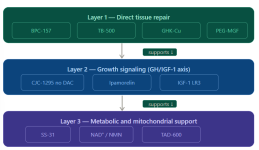
[DIAGRAM: Healing stack architecture Shows: Three-layer stack with specific compounds per layer Style: Structural/containment diagram]
Layer 1 — Direct repair (the crew on the ground)
This is where the actual tissue repair happens. BPC-157 builds new blood vessels to the injury and amplifies every repair signal in the area. TB-500 makes sure repair cells can physically get there and shifts inflammation from "active destruction" toward "cleanup and rebuild." Together, they address the two most common bottlenecks in healing: not enough blood supply, and not enough cell migration.
- BPC-157: 250–500 mcg/day, subcutaneous near injury site (or oral if injection isn't an option)
- TB-500: 2–2.5 mg twice weekly for first 4 weeks (loading), then 2 mg weekly (maintenance)
Layer 2 — Growth signaling (the supply chain)
BPC-157 and TB-500 can tell your body to repair faster, but the body still needs raw materials — primarily collagen. The GH/IGF-1 axis provides this. Growth hormone tells your liver to produce IGF-1, and IGF-1 tells fibroblasts to synthesize collagen. Without this layer, you're sending more construction workers to a site with no concrete.
- Ipamorelin: 200–300 mcg before bed
- CJC-1295 no DAC: 100 mcg before bed (paired with ipamorelin)
Layer 3 — Metabolic support (the power grid)
Every cellular process in Layers 1 and 2 runs on ATP. Every defense protecting new tissue from inflammatory damage depends on substrates like NAD⁺ and glutathione. In young, healthy individuals, these are usually adequate. But in anyone over ~35, chronically inflamed, or metabolically stressed, the power grid is already running at reduced capacity. Adding repair signals on top of an energy deficit is like running power tools on a dying generator.
- NMN: 250–500 mg oral daily
- TAD-600: 200–400 mg oral or 200 mg IM weekly
Additions based on injury type
- Tendon/ligament injury: Prioritize BPC-157 via local injection near the tendon. Tendons have poor natural blood supply, so BPC-157's angiogenic effect and GH receptor upregulation in tendon fibroblasts have outsized impact here.
- Muscle tear/strain: Add PEG-MGF (200–400 mcg post-workout, 2–3×/week) to recruit satellite cells. Without them, muscle repair hits a ceiling regardless of other compounds.
- Skin wound/post-surgical: Add GHK-Cu topically (0.01–0.1% cream/serum) after wound closure. GHK-Cu improves remodeling quality, not initial closure.
- Chronic/slow-healing or older individual: Add SS-31 (0.5–1 mg/day subcutaneous). If repair peptides aren't producing results, the bottleneck may be cellular energy, not signaling.
Remodeling phase (weeks 4–12+)
- Taper TB-500 loading to maintenance (the acute cell migration demand has passed)
- Add GHK-Cu topically if scar quality matters — this is its window
- Continue GH secretagogues — collagen remodeling is slow and benefits from sustained IGF-1 over months
- Continue NMN — remodeling is energy-intensive and lasts 3–6 months for connective tissue
What not to do
Don't take NSAIDs in the first 48–72 hours after injury.
NSAIDs — non-steroidal anti-inflammatory drugs — are common painkillers you probably have in your medicine cabinet: ibuprofen (Advil/Motrin), naproxen (Aleve), and aspirin. They work by blocking enzymes called COX-1 and COX-2, which your body use
s to produce prostaglandins — small signaling molecules that cause pain, swelling, and inflammation.
The problem: that early inflammatory response isn't just causing you pain. It's also doing critical work — recruiting immune cells to clean debris, signaling for new blood vessel growth, and activating repair cascades. Prostaglandins are part of the "build blood vessels here" signal. Blocking them entirely in the first 48–72 hours can delay the very process you're trying to accelerate. After that initial window, the acute signaling work is largely done and NSAIDs become less problematic.
If you need pain management in that early window, acetaminophen (Tylenol in the US, paracetamol in Europe) is a better option — it reduces pain through a different mechanism that doesn't suppress the inflammatory cascade needed for healing.
This is also why TB-500's anti-inflammatory effect is different from NSAIDs in a way that matters: NSAIDs block inflammation from happening. TB-500 doesn't block it — it helps the body move
through it faster. It shifts the cytokine balance from "active cleanup" toward "resolution and rebuilding." That distinction is meaningful — one prevents a necessary process, the other accelerates it.
Don't run PEG-MGF and IGF-1 LR3 at the same time.
They target sequential steps in muscle repair. PEG-MGF tells satellite cells to wake up and multiply (proliferation). IGF-1 tells those cells to mature into functional muscle fibers (differentiation). Pushing both signals simultaneously is contradictory — you're telling cells to keep dividing and to stop dividing and mature at the same time. Alternating protocols (PEG-MGF post-workout, IGF-1 on rest days) align with the natural sequence.
Don't expect fast results from GH secretagogues.
Ipamorelin and CJC-1295 are infrastructure compounds. Collagen synthesis takes weeks to measurably increase, and the remodeling process that converts rough type III collagen to strong type I collagen runs for months. These compounds are a slow, broad investment — not an acute intervention.
Don't skip the loading phase for TB-500.
TB-500 needs to reach sufficient levels throughout the body before its effects on cell migration and inflammation resolution become consistent. The twice-weekly loading for 4 weeks isn't arbitrary — it reflects the time needed to build tissue-level concentrations of a compound that distributes system-wide rather than acting locally.
Common questions
Which peptide first if I can only pick one?
BPC-157. Broadest preclinical evidence across the most tissue types, strongest connection to the main bottleneck in most injuries (blood supply), and least systemic side-effect risk. For muscle-specific training injuries, TB-500 is a reasonable alternative.
Oral or injection for BPC-157?
Both work in animal models. BPC-157 is acid-stable and survives stomach passage. Subcutaneous injection near the injury produces higher local concentrations — better for tendons and ligaments. Oral makes more sense for gut-related issues.
How long should I run a healing stack?
Acute/loading phase: 4–8 weeks. Then maintenance through active remodeling — 3–6 months for tendons and ligaments. Track functional benchmarks (strength, range of motion) rather than calendar time. When progress plateaus for 2+ weeks, the tissue has likely reached its current remodeling ceiling.
Will I feel anything?
BPC-157 may visibly reduce pain and swelling. TB-500 may improve flexibility. Ipamorelin usually improves sleep. Everything else — collagen synthesis, satellite cell activation, mitochondrial restoration — is silent. Track objectively with range of motion, strength tests, and blood markers.
Is any of this FDA-approved?
No compound in this stack is FDA-approved for tissue healing. BPC-157 and TB-500 are under active FDA review as bulk drug substances. SS-31 is furthest along clinically (Phase II/III for cardiac conditions). This is an off-label, self-research context.
References
- McGuire FP, Cushman DM. Regeneration or Risk? A Narrative Review of BPC-157 for Musculoskeletal Healing. Curr Rev Musculoskelet Med. 2025. PMID: 40789979
- Chang CH, Tsai WC, Lin MS, Hsu YH, Pang JH. Pentadecapeptide BPC 157 Enhances the Growth Hormone Receptor Expression in Tendon Fibroblasts. Molecules. 2014;19(11):19066-19077. PMID: 25415472
- Chang CH, Tsai WC, Hsu YH, Pang JH. The promoting effect of pentadecapeptide BPC 157 on tendon healing involves tendon outgrowth, cell survival, and cell migration. J Appl Physiol. 2011;110(3):774-780. PMID: 21030672
- Staresinic M, et al. Stable Gastric Pentadecapeptide BPC 157 and Striated, Smooth, and Heart Muscle. Biomedicines. 2022;10(12):3276. PMID: 36551977
- Pickart L, Vasquez-Soltero JM, Margolina A. GHK Peptide as a Natural Modulator of Multiple Cellular Pathways in Skin Regeneration. Biomed Res Int. 2015;2015:648108. PMID: 26236730
- Maquart FX, et al. Stimulation of collagen synthesis in fibroblast cultures by the tripeptide-copper complex glycyl-L-histidyl-L-lysine-Cu2+. FEBS Lett. 1988;238(2):343-346. PMID: 3169264
- Doessing S, et al. Growth hormone stimulates the collagen synthesis in human tendon and skeletal muscle without affecting myofibrillar protein synthesis. J Physiol. 2010;588(Pt 2):341-351. PMID: 19933753
- Hansen M, et al. Local administration of insulin-like growth factor-I (IGF-I) stimulates tendon collagen synthesis in humans. Scand J Med Sci Sports. 2013;23(5):614-619. PMID: 22288768
- Kandalla PK, et al. Mechano Growth Factor E peptide (MGF-E) activates human muscle progenitor cells and induces an increase in their fusion potential at different ages. Mech Ageing Dev. 2011;132(4):154-162. PMID: 21354439
- Wong W, et al. Pgc-1α controls epidermal stem cell fate and skin repair by sustaining NAD(+) homeostasis during aging. Mol Metab. 2022;65:101575. PMID: 35987498
- Zhao K, et al. Cell-permeable peptide antioxidants targeted to inner mitochondrial membrane inhibit mitochondrial swelling, oxidative cell death, and reperfusion injury. J Biol Chem. 2004;279(33):34682-34690. PMID: 15178689
- Treadwell T, et al. The regenerative peptide thymosin β4 accelerates the rate of dermal healing in preclinical animal models and in patients. Ann N Y Acad Sci. 2012;1270:37-44. PMID: 23050815
- Kleinman HK, Sosne G. Thymosin β4 Promotes Dermal Healing. Vitam Horm. 2016;102:251-275. PMID: 27450738
- Guarnera G, et al. The effect of thymosin treatment of venous ulcers. Ann N Y Acad Sci. 2010;1194:207-212. PMID: 20536470
- Shi Y, et al. Nicotinamide mononucleotide enhances fracture healing by promoting skeletal stem cell proliferation. Theranostics. 2024;14:5999-6015. PMID: 39346542
- Pickart L, et al. Regenerative and Protective Actions of the GHK-Cu Peptide in the Light of the New Gene Data. Int J Mol Sci. 2018;19(7):1987. PMID: 29986520