Sleep is not passive rest. During the deepest stages of sleep, your body runs its main tissue repair cycle, consolidates memory, regulates hormones, and clears metabolic waste from the brain. The
Peptides covered in this article don't work by making you feel sleepy — they work by modifying the biological processes that determine whether sleep is restorative.
This article covers two distinct problems:
sleep architecture disruption (you sleep but don't recover) and
anxiety-driven insomnia (you don't sleep well because your nervous system won't quiet down). The compounds relevant to each problem are mechanistically different, and conflating them is one of the most common errors in peptide protocol design.
The question this article answers: which
Peptides support better sleep quality and faster recovery, how do they work, and what can you realistically expect from each?
Quick-reference overview
| Compound | Main role in sleep/recovery | What you'll likely notice | Evidence level |
|---|
| CJC-1295 (no DAC) | Amplifies slow-wave GH pulse | Deeper sleep, vivid dreams (weeks 3–6+) | Human RCT (GH axis); sleep via GHRH mechanism |
| Ipamorelin | Synergistic GH release, clean profile | Minimal subjective; stack with CJC-1295 | Human data (GH axis); sleep effect indirect |
| DSIP | Delta sleep modulation; state-dependent sleep normalisation | Subtle improvement in sleep depth and onset if baseline is disrupted; nothing if sleep is normal | Mixed human studies (insomnia, withdrawal); no large RCTs |
| Selank | Reduces hyperarousal, normalises GABAergic tone | Calmer pre-sleep state, reduced rumination | Clinical RCTs (Russia); anxiolytic comparable to BDZ |
| Semax | Stress-axis regulation, BDNF, HPA dampening | Reduced daytime stress bleed into sleep | Phase 2/3 human data; sleep benefit secondary |
| Epitalon | Pineal melatonin synthesis restoration; circadian gene modulation | More consistent sleep pressure timing; primarily in older users or those with circadian disruption | Early human data; primate data; Khavinson group primarily |
| PE-22-28 | Depression/anhedonia-disrupted sleep | Improved mood → improved sleep architecture | Preclinical only |
| BPC-157 | Reduces inflammation/pain disrupting sleep | Reduced soreness; may notice deeper sleep | Preclinical only |
| TB-500 | Systemic repair, reduced fatigue | Faster post-training recovery | Preclinical only |
| SS-31 | Mitochondrial repair during recovery | None subjective; supports recovery capacity | Preclinical + Phase 2 human (cardiac) |
| GHK-Cu | Anti-inflammatory, collagen | None subjective | Preclinical only |
What you need to understand first: the sleep-GH relationship
Growth hormone (GH) is not simply a muscle-building molecule. Its largest daily pulse occurs during
N3 sleep — the deepest, slowest-wave stage that typically occupies the first 1–2 hours of the night. This pulse drives the majority of cellular repair, protein synthesis, and tissue remodelling that happens during sleep. In GH-deficient individuals, N3 sleep is fragmented, shorter, and less restorative, and this pattern is partially reversible with GH restoration.
The endogenous signal that triggers this GH pulse is
GHRH (growth hormone-releasing hormone), released from the hypothalamus. GHRH is not only pro-GH: it is independently somnogenic in humans, meaning it actively promotes slow-wave sleep beyond whatever effect GH itself has. This is the mechanistic basis for using GHRH analogs (like CJC-1295) to improve sleep architecture.
A critical distinction, often wrong in popular sources:
GHRPs (ghrelin receptor agonists like ipamorelin) do not independently enhance slow-wave sleep in humans. A controlled human study administering GHRP-2 — with GH elevations comparable to GHRH — found no enhancement of slow-wave sleep whatsoever. The somnogenic effect belongs to the GHRH axis, not the ghrelin axis. Ipamorelin is valuable as part of a stack because it amplifies GH release synergistically, but it is not itself sleep-promoting.
The second major mechanism is
anxiety and hyperarousal, which disrupts sleep architecture through a completely different pathway. Chronic elevated arousal — driven by dysregulated GABA signalling, elevated cortisol, and HPA axis overactivation — keeps the brain from descending into N3 efficiently. The nootropic/anxiolytic peptide Selank targets this pathway.
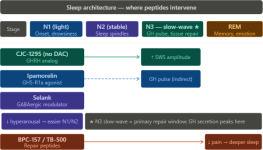
[DIAGRAM: Sleep architecture and peptide intervention points Shows: four sleep stages (N1, N2, N3, REM) with compound-level annotations indicating where each peptide class acts Style: structural overview with stage columns and compound rows]
The GH-axis stack: CJC-1295 + Ipamorelin
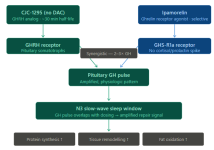
[DIAGRAM: CJC-1295 and ipamorelin dual mechanism Shows: GHRH-R and GHS-R1a convergence → pituitary GH → N3 sleep window → repair outcomes Style: flowchart, dual-entry convergence]
CJC-1295 (no DAC) — the somnogenic GHRH signal
What to expect
You probably won't feel CJC-1295 working for the first 2–3 weeks. Around weeks 3–6, many users report deeper sleep, more vivid dreams, and waking more refreshed — though this is gradual and individual. You will not feel "sedated." The mechanism is upstream amplification of a pulse that was already happening; the subjective shift is subtle.
- Onset: Physiological GH changes within days; sleep architecture shift over 3–6 weeks
- What you may feel: Heavier limbs before sleep, more vivid dreams, improved morning recovery
- What you won't feel: GH itself working, IGF-1 rising, collagen synthesis occurring
- Who benefits most: Users with blunted GH pulses (over 30, AAS history, high stress, poor sleep), athletes with high recovery demands
- How to verify: Fasting IGF-1 at baseline and 6–8 weeks; subjective sleep quality log
CJC-1295 without DAC (also called Mod GRF 1-29) is a modified analog of endogenous GHRH with a half-life of approximately 30 minutes, extended from natural GHRH's 2–7 minutes via amino acid substitutions that resist enzymatic degradation. It binds the GHRH receptor on pituitary somatotrophs, activating the cAMP/PKA pathway and triggering GH release from storage granules.
The sleep connection is mechanistically distinct from the GH effect: GHRH itself is somnogenic in humans, independently increasing slow-wave sleep when administered during the night. The current model is that GHRH-responsive neurons in the anterior hypothalamus interface with sleep-promoting circuits, promoting the descent into N3 sleep. This effect is not replicated by ghrelin receptor agonists (GHRPs), even when those agonists produce equivalent GH elevations.
Dosing for sleep
100–300 mcg subcutaneous, 30–60 minutes before sleep. The pre-sleep window positions the peptide to overlap with the body's natural first-of-night GH pulse. Taking CJC-1295 with DAC (weekly dosing) produces sustained IGF-1 elevation but a blunted pulsatile pattern — less desirable for sleep architecture, which benefits from the sharp nocturnal pulse.
Evidence tier
CJC-1295 has two human RCTs demonstrating dose-dependent GH and IGF-1 elevation. The sleep benefit is supported mechanistically by GHRH's somnogenic action in human studies, but CJC-1295 specifically has not been tested in sleep RCTs. The mechanism is solid; the translation is extrapolation.
Ipamorelin — the clean amplifier (but not the sleep driver)
What to expect
Ipamorelin's contribution to sleep comes primarily through its synergistic amplification of the GH pulse driven by CJC-1295, not through independent sleep-promoting action. Used alone, it produces a physiologically significant GH release but minimal change to sleep architecture. Its value in a sleep-focused protocol is its selectivity: no cortisol, no prolactin, no significant hunger spike — meaning it doesn't introduce variables that would undermine sleep quality.
- Onset: GH peak within 45–60 minutes of injection
- What you may feel: Minimal alone; part of recovery in combination with CJC-1295
- Who benefits most: Users sensitive to cortisol spikes from older GHRPs (GHRP-6, hexarelin)
- How to verify: IGF-1 as proxy; compare morning recovery scores solo vs. stacked
Ipamorelin activates GHS-R1a (the ghrelin receptor) in pituitary somatotrophs. Unlike GHRP-2, GHRP-6, and hexarelin, ipamorelin's receptor binding is selective enough that it does not co-activate the ACTH/cortisol pathway or stimulate prolactin release. This selectivity matters for sleep: elevated evening cortisol is one of the most reliable destroyers of sleep quality, and older GHRPs that raise it are mechanistically counterproductive for this application. A human trial from 1999 confirmed ipamorelin produces robust GH secretion in multiple dose cohorts, with peak concentrations at approximately 45–60 minutes.
When combined with CJC-1295, the two
Peptides activate separate receptor populations on the same cell type. The result is a synergistic GH release estimated at 2–3× either peptide alone — relevant because the amplitude of the nocturnal GH pulse is correlated with the depth and quality of slow-wave sleep.
Evidence tier
Human data supporting GH secretagogue effect; sleep benefit is mechanistically inferred from GH/SWS relationship, not directly demonstrated for ipamorelin specifically.
DSIP — the endogenous sleep modulator
What to expect
DSIP is unusual among sleep compounds in two ways: it is endogenous (your body already makes it, with plasma levels that follow a diurnal pattern), and it is not a sedative. It modulates sleep pressure rather than forcing it. The most counterintuitive practical implication is that DSIP works better administered during the day, not immediately before sleep — effects on sleep quality appear the following night and can persist for several nights. Users with disrupted sleep will notice more than users who already sleep normally, because DSIP's activity is proportional to how far sleep is from its healthy baseline.
- Onset: Sleep quality improvement the night after (or night of late-day) administration; not immediate
- What you may feel: Easier sleep onset, longer N3 duration; effect is subtle, not sedating
- What you won't feel: Sedation, impairment, or hangover at therapeutic doses
- Who benefits most: Insomnia, fragmented sleep, shift workers, opioid/alcohol withdrawal-related sleep disruption
- How to verify: Sleep quality log, sleep latency timing; PSQI across 2–4 weeks
- Caution: Avoid combining with ACE inhibitors (captopril, enalapril, etc.) — both DSIP and ACE inhibitors are substrates of aminopeptidases; interaction is pharmacokinetically plausible though not well-characterised in humans
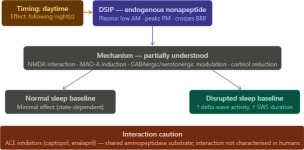
[DIAGRAM: DSIP mechanism and timing Shows: endogenous diurnal pattern, state-dependent effect on delta sleep, daytime administration → following night sleep benefit Style: flowchart with state-dependent branching]
DSIP (Delta Sleep-Inducing Peptide) is a nonapeptide (Trp-Ala-Gly-Gly-Asp-Ala-Ser-Gly-Glu) originally isolated from rabbit cerebral venous blood in 1977 by the Schoenenberger-Monnier group after electrical stimulation of thalamic nuclei. It is endogenous in humans — present in the hypothalamus, limbic system, pituitary, peripheral organs, and notably in human breast milk at concentrations of 10–30 ng/mL. Plasma DSIP shows diurnal variation: low in the morning, higher in the afternoon and evening.
The mechanism remains incompletely understood, which is a real limitation. Several pathways have been proposed: interaction with NMDA receptors, induction of cerebral MAO-A activity, modulation of GABAergic, serotonergic, noradrenergic, and histaminergic systems, and indirect effects on cortisol and circadian locomotor rhythms. The peptide does not map cleanly to a single target, which is why it has been difficult to study systematically. One consistent pattern across the literature is that DSIP's effect is
state-dependent — the weaker the baseline sleep quality, the larger the observed effect. In healthy subjects with normal sleep, effects are minimal.
A critically important pharmacological property: DSIP crosses the blood-brain barrier freely and is absorbed from the gut without significant degradation by digestive enzymes — both unusual for a peptide. Its plasma half-life is approximately 7–8 minutes, but its behavioural effects persist far longer than this would suggest, indicating either receptor-level downstream persistence or that it complexes with carrier proteins in vivo.
The human evidence is mixed but real. Several studies in insomnia patients reported improved sleep architecture (increased delta wave activity, reduced sleep latency). One pilot study also found effects on psychomotor performance and on withdrawal symptoms in alcoholics and opiate addicts. No dose has ever produced lethality in animal studies; reported side effects in humans are transient (headache, nausea, vertigo) at higher doses. The dose-response curve is described as U-shaped for both dose and duration of infusion — meaning there is an effective range beyond which effects diminish or reverse.
Dosing used in research
25–50 mcg/kg intravenous (original studies) or subcutaneous; intranasal is used experimentally (shown to cross BBB effectively via this route). Timing: afternoon or early evening administration, not immediately pre-sleep. No tolerance develops, but receptor downregulation over extended use is not ruled out.
Evidence tier
Human studies exist for insomnia and withdrawal contexts; results are mixed across different patient populations. More consistent in disturbed-sleep populations than in healthy controls. No large RCTs. Mechanistic picture is incomplete.
The anxiety pathway: Selank
What to expect
Selank's sleep benefit is indirect but real: it reduces the hyperarousal state that prevents efficient sleep onset and disrupts sleep architecture. You won't feel sedated. The subjective experience is a reduction in mental noise, rumination, and baseline tension before sleep — not drowsiness. This matters because anxiety-driven insomnia responds poorly to compounds that simply force sedation; the underlying arousal bleed-through continues to fragment sleep even when onset improves.
- Onset: Anxiolytic effects within 20–40 minutes of intranasal administration
- What you may feel: Calmer pre-sleep cognition, reduced racing thoughts, easier wind-down
- What you won't feel: Sedation, cognitive impairment, or altered consciousness
- Who benefits most: Users with hyperarousal-pattern insomnia, high stress load, GAD, PTSD
- How to verify: Subjective sleep onset latency; anxiety scale (GAD-7) at baseline vs. 2 weeks
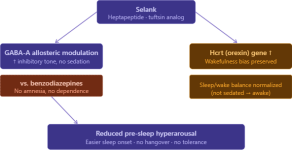
[DIAGRAM: Selank sleep mechanism Shows: GABA-A allosteric modulation branch + Hcrt/orexin gene upregulation branch → pre-sleep hyperarousal reduction Style: dual-pathway, benzodiazepine contrast callout]
Selank is a synthetic heptapeptide (Thr-Lys-Pro-Arg-Pro-Gly-Pro) derived from tuftsin, developed at the Institute of Molecular Genetics of the Russian Academy of Sciences. Its mechanism involves
allosteric modulation of GABA-A receptors — specifically, enhancing the inhibitory effect of endogenous GABA without the global CNS suppression of classical benzodiazepines. Gene expression analysis in rat frontal cortex found Selank produced significant correlated changes in 45 GABA-related genes within one hour, with the pattern partially overlapping the GABA comparator group.
The distinction from benzodiazepines is mechanistically important: Selank does not produce tolerance, withdrawal, or the cognitive impairment (particularly memory encoding deficits) associated with positive allosteric modulators like diazepam. Additionally, Selank upregulates expression of the
Hcrt gene
(hypocretin/orexin precursor), which maintains the wakefulness component of the sleep-wake balance. This is the mechanism behind Selank's unusual profile — it reduces anxiety without tipping the arousal system toward sedation.
In a Russian clinical trial (Zozulia et al., 2008), 62 patients with generalized anxiety disorder and neurasthenia were randomised to Selank or medazepam. Anxiolytic effects were comparable on Hamilton, Zung, and CGI scales, with Selank additionally showing antiasthenic and mild psychostimulant effects absent from the benzodiazepine arm.
Dosing for sleep
100–250 mcg intranasal, 30–60 minutes before sleep. Cycle 10–14 days on, 10 days off.
Evidence tier
Clinical RCTs in Russia (approved anxiolytic); anxiolytic effect well-supported; direct sleep architecture data limited.
Semax — upstream stress regulation
What to expect
Semax's sleep benefit operates through a different pathway: it dampens the HPA axis stress response and elevates BDNF (brain-derived neurotrophic factor), promoting neuroplasticity and reducing the cortisol load that disrupts sleep architecture. This is not a direct sleep compound. Its value in a sleep protocol is adjunctive: users with chronic stress-driven sleep disruption may find the daytime cortisol blunting translates into better sleep quality at night.
- Onset: BDNF effects within hours; sleep-relevant HPA effects over 1–2 weeks
- What you may feel: Reduced stress reactivity during the day; modest mood improvement
- Who benefits most: High-stress users whose sleep disruption tracks daytime cortisol load
Semax is a synthetic ACTH(4–10) analog with extended half-life through Pro-Gly-Pro extension. Its primary nootropic mechanism is rapid BDNF induction in the hippocampus and prefrontal cortex. For sleep relevance, the more important effect is its modulation of the HPA axis: Semax attenuates exaggerated stress-induced cortisol responses in animal models, and its neuroprotective effects include mitochondrial stabilisation relevant to recovery.
Semax and Selank are frequently combined because they address complementary deficits: Selank reduces overactive arousal systems (GABA hypofunction, amygdala hyperreactivity), while Semax addresses underperforming recovery systems (low BDNF, impaired stress resolution). For users navigating both anxiety-driven insomnia and blunted neuroplasticity from chronic stress, this combination has clinical rationale — though direct sleep RCT data is absent.
Evidence tier
Phase 2/3 human data for neuroprotection/stroke; sleep benefit mechanistically extrapolated from HPA modulation and BDNF induction.
Epitalon — restoring the melatonin signal at its source
What to expect
Epitalon does not produce melatonin — it stimulates the pineal gland to produce more of its own. This distinction matters: exogenous melatonin bypasses the circadian regulation mechanism; Epitalon restores the regulatory capacity of the gland itself. The practical implication is that Epitalon's sleep benefit is most relevant for populations where pineal function is actually declining — primarily aging, chronic light exposure disruption, or HPA-driven pineal suppression. In young users with intact pineal function, the modulatory data suggests effects are minimal or absent.
- Onset: Melatonin rhythm normalisation over days to weeks
- What you may feel: Earlier and stronger sleep pressure at appropriate times; more consistent wake times
- What you won't feel: Sedation; likely nothing if pineal function is intact
- Who benefits most: Users over ~35 with age-related sleep fragmentation, those with chronobiological disruption (shift work, jet lag, high light exposure at night)
- How to verify: Urinary 6-sulfatoxymelatonin excretion (validated melatonin output proxy); salivary melatonin at DLMO
Epitalon is a synthetic tetrapeptide (Ala-Glu-Asp-Gly, AEDG) derived from Epithalamin, a polypeptide extract of bovine pineal gland, developed by Russian gerontologist Vladimir Khavinson. It was detected in physiological human pineal extract in 2017, confirming it has an endogenous counterpart. Its central mechanism relevant to sleep is upregulation of
AANAT (arylalkylamine N-acetyltransferase) and
pCREB in pinealocytes — the rate-limiting enzyme and its transcriptional activator in melatonin biosynthesis. It also modulates circadian clock gene expression: in the human study, Epitalon increased Cry2 expression and decreased Csnk1e (casein kinase 1 epsilon, a clock speed regulator), suggesting it shifts the circadian machinery toward a more stable, younger-pattern rhythm.
The human evidence is narrow but direct. A study in 75 elderly women administering Epitalon sublingually at 0.5 mg/day for 20 days found a 1.6-fold increase in urinary 6-sulfatoxymelatonin excretion versus placebo, alongside circadian gene expression changes. Primate data (old rhesus monkeys) showed restoration of night-time melatonin levels toward young-monkey baselines. In elderly humans using the parent compound Epithalamin, the modulatory pattern held: those with initially low pineal output increased; those with normal function showed no change.
Additional properties with indirect sleep relevance: Epitalon activates telomerase in human somatic cells, activates Nrf2-driven antioxidant defences, and has anti-inflammatory effects. These support general cellular recovery during sleep without directly altering sleep architecture.
Dosing in research
0.5–1 mg/day sublingual for 20-day courses; alternatively 5–10 mg subcutaneous daily for shorter courses. Cycling is standard given its telomerase-activating effect. Evening administration is logical given the melatonin biosynthesis target.
Evidence tier
Early human data (one adequately designed study); primate data supporting mechanism. All research primarily from the Khavinson group — limited independent replication is a real limitation. The mechanism is well-defined; the clinical translation warrants cautious interpretation.
Recovery peptides: BPC-157 and TB-500 — when pain is the sleep disruptor
What to expect
If disrupted sleep is driven by musculoskeletal pain, inflammation, or unresolved injury, BPC-157 and TB-500 address the source rather than the symptom. Neither compound is a sleep aid. Their contribution is reducing the nociceptive and inflammatory signals that fragment sleep architecture — particularly the transition to N3 that pain interrupts.
- Onset: Anti-inflammatory effects 1–2 weeks; structural repair effects over months
- What you may feel: Reduced training soreness, joint comfort; sleep depth may improve secondarily
- Who benefits most: High-volume training athletes, users with chronic musculoskeletal issues
BPC-157 (Body Protection Compound 157) is a pentadecapeptide derived from human gastric juice. Its mechanism in tissue repair involves activation of Src kinase, which phosphorylates caveolin-1 (Cav-1) and releases endothelial nitric oxide synthase (eNOS) from inhibition, promoting angiogenesis and local blood flow to injury sites. It also modulates the nitric oxide system, tendon growth factor signalling, and inflammatory cytokine production. TB-500 (thymosin β4) promotes actin polymerisation and angiogenesis through separate pathways, with particular affinity for connective tissue remodelling.
For sleep, the relevant mechanism is inflammatory load reduction. Pro-inflammatory cytokines (IL-1β, TNF-α) actively fragment sleep architecture, particularly disrupting N3 entry. Reducing systemic inflammation through repair peptide use can secondarily restore more normal sleep staging.
Evidence tier
Preclinical only (animal models). No human RCTs. Mechanistic evidence is compelling; clinical translation remains unconfirmed.
Additional compounds with limited but relevant evidence
SS-31 (elamipretide) targets the inner mitochondrial membrane, stabilising cardiolipin and improving mitochondrial efficiency during recovery. Relevant for users on AAS or with high oxidative stress loads — these populations have impaired mitochondrial recovery that delays the cellular repair occurring during sleep. Phase 2 human data exists for cardiac applications; sleep relevance is extrapolation.
GHK-Cu (copper peptide) has anti-inflammatory and collagen-promoting effects, with some data suggesting it modulates gene expression related to circadian rhythms. The sleep connection is speculative and the evidence is preclinical, but its systemic anti-inflammatory role is relevant to recovery quality during sleep.
PE-22-28 (a TREK-1 channel inhibitor with antidepressant-like effects) is relevant for users whose sleep disruption is driven by anhedonia or depression, where normal sleep architecture is severely impaired. Depression consistently fragments REM sleep and reduces N3 duration. If PE-22-28's antidepressant mechanism holds in humans, the sleep architecture benefit would follow. Currently preclinical only.
Oxytocin has anxiolytic properties via the central oxytocin receptor and may support sleep onset in individuals with social anxiety or hyperarousal. The evidence is mixed and effect sizes in healthy populations are small. Not a primary sleep compound.
What you won't feel — and what to actually measure
| Compound | Felt effect | Timeline | What to actually track |
|---|
| CJC-1295 | None (weeks 1–3); subtle sleep depth shift | 3–6 weeks | Fasting IGF-1, PSQI score, morning HRV |
| Ipamorelin | None | Days (GH peak) | IGF-1 as stack proxy |
| DSIP | Subtle improvement in sleep onset/depth | 1 night to several nights post-dose | PSQI, sleep latency log |
| Selank | Calmer pre-sleep state | Days–weeks | Sleep onset latency, GAD-7 |
| Semax | Reduced daytime stress | 1–2 weeks | Perceived stress scale; daytime cortisol if accessible |
| Epitalon | Earlier sleep pressure; more consistent timing | Days to weeks | Urinary 6-sulfatoxymelatonin; salivary DLMO |
| BPC-157 | Reduced soreness | 1–4 weeks | Training recovery rate, pain scale |
| TB-500 | Reduced fatigue, connective tissue | 2–6 weeks | Training volume tolerance |
| SS-31 | None | Weeks | Indirect: exercise recovery markers |
| GHK-Cu | None | Weeks–months | Inflammatory markers (CRP, IL-6) if available |
Core monitoring toolkit:
- Fasting morning IGF-1 (GH-axis proxy, baseline and 6–8 weeks)
- Pittsburgh Sleep Quality Index (PSQI) — a validated 7-domain sleep quality score
- Morning HRV (heart rate variability) — correlates with recovery quality and parasympathetic tone
- GAD-7 score for anxiety-driven insomnia (Selank users)
- Urinary 6-sulfatoxymelatonin (Epitalon users; standard lab test)
Stacking logic: matching compounds to the actual problem
Not all poor sleep has the same mechanism. The choice of compound depends on diagnosing the disruption pattern:
Pattern 1 — blunted recovery despite adequate sleep duration: GH-axis stack (CJC-1295 + Ipamorelin pre-sleep). The problem is GH pulse amplitude and N3 quality, not sleep onset.
Pattern 2 — difficulty initiating sleep, hyperarousal, rumination: Selank 30–60 minutes pre-sleep. If stress is also high during the day, add Semax in the morning.
Pattern 3 — pain or inflammation fragmenting sleep: BPC-157 and/or TB-500 systemically, addressing the inflammatory load disrupting sleep architecture.
Pattern 4 — depression/anhedonia with flattened sleep architecture: PE-22-28 is the most mechanistically targeted option, though evidence is preclinical only.
Pattern 5 — circadian disruption, declining melatonin output (age, shift work, light exposure): Epitalon is the targeted option. DSIP may complement it by addressing sleep architecture rather than sleep timing.
Pattern 6 — insomnia with no clear hyperarousal or hormonal aetiology: DSIP is the first compound to consider — it's the only one in this article that operates on sleep drive directly rather than through a secondary mechanism. Its state-dependence means it will show no effect if the insomnia has a different root cause (anxiolytic deficit → Selank; GH axis → CJC-1295 stack; circadian → Epitalon).
These patterns can co-exist. A common combination for athletes is CJC-1295 + Ipamorelin (recovery and GH pulse) with Selank (anxiety/stress management), which addresses both the architecture and the arousal axis without introducing sedation.
References
- Ehlers CL, Reed TK, Henriksen SJ. Effects of corticotropin-releasing factor and growth hormone-releasing factor on sleep and activity in rats. Neuroendocrinology. 1986;42(6):467–474. PMID: 3083749 (GHRH somnogenic effects)
- Steiger A, Guldner J, Hemmeter U, Rothe B, Wiedemann K, Holsboer F. Effects of growth hormone-releasing hormone and somatostatin on sleep EEG and nocturnal hormone secretion in male controls. Neuroendocrinology. 1992;56(4):566–573. PMID: 1279555 (GHRH and slow-wave sleep, human)
- Frieboes RM, Murck H, Schier T, Holsboer F, Steiger A. Evidence against a role for the growth hormone-releasing peptide axis in human slow-wave sleep regulation. J Neuroendocrinol. 1998;10(7):525–529. PMID: 9612233 (Critical: GHRPs do not enhance SWS in humans)
- Teichman SL, Neale A, Lawrence B, Gagnon C, Castaigne JP, Frohman LA. Prolonged stimulation of growth hormone (GH) and insulin-like growth factor I secretion by CJC-1295, a long-acting analog of GH-releasing hormone, in healthy adults. J Clin Endocrinol Metab. 2006;91(3):799–805. PMID: 16352683 (CJC-1295 human RCT)
- Zdravkovic M, Bohidar NR, Christiansen JS, Agersø H. Pharmacodynamics of a new growth hormone releasing peptide, NN703, in young healthy males. Br J Clin Pharmacol. 1999;48(4):543–549. PMID: 10583024 (Ipamorelin human pharmacodynamics)
- Volkova A, Shadrina M, Kolomin T, Andreeva L, Limborska S, Myasoedov N, Slominsky P. Selank administration affects the expression of some genes involved in GABAergic neurotransmission. Front Pharmacol. 2016;7:31. PMID: 26941643 (Selank GABAergic mechanism, orexin expression)
- Zozulia AA, Neznamov GG, Esmanov TN. [Efficacy and possible mechanisms of action of a new peptide anxiolytic selank in the therapy of generalized anxiety disorders and neurasthenia]. Zh Nevrol Psikhiatr Im S S Korsakova. 2008;108(4):38–48. PMID: 18454096 (Selank clinical RCT vs medazepam)
- Filatova EV, Kasian AM, Kolomin TA, et al. GABA, Selank, and Olanzapine affect the expression of genes involved in GABAergic neurotransmission in IMR-32 cells. Front Pharmacol. 2017;8:89. PMID: 28387487
- Graf MV, Kastin AJ. Delta sleep-inducing peptide (DSIP): a review. Neurosci Biobehav Rev. 1984;8(1):83–93. PMID: 6145137
- Pollard BJ, Pomfrett CJ. Delta sleep-inducing peptide. Eur J Anaesthesiol. 2001;18(7):419–422. PMID: 11473557 (Safety, dosing, ACE inhibitor interaction)
- Araj SK, Brzezik J, Mądra-Gackowska K, Szeleszczuk Ł. Overview of Epitalon — highly bioactive pineal tetrapeptide with promising properties. Int J Mol Sci. 2025;26(6):2691. PMID: 40141333 (Comprehensive recent review)
- Goncharova ND, Vengerin AA, Khavinson VKh, Lapin BA. Pineal peptides restore the age-related disturbances in hormonal functions of the pineal gland and the pancreas. Exp Gerontol. 2005;40(1–2):51–57. PMID: 15664732 (Epitalon, melatonin, primate data)