Thematic article — covers multiple compound classes with different mechanisms
Here is a frustrating truth about cognitive
Peptides: the ones that produce the most noticeable effects are often not doing the most important work. The compounds quietly building new synaptic architecture produce no sensation at all. You finish a four-week run of something genuinely restructuring your hippocampus and conclude it did nothing — because you didn't feel it.
This article is partly about mechanism, but mostly about what to actually expect from each compound, and why the gap between "what's happening" and "what you feel" varies so dramatically across this class.
Three things cognition actually runs on
Before the compounds: a brief orientation, because the mechanism tells you everything about the timeline.
Memory formation depends on long-term potentiation (LTP) — the process by which repeated synapse activation makes that connection more efficient.
Neuroplasticity, the broader capacity to build and reorganize connections, runs primarily on a protein called
BDNF (Brain-Derived Neurotrophic Factor), which signals through the TrkB receptor and drives synaptic growth, neuronal survival, and new neuron formation in the hippocampus. And
hippocampal neurogenesis — the continuous generation of new neurons in the brain's memory hub — governs pattern separation memory, the ability to distinguish between similar but distinct experiences. This is often the first cognitive function to deteriorate.
Compounds that target these systems produce slow, structural changes. Compounds that modulate neurotransmitters produce fast, perceptible changes. Most
Peptides in this article do the former.
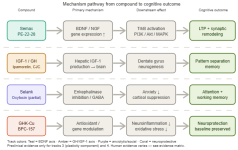
The diagram below shows how each compound class reaches a cognitive outcome — which biological lever it pulls, and what comes out the other end. Reading it before the compound sections makes the mechanisms significantly easier to follow.
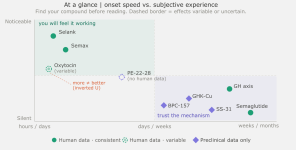
Once you understand the routes, the second diagram maps where each compound sits on two practical axes: how quickly it starts working, and whether you will actually feel it doing anything.
Semax — the BDNF shortcut
In 1994, Russia approved a peptide for cognitive disorders and stroke recovery that the rest of the world mostly ignored for the next twenty years. Semax is unusual for a research compound in having both a multi-decade clinical track record and a mechanism precise enough to generate real confidence in what it's doing.
The problem Semax solves is delivery: BDNF is a large protein that cannot be injected and reach the brain intact. Semax bypasses this by instructing hippocampal cells to produce more BDNF themselves — starting within 90 minutes of intranasal administration — while simultaneously upregulating the TrkB receptor that BDNF signals through. The result is more BDNF being produced and a brain that is more sensitive to the BDNF it already had. Peak BDNF protein elevation lands around 24 hours; measurable effects persist for 48 hours from a single dose.
The secondary dopaminergic and serotonergic activation from Semax is what produces its more immediate perceptible effects — improved focus and motivation arrive before the slower neuroplastic changes begin accumulating.
Dosing: 300–600 µg intranasally once or twice daily. Cycling (4–8 weeks on, 2–4 weeks off) is standard.
What to expect
Onset: Days 1–3 for the subjective response. Weeks 2–4 for measurable cognitive changes.
What you may feel: Mental clarity without stimulation — reduced cognitive interference, easier sustained attention, mild elevation in motivation. Some users describe the experience as caffeine's focus benefit without the jitteriness or rebound. This reflects the dopaminergic component and is noticeable quickly. The BDNF-driven changes accumulate quietly underneath and are more likely to be noticed retrospectively.
What you won't feel: Neuroplasticity happening. The structural changes to synaptic architecture produce no sensation. If your learning or memory consolidation improves over the weeks of use, you will probably notice it in hindsight rather than in real time.
Who benefits most: People with cognitive difficulties secondary to stress, depression, or recovery from neurological events have the clearest rationale. In healthy individuals with normal BDNF baseline, the effect is real but less predictable in magnitude.
How to verify: N-back test, digit span, or reaction time at baseline and 4 weeks. A daily subjective attention rating takes 10 seconds and is often more informative than bloodwork.
Selank — removing the brake
Most nootropics work by adding to a signal. Selank works primarily by removing something that was getting in the way.
Chronic stress — even the diffuse, low-grade variety that is just part of modern life — actively degrades the brain's cognitive infrastructure. Elevated cortisol reduces hippocampal BDNF, impairs LTP, and with sustained exposure, measurably shrinks hippocampal volume. The brain performs worse not because the hardware is broken, but because the operating environment is hostile.
Selank addresses this by inhibiting enkephalinase — the enzyme that breaks down enkephalins, the brain's own stress-modulating opioid
Peptides. With less enzymatic breakdown, enkephalin activity is extended, anxiety decreases, and the cortisol-driven suppression of cognitive function eases. In a clinical trial comparing Selank against medazepam (a benzodiazepine), it matched the drug for anxiolytic effect — and then did something benzodiazepines cannot: it also improved attention and memory in the same trial. Benzodiazepines did not. The difference is that Selank's mechanism removes stress interference while leaving the underlying cognitive machinery intact. Benzodiazepines suppress both.
With repeat dosing, Selank also upregulates hippocampal BDNF — complementing rather than overlapping with Semax when the two are stacked.
Dosing: 250–500 µg intranasally once or twice daily.
What to expect
Onset: The anxiolytic effect typically appears within the first dose or two. The cognitive improvement — which really represents the lifting of stress-driven suppression — takes a few more days to become apparent.
What you may feel: A quieting of mental noise. Less intrusive rumination, easier focus under pressure, a sense of mental space that wasn't there before. Many users describe it as having the cognitive benefits of being calm without the sedation of feeling medicated. Emotional tone often improves alongside cognition.
What you won't feel: Any stimulant-like enhancement. If anxiety is not a meaningful driver of your cognitive dysfunction, the benefit will be modest — Selank removes an obstacle rather than building new capacity.
Who benefits most: Anyone whose cognitive difficulties are substantially driven by anxiety or chronic stress. Also the natural companion to Semax in a stack: Semax drives BDNF up; Selank prevents stress from simultaneously pulling it back down.
PE-22-28 — releasing a different brake
TREK-1 is a potassium channel that, when overactive, holds neurons below their firing threshold — hyperpolarized and effectively silenced. This is more common than widely understood, and it correlates strongly with depression and the neuroplasticity deficits that accompany it. PE-22-28 blocks TREK-1, allowing neurons to reach firing threshold more readily, which downstream triggers a cascade of BDNF expression and neurogenesis.
What makes PE-22-28 interesting is the timeline. In mouse studies, antidepressant-equivalent effects appeared within 4 days, alongside measurable increases in hippocampal cell proliferation, synaptic density (measured by PSD-95 expression), and BDNF mRNA. SSRIs producing similar downstream outcomes take 3–6 weeks by working through an entirely different route. This faster timeline for structural change is the compound's most unusual property.
There is no human clinical data. All of this is rodent models. That caveat needs to be stated clearly, but the mechanism is verifiable and the preclinical profile is compelling enough to explain the ongoing research interest.
Dosing: 100–500 µg subcutaneously or intranasally. No standardized human protocol exists.
What to expect
Onset: Preclinical data suggests meaningful cellular changes within 4–7 days. Whether this translates to humans is unknown.
What you may feel: No established human subjective profile. Based on mechanism — reduced TREK-1 suppression, downstream BDNF and neurogenesis — improved mood, motivation, and cognitive engagement over the first 1–2 weeks would be the expected direction, if the rodent data translates. This is speculative.
Who benefits most: People with cognitive dysfunction secondary to depression or anhedonia, where TREK-1 overactivity is a plausible driver. There is no particular rationale for its use in cognitively healthy individuals without mood disturbance.
GH/IGF-1 axis — the slow infrastructure play
Growth hormone does not reach the brain well on its own. What it does is trigger the liver to produce IGF-1 (Insulin-like Growth Factor 1), which crosses the blood-brain barrier readily and finds receptors throughout the hippocampus and cortex. IGF-1 then drives neurogenesis in the dentate gyrus — the same hippocampal structure that governs pattern separation memory — via the PI3K/Akt pathway.
This is a two-step process with a slow clock. The cognitive rationale for GH secretagogues (Ipamorelin, CJC-1295 no DAC, GHRP-2) is real but unfolds over months, not days. It is also most relevant for people in whom GH output is already declining — which describes most people over 35, most people who are significantly overweight, and most people under chronic stress. In young adults with normal IGF-1, the cognitive effect is genuinely modest.
Ipamorelin and CJC-1295 are the standard pairing because they activate different receptors — the ghrelin receptor and the GHRH receptor respectively — and through different intracellular cascades (calcium/PKC vs. cAMP/PKA). This is why their combination produces substantially more GH than either alone.
A note on GHRP-2 and GHRP-6: both raise cortisol and prolactin alongside GH, an effect that is dose-dependent and becomes a meaningful concern in longer protocols. Ipamorelin does not produce this — confirmed in primary literature at any tested dose — which makes it the cleaner choice when cognitive outcomes (rather than maximum GH) are the goal.
Dosing: Ipamorelin 100–300 µg, CJC-1295 100–300 µg, both subcutaneously, once to three times daily on an empty stomach.
The IGF-1 ceiling — more is not better. The neurogenic benefit of IGF-1 follows a curve, not a line. Below optimal range: neurogenesis is impaired, pattern separation memory declines, and the benefits described above are absent. At optimal range: the dentate gyrus receives the signal it needs, new neurons are generated, and cognitive function is supported. But above optimal — with persistently supraphysiological IGF-1 from aggressive GH protocols — the relationship flips. Excess IGF-1 signalling can suppress BDNF expression via negative feedback, and chronically elevated GH produces its own problems: glucose intolerance, potential proliferative effects on tissue, and paradoxically impaired cognitive function in conditions such as acromegaly (pathological GH excess), where cognitive deficits are well-documented. The take-away is that this compound class has a meaningful therapeutic window, not a dose-response gradient where more always means better. Monitoring IGF-1 isn't just good practice — it tells you whether you're in the window or past it.
What to expect
Onset: 8–16 weeks for measurable cognitive change. This is the slowest compound class in the article.
What you may feel: Improved sleep quality, mood, and verbal fluency over 2–3 months — though these overlap with the broader metabolic effects of GH elevation and are hard to attribute specifically to cognitive mechanisms. There is no acute cognitive effect on the day of injection.
Who benefits most: Older adults or individuals with demonstrably low IGF-1. These are systemic metabolic compounds with cognitive benefits as a downstream consequence, not the primary mechanism.
How to verify: Serum IGF-1 at baseline and 8 weeks — and then use the number, not just confirm it went up. IGF-1 in the upper quartile of the age-appropriate reference range is the target; driving it above the reference range is not the goal and carries risk.
Oxytocin — social memory, specifically, and less perceptible than it sounds
The first thing to get right about intranasal oxytocin is that its subjective effects are far more variable than popular accounts suggest. A significant fraction of people who try it in non-social settings report nothing at all. That is worth understanding mechanistically before getting to what it actually does.
The bioavailability problem. Nasal oxytocin bioavailability to the brain is approximately 2% — meaning 98% doesn't get there via the direct nose-to-brain route. What does reach the brain travels along olfactory and trigeminal nerve fibers and appears genuinely active; studies using labelled oxytocin in non-human primates confirmed direct CSF penetrance via this route. But a 2023 study (Yao et al.,
Mol Psychiatry, PMID 37185959) complicated the picture further by finding that blocking peripheral vasculature abolished most of the neural effects of intranasal oxytocin — suggesting that some of what looks like central brain action may actually be mediated through peripheral blood vessels, not the nose-to-brain pathway directly. The mechanistic debate is ongoing.
What it does when it works. Oxytocin's cognitive relevance is specific: it acts on CA2, a hippocampal subfield so specialized for social recognition that removing its oxytocin and vasopressin receptors — in mice — nearly eliminates the ability to remember other individuals. At moderate doses, oxytocin suppresses amygdala reactivity to social threat, which is why the subjective experience is typically a reduction in social anxiety rather than a general cognitive lift. A 2026 preregistered trial (N=445) confirmed that post-encoding oxytocin — administered after a social interaction, not before — significantly improved consolidation of social face memories. Non-social memory tasks show no benefit and sometimes mild impairment, likely from the same amygdala suppression.
The inverted U-curve — and why it matters more here than almost anywhere else.
This is the part the dosing guides skip. Oxytocin does not produce more benefit at higher doses. The dose-response relationship is inverted: at moderate doses (around 24 IU intranasally), it reduces amygdala reactivity to threat and facilitates prosocial cognition. At higher doses (48 IU), fMRI studies show amygdala reactivity to fearful stimuli
increases — the exact opposite of the intended effect. The anxiolytic becomes anxiogenic.
The mechanistic explanation involves oxytocin receptor desensitization. Chronically elevated oxytocin receptor stimulation causes downregulation of receptor availability — after extended use, the baseline receptor density decreases, and the system requires more oxytocin to achieve the same effect, while also becoming less predictable in its response. This creates conditions where regular use at doses intended to produce social ease can actually produce a net increase in anxiety over time.
Sex differences add another layer. Women appear to have higher baseline endogenous oxytocin and greater receptor sensitivity, which means the inverted U's peak sits at a lower dose. There is evidence that the standard 24 IU protocol — designed for male subjects in most early research — may already be on the descending arm of the curve for some women, producing anxiogenic rather than anxiolytic effects. The practical takeaway: if you feel worse socially after taking it, or notice increased anxiety rather than decreased, you are likely past the optimal dose, not experiencing a paradox.
Dosing: 8–24 IU intranasally is a more defensible range than the commonly cited 24–40 IU. Post-encoding timing matters most for the memory consolidation application.
What to expect
Onset: Perceptible effects, if they occur, typically emerge within 20–45 minutes. The window of effect on amygdala reactivity peaks around 45 minutes post-administration.
What you may feel: In the right context — social, not solitary — a calming of threat sensitivity, easier interpersonal engagement, and sometimes a mild warmth. The key qualifier is
context: in a quiet room alone, most users feel nothing. The compound is modulating social salience, not sedating or stimulating you.
What you may also feel (at higher doses): Increased anxiety, social guardedness, or flatness. This is the descending arm of the inverted U and should prompt a dose reduction, not an increase.
What you won't feel: General cognitive enhancement. Oxytocin is a social specificity tool, not a nootropic.
Who benefits most: People with social anxiety driving avoidance of interpersonal situations, or anyone needing to specifically improve social face memory. The narrower the use case, the more appropriate this compound is.
Honest assessment of noticeability: Lower than usually claimed. Highly context-dependent, variable between individuals, and subject to a meaningful dose-response reversal that makes reliable subjective calibration difficult.
Neuroprotective compounds — BPC-157, GHK-Cu, SS-31
These three share an important characteristic: they are protective rather than enhancing. They reduce the damage and dysfunction that degrades cognitive performance. None will improve cognition in a healthy baseline — but that framing undersells what they do.
BPC-157 has documented interactions with dopaminergic and serotonergic systems in rodent models, partially reversing dopamine depletion from neurotoxic insult and protecting against excitotoxic damage. The relevance for cognition is as a background compound in contexts of neuroinflammation, gut-brain dysregulation, or dopaminergic disruption. All evidence is preclinical. No acute nootropic effect should be expected.
GHK-Cu is a naturally occurring copper-binding tripeptide that declines with age. Its neuroprotective case rests on gene expression modulation — resetting aging-associated gene expression patterns including antioxidant defense (SOD1 support) and nerve growth factor signaling. The caveat is complete: no study has directly measured cognitive outcomes after systemic GHK-Cu administration. The mechanism is plausible; the clinical evidence is absent.
SS-31 (elamipretide) targets mitochondrial cardiolipin — the phospholipid responsible for cristae structure in the inner mitochondrial membrane. When cristae structure deteriorates, as it does with aging and neuroinflammation, electron transport efficiency drops and ATP yield falls. SS-31 stabilizes this architecture, restoring energy production and reducing reactive oxygen species. In aged mice, this rescued neurovascular coupling (the brain's real-time blood flow regulation) and correlated with improved spatial working memory. All evidence is preclinical; human cognitive endpoint data does not exist.
The profile for all three: use them as background adjuncts if the biological context warrants it (aging, inflammation, metabolic stress). Do not stack them expecting a nootropic effect that the literature does not support.
Semaglutide — not the cognitive compound it was hoped to be
GLP-1 receptors exist throughout the brain. Large observational studies show GLP-1 receptor agonist users have 30–70% lower dementia incidence than matched non-users. The mechanistic case — anti-inflammatory, vascular, possible Aβ clearance — looked promising.
Then the EVOKE and EVOKE+ Phase 3 trials completed in 2025. These enrolled approximately 3,700 amyloid-confirmed early Alzheimer's patients over 68 weeks and found that semaglutide did not significantly slow cognitive decline on the primary endpoint, despite some biomarker improvements. This is a substantial negative result that changes the picture.
For cognitively healthy individuals without metabolic dysfunction, there is no meaningful rationale for semaglutide as a cognitive intervention. The benefit, if real, appears to operate through metabolic pathways (improved brain insulin sensitivity, reduced vascular inflammation) that are relevant primarily in people with insulin resistance or obesity.
Stacking logic
The most rational cognitive stacks pair compounds that address different layers of the problem without mechanism overlap.
Semax + Selank is the most evidence-grounded starting point: direct BDNF elevation (Semax) combined with stress-driven suppression removal (Selank). These two have complementary mechanisms, no documented interaction concerns, and the strongest ratio of human data to preclinical speculation in this class.
Adding
GH axis peptides (Ipamorelin + CJC-1295) makes sense as a background layer for anyone with declining IGF-1 or established GH protocols — it contributes hippocampal neurogenesis support via a completely distinct pathway on a longer timeline.
PE-22-28 is worth considering specifically when depression or motivational deficits are driving the cognitive picture. Its TREK-1 inhibition does not overlap with the Semax/Selank mechanism and may work faster on the neuroplasticity deficit underlying depressive cognition.
BPC-157, GHK-Cu, SS-31, and semaglutide do not belong in a primary cognitive stack assembled around enhancement. They are background protective compounds for specific contexts, not nootropic additions.
Evidence at a glance
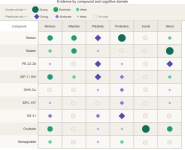
The matrix below separates human clinical evidence from preclinical data across every compound and cognitive domain covered in this article. It is easy to overestimate the human evidence base for this compound class — the matrix makes the gaps visible.
How to actually verify whether something is working
Most of these compounds produce no reliable acute sensation. The only honest way to know if a protocol is doing anything is to measure something before and after. The table below maps each compound class to the most useful biomarkers and cognitive tests.
| Compound | Measurable biomarker | Cognitive test |
|---|
| Semax / Selank | Serum BDNF (baseline + 4 weeks) | N-back, digit span, reaction time |
| GH axis | Serum IGF-1 (baseline + 8 weeks) — target upper quartile of age-appropriate range, not above it | Verbal memory, processing speed at 8 and 16 weeks |
| GHK-Cu | CRP, IL-6 (inflammation proxy) | No validated cognitive correlate established |
| SS-31 | Oxidative stress panel (8-OHdG, SOD activity) | No established cognitive test — effects are protective in disease/impairment models only |
| Oxytocin | — | Cambridge Face Memory Test, face-name association tasks; social anxiety scales (LSAS) |
| Semaglutide | Fasting insulin, HOMA-IR, CRP | No direct cognitive enhancement expectation in metabolically healthy individuals |
References
- Dolotov OV, et al. Semax, an analog of ACTH(4-10) with cognitive effects, regulates BDNF and trkB expression in the rat hippocampus. Brain Res. 2006;1117(1):54-60. PMID: 16996037
- Shadrina MI, et al. The heptapeptide SEMAX stimulates BDNF expression in different areas of the rat brain in vivo. Mol Biol (Mosk). 2001;35:512-516. PMID: 14556513
- Zozulya AA, et al. The inhibitory effect of Selank on enkephalin-degrading enzymes as a possible mechanism of its anxiolytic activity. Bull Exp Biol Med. 2001;131(4):315-317. PMID: 11550013
- Zozulia AA, et al. Efficacy and possible mechanisms of action of a new peptide anxiolytic selank in the therapy of generalized anxiety disorders. Zh Nevrol Psikhiatr. 2008;108(4). PMID: 18454096
- Djillani A, et al. Shortened Spadin Analogs Display Better TREK-1 Inhibition, In Vivo Stability and Antidepressant Activity. Front Pharmacol. 2017;8:643. PMID: 28955242
- Morel GR, et al. Therapeutic potential of IGF-I on hippocampal neurogenesis and function during aging. Aging (Albany NY). 2017;9(2):252. PMC5386180
- Johansen PB, et al. Ipamorelin, the first selective growth hormone secretagogue. Eur J Endocrinol. 1999;139(5):552-561. PMID: 9849822
- Yoneda H, et al. Oxytocin receptor signaling in the hippocampus. Neuropharmacology. 2019;149. PMID: 30359747
- Liu W, et al. Post-encoding administration of oxytocin selectively enhances memory consolidation of male faces in females. Proc Natl Acad Sci U.S.A. 2026;123. [N=445, preregistered RCT]
- Pickart L, et al. The Effect of the Human Peptide GHK on Gene Expression Relevant to Nervous System Function and Cognitive Decline. Brain Sci. 2017;7(2):20. PMID: 28212278
- Hou Z, et al. Elamipretide (SS-31) improves mitochondrial dysfunction, synaptic and memory impairment induced by lipopolysaccharide in mice. J Neuroinflammation. 2019;16:206. PMC6865061
- Tarantini S, et al. SS-31 rescues neurovascular coupling responses and cerebrovascular endothelial function and improves cognition in aged mice. Aging Cell. 2018;17(2):e12731. PMC5847870
- Atri A, et al. evoke and evoke+: Phase 3 studies evaluating the neuroprotective effects of semaglutide in early Alzheimer's disease. Alzheimers Dement. 2022;18:e062415