Why Peptides Don’t Always Feel Like They’re Working - And What Actually Limits Them
You’ve been running a peptide protocol for a few weeks. You feel nothing. No obvious difference in recovery, no change in focus, no noticeable shift in body composition. Meanwhile, someone else on the same compound says it changed their life.
This pattern comes up constantly - and it almost never means the peptide is fake or the dose is wrong. Most of the time, it comes down to one of two things: either the compound is doing something you can’t directly feel, or the conditions needed for it to work are being undermined by factors that have nothing to do with the peptide itself.
This article covers both. First, why “feeling nothing” doesn’t mean “nothing is happening.” Then, how sleep, stress, and nutrition interact differently with each major peptide category - because the reasons GHRPs underperform in a sleep-deprived person are completely different from the reasons Semax underperforms in someone under chronic stress, which are different again from why BPC-157 might stall in someone eating poorly.
The Gap Between What You Feel and What’s Actually Happening
When people take something like pre-workout or a stimulant, the feedback is immediate and obvious. That’s not how most
Peptides work. Most peptide effects are structural, systemic, or accumulative - changes that happen at the tissue or cellular level over days and weeks, with no sensation attached to the process.
Consider a few examples: BPC-157 works primarily by stimulating the growth of new blood vessels (angiogenesis - the formation of new capillaries) and activating fibroblasts, the cells responsible for collagen production. Neither of these processes produces any feeling. Tendons and ligaments becoming gradually stronger, more vascular, and better organized over 6-8 weeks is not something you’ll notice on any given day.
GHK-Cu (a copper-binding tripeptide found naturally in human plasma) works partly by modulating gene expression in damaged or aged tissue - turning on repair programs and antioxidant defenses. Gene expression changes are invisible. So is gradual skin collagen remodeling.
Semax increases BDNF (Brain-Derived Neurotrophic Factor - a protein that promotes the growth and survival of neurons, essentially the brain’s own repair and growth signal) in the hippocampus. Neuroplasticity improvements and BDNF-related changes in cognitive resilience don’t feel like anything acutely. They show up as subtle shifts in stress tolerance, memory consolidation, and focus over weeks.
The only
Peptides that produce reliably noticeable acute sensations are GHRPs - the ghrelin-receptor agonists like GHRP-6 - which cause a genuine hunger spike, and some GHRH/GHRP combinations that produce mild warmth or a flushing sensation from the GH pulse. Those sensations are side effects of the mechanism, not the therapeutic effect itself.
How to Actually Verify if Something Is Working
If you want to know whether a compound is doing anything, you need to track the right metrics for the right compound class:
- GH-axis Peptides (ipamorelin, CJC-1295, etc.): Serum IGF-1 before and after a cycle. Sleep quality tracking (deep sleep duration via a wearable). Body composition over 8+weeks.
- Semax / Selank: Harder to verify biochemically. Track cognitive performance using consistent tasks — reaction time, working memory, sustained focus. Mood and stress tolerance logged daily. Serum BDNF testing is possible but expensive and variable.
- BPC-157 / TB-500: Recovery timeline from a specific injury. Subjective joint pain scores tracked consistently. In a longer protocol, inflammatory markers (CRP, IL6) can shift.
- GHK-Cu: Skin texture, elasticity, and wound healing rate over $8-12$ weeks. Not measurable without consistent photos or assessments, but objectively visible over time.
The common thread: all of these require patience and tracking, not acute sensation.
Why the Platform Matters as Much as the Peptide
Every peptide works through a biological system - a receptor, a pathway, a cellular process. That system exists inside a body that is either in good condition to respond or isn’t. Sleep, stress, and nutrition are the three main variables that determine the condition of the underlying system. The peptide is the signal; these factors determine whether there’s anything primed to receive it.
What makes this complicated is that the specific reason a factor limits effectiveness is different for each compound class. High cortisol doesn’t undermine BPC-157 the same way it undermines Semax. Poor protein intake doesn’t hurt GH-axis peptides the same way it hurts GHK-Cu. Each class needs to be understood separately.
GH-Axis Peptides: Sleep and Insulin Are the Main Limiters
Peptides covered: Ipamorelin, GHRP-2, GHRP-6, Hexarelin, CJC-1295, Sermorelin, Tesamorelin
GHRPs (Growth Hormone Releasing Peptides) and GHRH analogs work by stimulating the pituitary gland to release growth hormone in pulses. The pituitary’s readiness to respond depends heavily on two counter-regulatory factors: somatostatin (a hormone that actively suppresses GH release) and circulating insulin.
Sleep is the primary driver of GH secretion in adults - roughly 70% of daily GH pulses coincide with slow-wave (deep) sleep [1]. When sleep is fragmented, shortened, or chronically delayed, the deep sleep window shrinks, and the GH pulse associated with it diminishes. A GHRP injected before bed is amplifying a system that is either primed (good sleep architecture) or already suppressed (poor sleep). The peptide cannot manufacture deep sleep — it can only work with what’s there.
Insulin acutely suppresses GH secretion. When blood glucose is elevated after a meal - especially a carbohydrate-heavy one - insulin rises, and the pituitary’s GH output drops for $2-3$ hours [2]. This is why all GH-axis peptides should be injected in a fasted state. Injecting after a meal means working against active insulin-driven suppression.
Chronic stress adds a third layer: elevated cortisol increases somatostatin tone (pushing the GH brake harder) and reduces pituitary sensitivity to GHRH signaling [3]. Users under high chronic stress often report blunted responses that improve when stress is managed - not because the peptide changed, but because the system did.
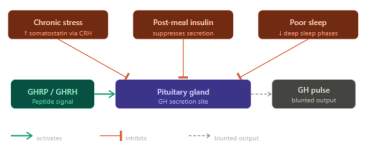
[DIAGRAM: GH axis suppression Shows: GHRP signal → pituitary, with three converging inhibitory arrows labeled: (1) Somatostatin - elevated by stress/CRH, (2) Insulin elevated after carbohydrate meals, (3) Reduced SWS - from poor sleep Style: simple signal pathway with inhibition arrows]
Semax and Selank: The Stress Paradox
These are nootropic peptides - compounds that work in the brain rather than the hormonal or tissue-repair systems. Their mechanisms are fundamentally different from GH-axis peptides, and so the factors that limit them are different too.
Semax is a synthetic analog of a fragment of ACTH (the same hormone that tells the adrenal glands to make cortisol), but rather than activating the stress response, it upregulates BDNF in the hippocampus and prefrontal cortex - the brain regions most involved in learning, memory, and stress regulation [4]. A single dose in animal studies produced a 1.4 -fold increase in BDNF protein and a 3 -fold increase in BDNF gene expression in hippocampal tissue. Selank works through a complementary but distinct mechanism: it modulates GABA signaling (the brain’s main calming neurotransmitter system) and influences gene expression in neurotransmitter pathways.
Here is the problem. Chronic stress - through sustained cortisol elevation - actively suppresses BDNF in the hippocampus and disrupts the very neuroplasticity processes these peptides are trying to support [5]. A recent controlled human study found that chronic stress perception was a significant predictor of lower basal BDNF levels, and that elevated cortisol accelerated BDNF decline after stress events [6]. Semax is attempting to push BDNF upward in a system that chronic stress is continuously pulling downward.
This creates a situation where the peptide is working, but the effect is partially or fully offset by the stress environment it’s operating in. Someone in a low-stress, well-slept state will experience a different magnitude of effect from someone who is chronically exhausted and cortisol-elevated - not because the peptide is doing less, but because the net change in the system is smaller.
Sleep matters here for a different reason than with GH-axis peptides. During sleep — particularly REM sleep - the brain consolidates new synaptic connections formed during waking hours. BDNF supports the formation of those connections; sleep is what makes them permanent. Using a BDNF-upregulating peptide while chronically sleepdeprived is analogous to building scaffolding in a structure that keeps being taken down overnight.
Nutritional note: Neither Semax nor Selank have meaningful direct nutritional dependencies in the way GH-axis or repair peptides do. However, severe micronutrient deficiencies - particularly B vitamins and omega-3 fatty acids, which are required for neuronal membrane integrity and neurotransmitter synthesis - create a generally hostile environment for neuroplasticity interventions. This is not a peptide-specific interaction but a baseline issue.
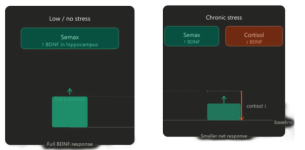
[DIAGRAM: Semax/Selank stress paradox Shows: Semax ⟶ ↑ BDNF (upward arrow) in hippocampus; Chronic stress → Cortisol → ↓ BDNF (downward arrow); Net effect = smaller change in chronically stressed vs. low-stress user Style: balance/scale diagram showing competing signals]
BPC-157 and TB-500: The Repair Environment
BPC-157 and TB-500 work through tissue-level mechanisms - angiogenesis, fibroblast activation, collagen organization - rather than through hormonal signaling or neuroplasticity. Their effectiveness depends less on acute hormonal state and more on the ongoing biological environment at the site of repair.
BPC-157 (Body Protective Compound-157, a 15-amino acid peptide originally isolated from gastric juice) promotes healing through several overlapping pathways, the most important being upregulation of VEGFR2 (a receptor for vascular growth factors) and activation of the Akt-eNOS axis to drive angiogenesis [7]. It also activates ERK1/2 signaling in endothelial cells, enhancing their ability to migrate, proliferate, and form new vessel networks. In animal models, this translates to accelerated tendon, ligament, and muscle healing with better collagen organization compared to controls [8]. TB-500 (a synthetic fragment of Thymosin Beta-4) promotes cellular migration and differentiation, complementing BPC-157’s angiogenic effects.
What limits these compounds isn’t primarily an acute hormonal state, but the background condition of the repair environment:
Inflammation and oxidative stress compete directly with the healing processes BPC157 is promoting. High systemic inflammation - whether from poor sleep (which elevates inflammatory cytokines), chronic stress, or a pro-inflammatory diet - creates a “noisy” environment where the peptide’s signaling has to work harder for the same result. The body’s prioritization shifts toward containment rather than repair.
Nutrition provides the raw materials. Angiogenesis and collagen synthesis are metabolically expensive. New blood vessels require protein, zinc, and vitamin C. Collagen fibers require adequate proline, glycine, and hydroxyproline - which depend on protein intake and vitamin C availability. BPC-157 can upregulate the signals for repair, but if the substrate isn’t there, the construction stalls. This is particularly relevant in aggressive caloric restriction protocols where protein intake drops.
Sleep matters here because the majority of tissue repair occurs during sleep - growth hormone pulses during deep sleep drive protein synthesis and cellular regeneration. A peptide protocol supporting tissue repair while chronically underslept is fighting against one of the primary windows when that repair happens.
TB-500 is more systemic in its effects, promoting cell migration toward injury sites across tissue types. Its dependencies are similar: adequate substrate, low systemic inflammation, sufficient sleep for repair execution.
GHK-Cu: Copper Availability and Oxidative Load
Peptides covered: GHK-Cu (Glycyl-L-Histidyl-L-Lysine Copper complex) GHK-Cu is distinct from all the above because its mechanism is fundamentally tied to a specific micronutrient: copper. The peptide’s primary role is as a copper-delivery system - it binds $\mathrm{Cu}^{2+}$ and makes it available to enzymatic systems that cannot function without it [9].
Copper is a cofactor for over a dozen essential enzymes. Among the most relevant for GHK-Cu’s documented effects: lysyl oxidase (which cross-links collagen and elastin, giving connective tissue its structural strength), superoxide dismutase (a front-line antioxidant enzyme that neutralizes reactive oxygen species - the unstable molecules that damage cells and accelerate aging), and cytochrome c oxidase (required for mitochondrial energy production). GHK-Cu stimulates collagen and glycosaminoglycan synthesis in fibroblast cultures and increases expression of both collagen I and collagen III in wound models [10].
The compound also modulates Nrf2 - the master regulator of the body’s antioxidant defense gene expression program. When Nrf2 is activated, cells upregulate production of their own protective enzymes (glutathione peroxidase, catalase, SOD). GHK-Cu acts partly through this pathway to reduce oxidative stress (the cellular damage caused by excess reactive oxygen species) [11].
This is where lifestyle factors become directly relevant: Chronic stress elevates oxidative stress systemically - cortisol and the inflammatory cascade it produces generate reactive oxygen species faster than the body’s antioxidant systems can clear them. GHK-Cu’s Nrf2-mediated antioxidant effects are in part addressing the same problem that chronic stress is continuously generating. The peptide isn’t being “blocked” — but it’s spending its effect countering damage rather than driving net improvement.
Sleep deprivation is one of the most reliable ways to increase oxidative stress markers. Studies consistently show elevated markers of oxidative damage after poor sleep. For a peptide working partly through antioxidant pathways, this is the equivalent of trying to drain a tub while the tap is open.
Copper status is the most direct limiting factor. GHK-Cu relies on adequate endogenous copper to form its active complex. Frank copper deficiency is uncommon in well-nourished people, but subclinical low copper - possible with very high zinc supplementation (zinc and copper compete for absorption), very low-meat diets, or malabsorptive conditions - can meaningfully limit how much active GHK-Cu complex is available to the tissue.
A Summary: What to Check Before Blaming the Peptide
| Peptide class | Primary sleep effect | Primary stress effect | Primary nutrition effect |
|---|
| GH-axis (GHRPs, GHRH) | Reduced deep sleep = reduced GH pulse | Cortisol ↑ somatostatin = blunted response | Post-meal insulin suppresses secretion; low protein limits IGF-1 |
| Semax / Selank | Sleep consolidates BDNF-driven plasticity | Cortisol directly suppresses BDNF | Less direct; general neuronal health (B vitamins, omega-3) |
| BPC-157 / TB-500 | Sleep is the primary repair window | Inflammation competes with healing signals | Protein + micronutrients = raw material for repair |
| GHK-Cu | Sleep deprivation ↑ oxidative load | Chronic stress ↑ oxidative load | Copper status gates activity; adequate protein needed |
If a protocol isn’t producing results, the question isn’t just “is the peptide real?” It’s: what system is this compound working through, and what is the current state of that system?
References
- Van Cauter E, Plat L, Copinschi G. Interrelations between sleep and the somatotropic axis. Sleep. 1996;19(10):853-861. PMID: 8627466
- Kochanowski M, Zietek M, Wisniewska A, et al. The role of glucose and insulin in the metabolic regulation of growth hormone secretion. Endokrynol Pol. 2021;72(2):129-138. PMID: 33586392
- Señarís RM, Lago F, Coya R, Pineda J, Diéguez C. Regulation of hypothalamic somatostatin, growth hormone-releasing hormone, and growth hormone receptor messenger ribonucleic acid by glucocorticoids. Endocrinology. 1996;137(12):5236-5241. PMID: 8940340
- Ischenko AA, Galoyan SM, Komissarov LB, et al. Semax, an analog of ACTH(4-10) with cognitive effects, regulates BDNF and trkB expression in the rat hippocampus. Brain Res. 2006;1117(1):54-60. PMID: 16996037
- Kim EJ, Pellman B, Kim JJ. Stress effects on the hippocampus: a critical review. Learn Mem. 2015;22(9):411-416. PMC4561403
- Petrowski K, Wichmann S, Pyrc J, et al. Dynamic interplay of cortisol and BDNF in males under acute and chronic psychosocial stress. Psychoneuroendocrinology. 2024;169:107144. PMID: 39332135
- Hsieh MJ, Liu HT, Wang CN, et al. Therapeutic potential of pro-angiogenic BPC157 is associated with VEGFR2 activation and up-regulation. J Mol Med. 2017;95(3):323-333. PMID: 27847966
- Bricic L, Staresinic M, Sikiric P. Modulatory effect of gastric pentadecapeptide BPC 157 on angiogenesis in muscle and tendon healing. J Physiol Pharmacol. 2009;60(Suppl 7):191-196. PMID: 20388964
- Pickart L, Margolina A. The human tripeptide GHK-Cu in prevention of oxidative stress and degenerative conditions of aging: implications for cognitive health. Oxid Med Cell Longev. 2012;2012:324832. PMID: 22666519
- Maquart FX, Pickart L, Laurent M, et al. Stimulation of collagen synthesis in fibroblast cultures by the tripeptide-copper complex glycyl-L-histidyl-L-lysine$\mathrm{Cu}^{2+}$. FEBS Lett. 1988;238(2):343-346. PMID: 3169264
- Pickart L, Vasquez-Soltero JM, Margolina A. GHK-Cu may prevent oxidative stress in skin by regulating copper and modifying expression of numerous antioxidant genes. Cosmetics. 2015;2(3):236-247. PMC6073405